 ultimate-guide
Commercial Dishwasher Safe Etched Glassware: Ultimate Guide
Table of Contents
- What Makes Etched Glassware Dishwasher Safe
- Sandblasted vs Laser Etched Glass: Which Survives Commercial Cycles
- Understanding Glassware Corrosion Prevention
- Preventing Cloudy Glasses in Commercial Dishwashers
- Proper Loading and Cycle Selection for Etched Designs
- How to Identify and Care for Branded Glassware
- Chemical Compatibility and Professional-Grade Standards
- Conclusion
Last Updated: August 11, 2026
What Makes Etched Glassware Dishwasher Safe
Dishwasher safe etched glassware withstands repeated high-temperature commercial cleaning cycles without fading or deteriorating. The key distinction lies in how the marking is applied and the glass composition chosen to resist thermal stress and chemical exposure.
Professional-grade etched glassware, when properly specified and maintained, remains crisp for years. Poorly executed etching or low-grade glass develops hazing and cloudiness within weeks. High-temperature cycles (65-75°C), alkaline detergents, hard water minerals, and mechanical action all work together inside a commercial dishwasher. When etching is shallow or applied to incompatible glass, the design becomes vulnerable. Professional etching penetrates deeper and bonds more securely, resisting both chemical erosion and thermal shock.
Sandblasted vs Laser Etched Glass: Which Survives Commercial Cycles
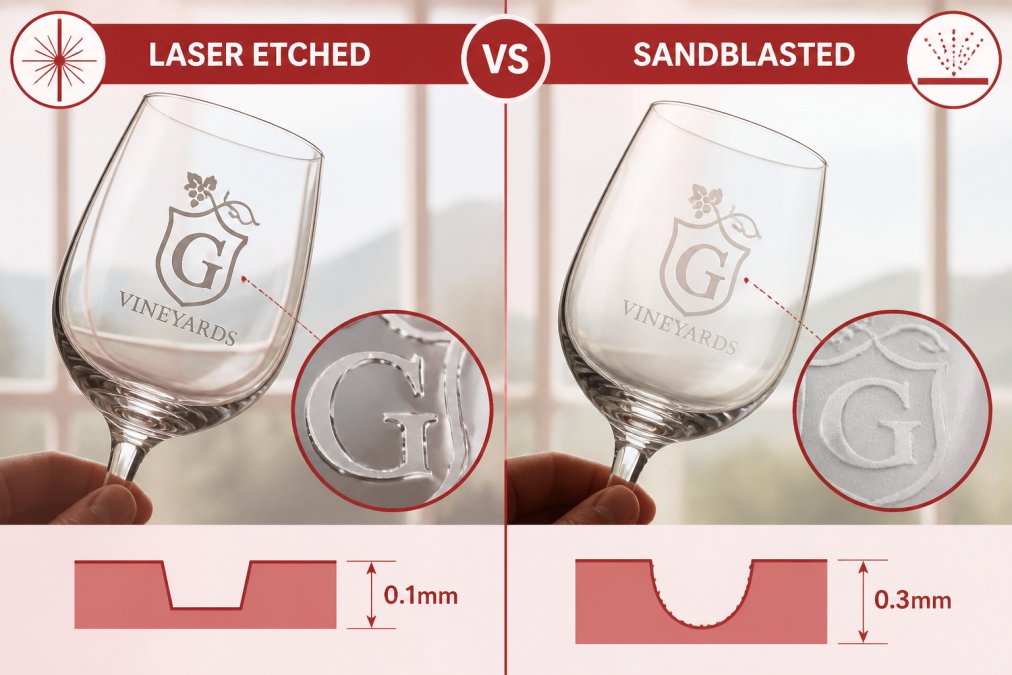
The choice between sandblasted and laser etched glass fundamentally affects how well branded glassware survives commercial dishwashing.
Laser Engraving for Permanent Marking
Laser engraving uses focused light energy to vaporise the glass surface, creating a mark that's technically part of the glass structure itself. The laser removes a microscopic layer (typically 0.1-0.3mm deep), leaving a permanent, crisp line that cannot fade or wear away.
In commercial settings, laser marks are inherently resistant to chemical erosion because they're etched into the glass, not applied to it. Alkaline detergents and abrasive scrubbing won't diminish a laser-engraved logo. Laser engraving works particularly well for detailed artwork, fine lines, and text, producing crisp edges with no feathering. The limitation is cost, laser engraving requires precision equipment and is slower than sandblasting for large production runs.
Sandblasting and Durability
Sandblasting propels fine abrasive particles at high pressure against the glass surface, creating a frosted, textured finish. Unlike laser engraving, sandblasting penetrates less deeply (typically 0.05-0.15mm), creating a surface-level mark rather than a structural one.
In commercial dishwashers, the frosted surface is more porous than original glass, trapping mineral deposits and detergent residue. Over time, this can lead to hazing or clouding in the etched area. Sandblasting is faster and more cost-effective for large volumes, and the frosted aesthetic is preferred for wine glasses and beer steins. The key to durability is glass selection and maintenance, borosilicate glass resists thermal shock and chemical degradation far better than standard soda-lime glass.
Understanding Glassware Corrosion Prevention
Glass is chemically inert under most conditions, yet it degrades when exposed to specific environments. In commercial dishwashers, high temperature, alkaline chemistry, and mineral-laden water accelerate degradation if preventive measures aren't in place.
How Hard Water and Alkaline Detergents Cause Damage
Commercial dishwasher detergents are intentionally alkaline (pH 10-13) to break down grease and proteins at scale. This alkalinity is necessary for sanitation but corrosive to glass over extended exposure. Hard water, water high in dissolved calcium and magnesium, compounds this problem. When alkaline detergent meets hard water inside a hot dishwasher, mineral ions react with the glass surface, forming deposits that appear as clouding or filming.
Etched glassware is particularly vulnerable because the etched surface has more exposed area than smooth glass. The solution involves three components: water softening, detergent selection, and rinse aid. Rinse aid is critical, it reduces surface tension, allowing water to sheet off rather than pooling and leaving mineral deposits.
Thermal Shock and Glass Degradation
Thermal shock occurs when glass experiences rapid temperature changes. In commercial dishwashers, glasses move from room temperature to 75°C wash cycles, then cool quickly during rinse. Standard soda-lime glass is moderately susceptible to thermal shock. Borosilicate glass expands and contracts more slowly, making it far more resistant.
Thermal shock risk increases with incorrect loading. If glasses are tightly stacked or placed in pre-heated dishwashers without proper spacing, thermal stress concentrates at contact points. Proper loading, with adequate spacing and glasses upright or at angles allowing water circulation, distributes thermal stress evenly and extends glassware lifespan significantly.
Preventing Cloudy Glasses in Commercial Dishwashers
Cloudiness and hazing are the most common complaints about etched glassware in commercial settings. This outcome is preventable with the right approach.
Identifying Filming and Hazing
Filming and hazing are distinct phenomena. Filming is a thin, often removable layer of mineral deposits or detergent residue that appears as a milky coating. Held to light, you might see streaks where water pooled. Filming can often be removed with white vinegar.
Hazing looks like the glass itself has become frosted or permanently clouded. It won't wipe away easily because it's the glass surface becoming porous and light-scattering. Hazing indicates excessive alkaline exposure or insufficient glass quality for commercial use.
Detergent Selection and Rinse Aid Use
The detergent used in commercial dishwashers has enormous impact on glassware longevity. Premium detergents are formulated at lower pH levels and include glass-protection additives.
Rinse aid is non-negotiable for etched glassware. It lowers surface tension, allowing water to sheet off rather than beading up and leaving mineral spots. Without rinse aid, every water droplet that dries leaves a microscopic mineral deposit. Many venues under-dose rinse aid or skip it to reduce costs, resulting in glassware replacement costs far exceeding savings.
Regular testing of dishwasher water pH and hardness is wise. If pH exceeds 12.5 or hardness exceeds 300ppm, adjust detergent concentration downward or upgrade to a gentler formulation. Some venues install water softening systems specifically for the dishwasher, guaranteeing consistent results.
Proper Loading and Cycle Selection for Etched Designs
How glassware is loaded and which cycle is selected directly affect both mechanical integrity and cleaning effectiveness.
Top Rack Loading Best Practice
Etched glassware should always go on the top rack, where water pressure is gentler and heat is less intense. Glasses should not touch each other, as contact points create stress concentrations during thermal cycling. Glasses should be placed upright or at a slight angle, never inverted, to allow water to flow freely inside and outside.
For stemware, ensure the stem is supported and won't flex during the wash cycle. Flexing stresses the joint between stem and bowl, eventually leading to breakage.
Commercial vs Residential Dishwasher Cycles
Commercial dishwashers operate very differently from residential models. Commercial cycles are faster (90-120 seconds), use higher water temperatures (65-75°C), and employ more aggressive mechanical action and chemical concentration.
For etched glassware in commercial environments, it must be specified as commercial-grade from the outset. Some commercial dishwashers offer adjustable cycles with a "gentle glass" setting that reduces temperature or extends rinse time. Use this option for etched glassware, the durability gain justifies slightly longer cycle times.
How to Identify and Care for Branded Glassware
Branded glassware represents a significant investment. Knowing how to identify quality etched glassware and maintain it properly protects that investment.
Visual Identification Guide for Dishwasher-Safe Etched Glass
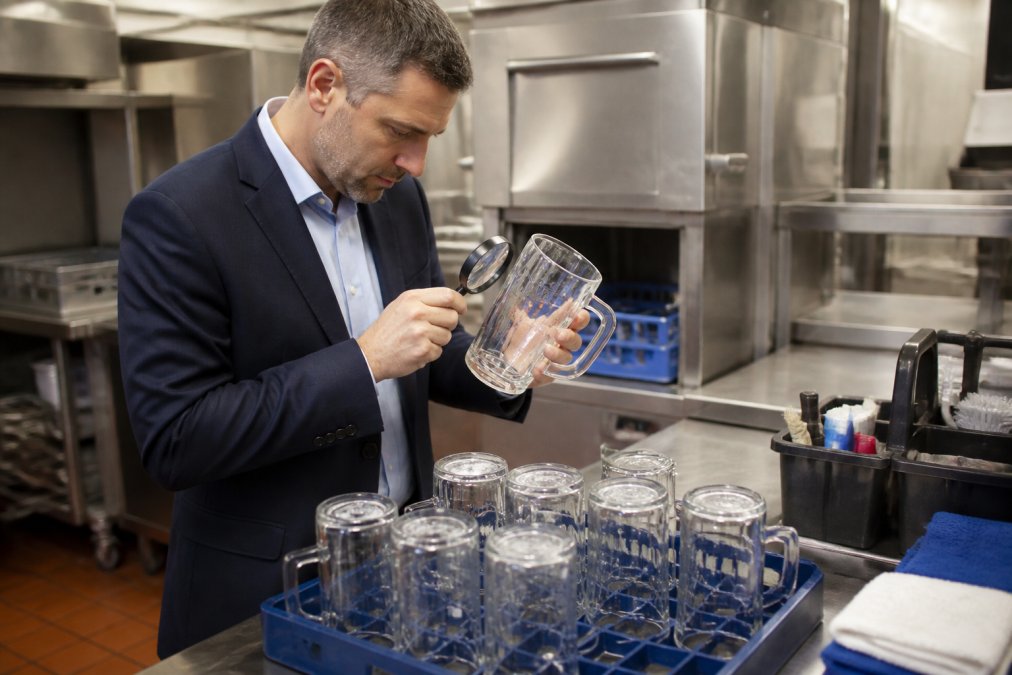
Quality etched glassware exhibits specific visual characteristics signalling durability:
Etching depth and clarity. Run your finger over the etched area, you should feel a distinct texture change. The etching should be at least 0.1mm deep. Hold the glass to light; sharp lines and consistent depth indicate professional execution.
Glass clarity and colour. High-quality glass is crystal clear with no bubbles or striations. The base should be smooth and polished, and the rim should be smooth to the touch.
Weight and balance. Commercial-grade glassware feels substantial. Lightweight, thin-walled glasses are more prone to breakage and thermal shock.
Consistency across the batch. Colour, weight, etching depth, and rim quality should be uniform.
Maintenance Tips for Etched Glassware Longevity
Pre-rinse before loading. Remove food debris and residue before placing glasses in the dishwasher to prevent trapped detergent residue.
Use appropriate detergent concentration. Over-dosing doesn't improve cleaning; it increases alkalinity and chemical erosion. Follow manufacturer recommendations for your water hardness.
Inspect rinse aid levels regularly. Check the rinse aid reservoir weekly if the dishwasher runs daily. Running out causes sudden filming or hazing.
Avoid abrasive scrubbing. Use soft cloths or sponges. Abrasive pads can scratch the etched surface, making it more prone to trapping minerals.
Store glasses upright. Upright storage prevents stress at contact points and dust accumulation.
Rotate stock regularly. In hospitality venues, rotate glassware so no single glass is used constantly. Even wear extends useful life.
Address filming early. If glasses develop cloudiness, soak them in white vinegar for 15-30 minutes, then wash and rinse thoroughly. If vinegar doesn't remove it, investigate your dishwasher's water chemistry and detergent selection.
Chemical Compatibility and Professional-Grade Standards
Professional-grade glassware typically uses borosilicate glass rather than standard soda-lime glass. Borosilicate contains silica and boron oxide in proportions creating lower thermal expansion, greater chemical resistance, and superior mechanical strength. This material costs more but withstands thermal cycling, alkaline exposure, and mechanical stress far better.
Chemical compatibility means the glass won't degrade when exposed to alkaline detergents, rinse aids, water softening compounds, and sanitising agents at commercial concentrations and temperatures. Professional etching creates deeper, more durable marks using precision equipment, while consumer-grade etching is often shallower and more prone to fading.
When specifying glassware for commercial environments, insist on professional-grade materials and methods. The Glassware Company manufactures glassware to these standards, ensuring branded pieces remain crisp year after year.
Cloudy glassware reflects poorly on your brand, and replacing etched glassware frequently is costly. The solution is selecting the right glass type, etching method, and maintenance practices from the start. The Glassware Company specialises in commercial-grade etched glassware designed for high-volume dishwasher use, backed by years of industry experience ensuring your logos remain sharp and your brand impression stays strong. Get started with a custom glassware quote and discover how professional-grade etching and borosilicate glass transform your promotional gifts into lasting impressions.
| Etching Method | Depth | Durability | Best For | Cost |
|---|---|---|---|---|
| Laser Engraving | 0.1-0.3mm | Excellent | Detailed logos, fine text | Higher |
| Sandblasting | 0.05-0.15mm | Good (with proper care) | Decorative, frosted aesthetic | Moderate |
| Challenge | Cause | Prevention | Outcome |
|---|---|---|---|
| Filming | Mineral deposits, detergent residue | Rinse aid, water softening | Removable with vinegar |
| Hazing | Alkaline corrosion, hard water exposure | Proper detergent pH, glass grade | Permanent without intervention |
| Thermal shock damage | Rapid temperature cycling, poor loading | Correct spacing, borosilicate glass | Extended glassware lifespan |
| Etching fading | Shallow etching, low-grade glass | Professional-grade methods | Logo remains crisp for years |
Frequently Asked Questions
Is etched glassware truly safe in commercial dishwashers?
Yes, properly etched glassware designed for commercial use is dishwasher safe. Laser-etched and professionally sandblasted designs withstand high-temperature sanitisation cycles when the glass composition is suitable and detergent chemistry is controlled. However, not all etching methods are equal, laser engraving for permanent marking is more durable than surface-level etching. The key is choosing glassware specifically manufactured for commercial dishwasher cycles and following proper loading and detergent protocols.
What causes permanent cloudiness on branded glassware in commercial dishwashers?
Cloudiness results from glass corrosion, not simple dirt. Hard water minerals, alkaline detergents, and high-temperature cycles chemically etch the glass surface, creating microscopic pits that scatter light. This hazing is permanent and cannot be polished away. Prevention requires using rinse aid to reduce mineral deposits, selecting pH-neutral or low-alkaline detergents, and ensuring water hardness is monitored. Professional-grade glassware with tempered composition resists this degradation better than standard glass.
How does laser etching compare to sandblasting for dishwasher durability?
Laser engraving creates a permanent subsurface mark by altering the glass structure, making it resistant to mechanical stress and chemical erosion. Sandblasting creates a frosted surface texture that can gradually smooth or cloud over time in commercial cycles. For branded glassware intended for frequent dishwashing, laser-etched designs maintain logo longevity far better. Sandblasted finishes offer aesthetic appeal but require more careful handling and gentler cycle selection.
What detergent and rinse aid should we use to protect etched glassware?
Select commercial-grade detergents with lower alkalinity (pH 10-11 rather than 12+) to minimise glass degradation. Rinse aid is essential, it reduces water hardness effects and prevents filming on etched surfaces. Test your water hardness first; high-hardness water requires stronger rinse aid dosing. Avoid abrasive detergents with harsh enzymes. Many venues find that switching to professional hospitality-grade products reduces cloudiness by 60-80% within weeks, protecting both etched logos and overall glassware clarity.
Can damaged or cloudy etched glassware be restored?
Unfortunately, glass corrosion and hazing are permanent. Once the surface has been chemically etched by hard water and alkaline detergents, the damage cannot be polished or chemically reversed. This is why prevention through proper loading, detergent selection, and cycle management is critical. If cloudiness appears, it signals that your dishwasher chemistry needs adjustment immediately to prevent further damage to remaining stock.
How should we load etched glassware in a commercial dishwasher?
Always place etched glassware on the top rack where water pressure and temperature are lower. Ensure glasses do not touch each other to prevent mechanical stress and chipping. Avoid crowding, as poor water circulation increases mineral deposit buildup on etched surfaces. Never place etched glassware in the hottest zones of the machine. For high-volume venues, running a separate gentle cycle for branded pieces rather than mixing them with heavily soiled items can significantly extend logo longevity.
What is the difference between commercial and residential dishwasher cycles for etched glassware?
Commercial cycles run hotter (typically 65-75°C) and use higher-alkalinity detergents for heavy-duty sanitisation. Residential cycles are gentler. Etched glassware rated for commercial use can handle these intense conditions, but residential glassware may degrade rapidly. Always verify that your branded glassware is specifically certified for commercial-grade dishwashing. Using residential-grade etched glass in a commercial machine will result in rapid clouding and logo degradation within weeks.
This article was written using GrandRanker