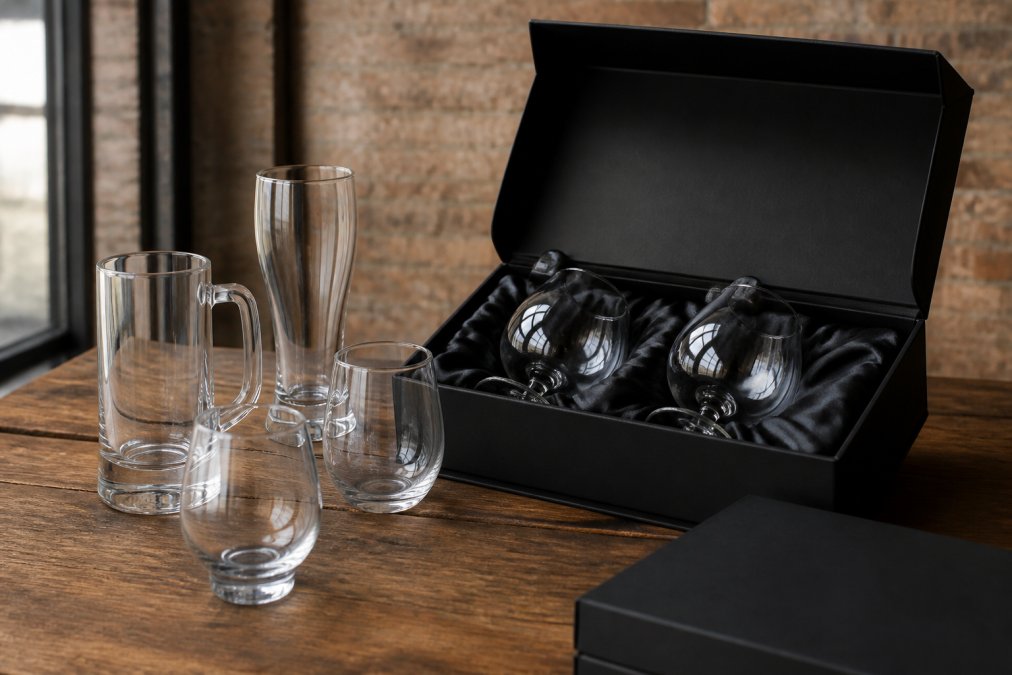
 ultimate-guide
How to Choose Durable Custom Beer Glasses
Table of Contents
- Why Glass Durability Matters for Custom Beer Glasses
- Etched vs Printed Beer Glasses: Which Branding Lasts Longer?
- Glass Types and Beer Style Compatibility
- What Makes Commercial Grade Beer Glasses Different?
- Capacity, Sizing, and Dishwasher Safety
- Custom Glassware Lead Times and the Proofing Process
- Choosing Beer Glasses for Bars vs Gifts
- Conclusion
- Frequently Asked Questions
Last Updated: September 25, 2026
Why Glass Durability Matters for Custom Beer Glasses
A custom beer glass that chips, clouds, or loses its logo after a few commercial washes is a sunk cost. Durability decides whether glassware promotes your brand for years or quietly disappears from the shelf.
At The Glassware Company, we've spent years etching and engraving glassware for breweries, corporate clients, and hospitality venues, and the questions we field rarely concern shape. They concern longevity: will the print fade, will the rim chip, will the glass survive the dishwasher.
This guide breaks down branding methods, the glass types that hold up under commercial use, and how to match a specification to your environment.
Etched vs Printed Beer Glasses: Which Branding Lasts Longer?
Etched branding outlasts printed branding in almost every commercial setting, because of where the mark sits relative to the surface.
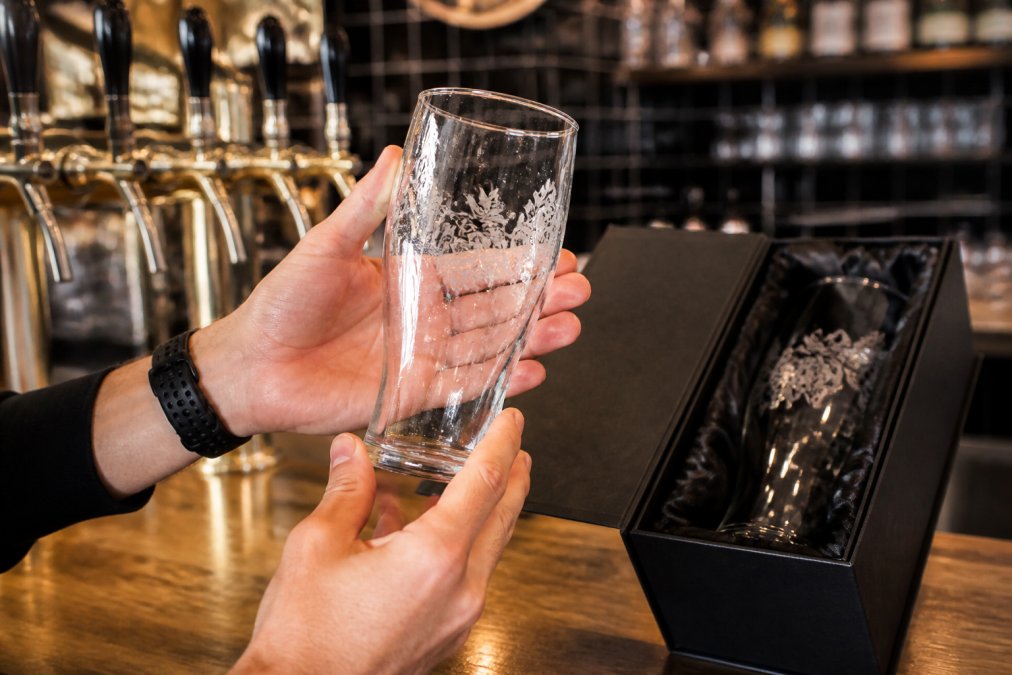
Etching removes or alters the top layer of glass, so the design becomes part of the material itself. Printing adds a layer on top of the glass, which means the mark can wear, peel, or fade independently of the glass.
How Etching and Engraving Work on Glass
Etching and engraving both create permanent marks, but differently. Chemical etching uses a masking film and an acidic compound to frost the design into the surface; physical engraving cuts it with a rotating wheel or laser. Because both alter the glass rather than coat it, the logo has no separate layer to fail.
Print Longevity and Stress Testing
Printed branding relies on adhesion, and adhesion degrades. A print that survives a hand wash often will not survive a commercial dishwasher, where high-temperature cycles, alkaline detergents, and thermal cycling attack the ink-to-glass bond.
Pad printing and high-fire decals outlast basic screen printing, but neither matches etching. In our stress tests, etched and engraved marks show no meaningful degradation after repeated commercial washes, while printed marks lift, shift colour, and scratch.
Glass Types and Beer Style Compatibility
Shape is not decoration: the glass you choose changes how a beer presents and performs.
Matching Shapes to Beer Styles
Different vessels exist because different beers need different handling:
- Schooner: A large, slightly tapered vessel common in Australian venues, suited to lagers and easy-drinking ales.
- Tulip glass: A bulbous bowl with a flared rim that concentrates aroma, ideal for IPAs and Belgian styles.
- Pilsner flute: A tall, slender glass that maintains carbonation and shows off clarity in pale lagers.
- Weizen glass: A tall, curved glass designed to hold a large head, built for wheat beers.
- Tankard: A sturdy, handled vessel that suits heavy ales and offers a secure grip.
Rim thickness matters more than most buyers expect: a thin rim delivers beer cleanly onto the palate, while a thick rim disrupts the pour and feels cheap. Base stability matters just as much, a top-heavy glass on a crowded tray is a spill waiting to happen.
What Makes Commercial Grade Beer Glasses Different?
Commercial grade beer glasses are built to survive repeated industrial washing, high-volume handling, and stacking. The difference from retail glassware sits in material treatment and manufacturing tolerances.
Tempered Glass and Thermal Shock Resistance
Thermal shock resistance is a glass's ability to withstand sudden temperature change without cracking, exactly what a commercial dishwasher delivers: a hot wash followed by a cooler rinse, repeated hundreds of times.
Standard glassware is annealed, cooled slowly so internal stresses settle into a stable but relatively weak structure. Tempered glass is reheated and rapidly cooled, locking the outer surfaces into compression while the interior stays in tension. That layer resists thermal shock and impact, and tempered glass breaks more safely, into small granular pieces rather than long shards.
Annealed glass typically shows edge chipping and hairline cracks within a few months of daily commercial washing, while tempered glass holds its structure far longer. If your venue runs glassware through a commercial machine, ask for tempered.
Ergonomics and Grip Durability
Grip durability matters most in high-turnover venues, where an awkward glass gets dropped. A glass held close to its centre of mass is far more stable than one gripped near the rim, which is why shapes that taper toward the base, schooners, tulip glasses, tankards, dominate busy service.
A thicker, weighted base resists tipping and absorbs impact when a glass is set down hard.
Sustainability and Manufacturing Method
Durability and sustainability are more connected than they first appear: a glass that lasts five years instead of one avoids four replacement cycles and the energy, raw material, and transport each represents.
Capacity, Sizing, and Dishwasher Safety
Capacity and dishwasher safety are specification decisions, not afterthoughts. Get them wrong and you over-pour, under-serve, or replace glassware sooner than necessary.
Matching Volume to Serve Size and Licensing
Standard beer glass volumes vary by style, from small tasting vessels to large schooners and steins. The sizing decision has three layers: the serve size you intend to pour (most venues specify a vessel slightly larger than the nominal pour to leave headroom), the licensing framework you operate under, which may prescribe standard measures, and the washer rack dimensions, a glass that does not fit your racks gets washed by hand, accelerating wear, or sits unused.
What Actually Happens to Glassware in a Commercial Washer
Dishwasher safety comes down to three factors:
- Material: Tempered glass handles commercial cycles; standard annealed glass does not. The thermal gradient between hot wash and cooler rinse is the primary stress, and tempered glass is engineered to absorb it.
- Branding method: Etched and engraved marks are unaffected by detergent and heat because they are part of the glass itself. Printed marks rely on adhesion, and alkaline detergents gradually attack the ink-to-glass bond, with thermal cycling accelerating the process.
- Detergent and temperature: Alkaline detergents and high wash temperatures accelerate wear on any glassware. Detergent concentration matters as much as temperature; an over-dosed machine is harder on glassware than a correctly dosed one.
Stress Testing: What 500 Wash Cycles Reveals
Most guides stop at "dishwasher safe." The more useful question is what happens over hundreds of cycles, the timescale a busy venue operates on.
In our stress tests, the pattern is consistent:
- Printed branding typically shows edge lifting and colour shift well before the 500-cycle mark under commercial conditions. Once lifting begins, detergent works into the lifted edge and accelerates the failure.
- Etched and engraved marks show no meaningful degradation, because there is no separate layer to fail. The mark is the glass.
Custom Glassware Lead Times and the Proofing Process
Custom glassware lead times depend on the branding method, the quantity, and whether your artwork needs adjustment before production. Etching and engraving require a proofing stage, because the design is cut into the glass and cannot be corrected afterwards:
- You supply your logo or artwork in a usable format.
- The supplier prepares a digital proof showing placement, scale, and orientation.
- You review and approve, or request changes.
- Production begins only after written approval.
Choosing Beer Glasses for Bars vs Gifts
The right specification depends on who receives the glass and how it will be used.
| Consideration | Bars and Venues | Gifts and Promotions |
|---|---|---|
| Priority | Durability under commercial washing | Presentation and perceived value |
| Best material | Tempered glass, commercial grade | Lead-free crystal, crystal clarity |
| Branding method | Etched or engraved | Etched or engraved |
| Typical shape | Schooner, tankard, tulip | Tulip, pilsner flute, tankard |
| Packaging | Standard rack or case | Custom manufactured gift box |
| Volume | High, replaced on breakage | Lower, kept long term |
Conclusion
The hardest part of sourcing custom beer glasses is not choosing a shape. It is specifying a glass that still looks right after a year of commercial washing, handling, and stacking, a decision made long before production starts.
Frequently Asked Questions
What glass material is most durable for commercial beer glasses?
Tempered glass offers the best balance of durability and clarity for commercial use. It withstands thermal shock from commercial dishwashers and resists chipping better than standard annealed glass. For venues that want lasting clarity and branding that holds up, tempered glass with etched logos is the strongest choice.
How does etching affect the structural integrity of custom beer glasses?
Etching removes a microscopic layer of glass from the surface, but when done correctly on tempered glass, it does not compromise structural integrity. The key is etching after the tempering process, not before, so the glass retains its strength. A well-etched logo becomes part of the glass itself and will not peel, fade, or wash away, even after hundreds of commercial dishwasher cycles.
What is the standard lead time for custom glassware orders?
Custom glassware lead times depend on order size and decoration method. For etched and branded glassware with custom gift boxing, allow approximately 28 working days. Rush orders may be possible depending on capacity, so confirm timelines early in your planning process.
How do I ensure my custom logo remains durable on glassware?
Choose etching or engraving over printing for the longest-lasting logo. Etched logos become part of the glass surface and resist fading, peeling, and scratching. Always confirm the decoration method is dishwasher safe and ask about stress testing results before committing to a large order.