 ultimate-guide
Impact of Accurate Pour Lines: A 2026 Guide
Table of Contents
- Why Accurate Pour Lines Matter for Hospitality
- Standard Drink Measures in Australia and Regulatory Compliance
- The Financial Reality: Impact of Over-Pouring on Profit
- Glassware Geometry and Visual Bias in Pour Accuracy
- Jigger vs. Free Pouring: Methods That Deliver Consistency
- Hospitality Glassware Compliance and Calibration Standards
- Training and Shift Management for Consistent Pours
- Frequently Asked Questions
Last Updated: August 31, 2026
Why Accurate Pour Lines Matter for Hospitality
The difference between a profitable bar and one that haemorrhages money comes down to a single detail most staff ignore: where the liquid stops in the glass. Accurate pour lines aren't about perfectionism, they're about survival. When you're running a busy venue, every ounce matters. A single staff member over-pouring by just 10 millilitres per drink across a 200-drink shift costs you real money. Multiply that across a week, a month, a year, and you're looking at significant margin erosion.
At The Glassware Company, we've worked with hospitality venues across wineries, breweries, and restaurants. The venues that win aren't the ones with the fanciest glassware, they're the ones where staff know exactly where to fill a glass, every single time. This guide covers why accurate pour lines matter and how to build a system that actually works.
The financial reality is straightforward: inconsistent pouring directly impacts your cost of goods sold and profitability. But beyond the numbers, accurate pour lines affect how your customers perceive value, whether your staff can work efficiently under pressure, and whether you can scale without losing control of quality.
Standard Drink Measures in Australia and Regulatory Compliance
Australia's standard drink measures are defined by the Australian Beverages Council and enforced through various state-based liquor licensing regulations. A standard drink in Australia contains 10 grams of pure alcohol, which translates to specific volumes depending on the beverage type: 30 millilitres for spirits, 100 millilitres for wine, and 285 millilitres for standard beer.
Understanding these measures isn't optional, it's a compliance requirement. Your venue's liquor licence depends on accurate serving measures. State regulators conduct audits, and venues that consistently over-pour face penalties ranging from fines to licence suspension. More importantly, venues that under-pour face customer complaints and reputation damage.
The challenge is that standard measures and profitable pouring don't always align perfectly. A 30-millilitre spirit pour meets compliance, but different glassware shapes make that volume look dramatically different. A tall, narrow glass makes 30 millilitres appear generous. The same volume in a wide, shallow glass looks stingy. Your staff's perception of what's "correct" shifts with every glass they pick up.
This is where calibration becomes essential. You need glassware where the standard measure is visually obvious, where staff can see at a glance whether they've hit the target. Custom-etched pour lines from The Glassware Company solve this problem directly. Rather than relying on eyeballing or mental math, your team pours to a physical line. Compliance becomes automatic.
The Financial Reality: Impact of Over-Pouring on Profit
Over-pouring is the silent killer of hospitality margins. A bartender who pours 35 millilitres instead of 30 millilitres on spirits isn't being generous, they're eating into your profit on every single drink. Over a busy weekend, this compounds into hundreds of dollars in lost revenue.
The math is brutal. Consider a standard spirit-based cocktail that costs you $8 to produce at the correct 30-millilitre pour. If your staff consistently pours 35 millilitres, your cost per drink rises to $9.33. Across 500 drinks per week, that's $665 in additional cost (peer-reviewed research). Annually, you're looking at over $34,000 in margin lost on a single spirit category alone.
But the financial impact extends beyond the immediate cost. Inventory variance becomes unmanageable. When you order stock based on expected pour volumes but staff are pouring inconsistently, your stock counts never match your sales records. This creates blind spots, you don't know whether you have a theft problem, a measurement problem, or both. Auditing becomes a nightmare.
Consistency in pouring also affects your ability to forecast. If you can't predict how much spirit you'll use per drink, you can't accurately forecast weekly or monthly costs. Your profit margins become guesswork.
The psychology of over-pouring matters too. When staff have no clear target, they tend to err on the generous side, it feels safer than under-pouring. One bartender might pour 32 millilitres, another 38 millilitres, and a third might hit exactly 30 millilitres. This inconsistency is expensive and creates customer expectations that are impossible to meet consistently.
Glassware Geometry and Visual Bias in Pour Accuracy
Here's what most guides miss: your eyes lie to you about volume. The shape of the glass fundamentally changes how much liquid you think you're pouring. This isn't opinion, it's how human perception works.
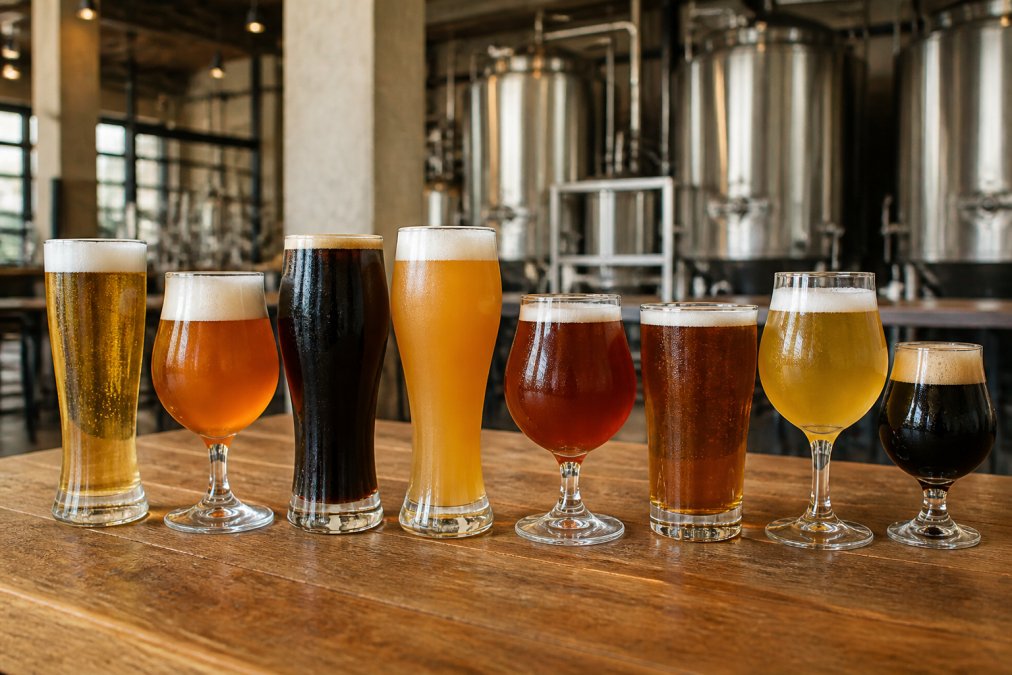
A tall, narrow glass makes a given volume appear larger than the same volume in a wide, shallow glass. A 100-millilitre pour in a highball glass looks generous and full. The same 100 millilitres in a wine glass looks sparse and disappointing. Your staff's brain registers these visual cues instantly, and their hand adjusts without conscious thought. They pour more into the wine glass to make it "look right."
This is called visual bias in portion estimation, and it's one of the most underestimated problems in hospitality (peer-reviewed research). A bartender working a busy shift doesn't consciously think "I need to adjust for glassware geometry." Instead, they rely on what looks correct, and what looks correct is shaped entirely by the glass shape in front of them.
The solution isn't to hope staff will remember glassware geometry. The solution is to remove the guesswork entirely. Etched pour lines on custom glassware eliminate visual bias because staff aren't estimating anymore, they're pouring to a physical target. The line is the same regardless of the glass shape or the ambient lighting.
This is why The Glassware Company's custom-etched glassware is so effective for hospitality venues. When you etch a pour line directly onto the glass, you're creating a visual anchor that overrides the brain's natural tendency to estimate based on shape. Staff can work at speed, under pressure, without losing accuracy.
Jigger vs. Free Pouring: Methods That Deliver Consistency
The jigger versus free pouring debate is really a question about speed versus accuracy. Both methods work, but they work under different conditions.
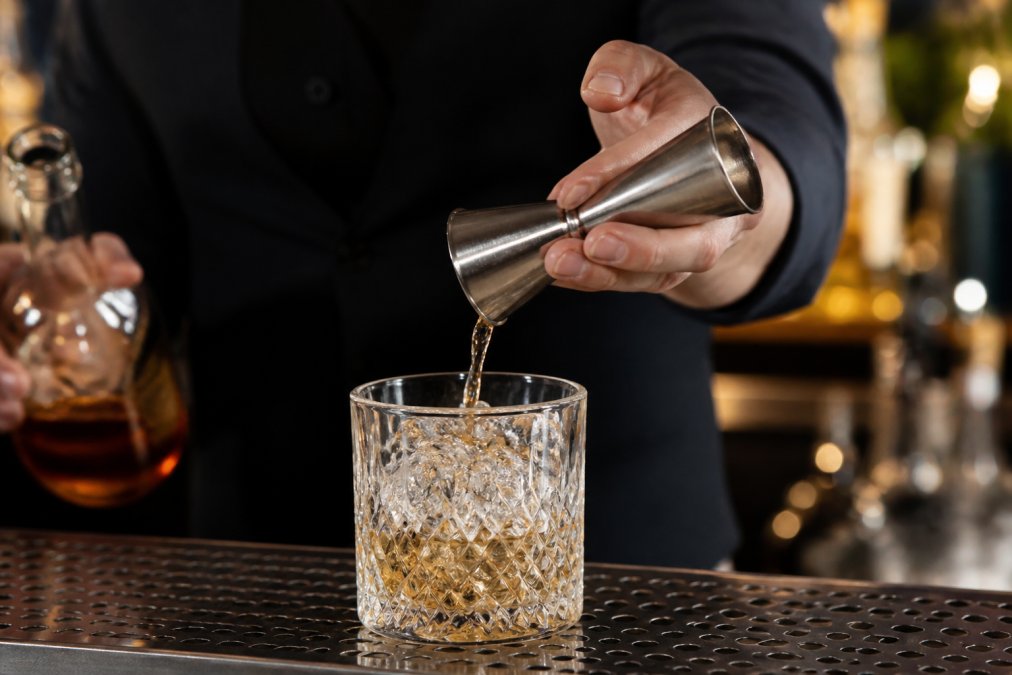
A jigger is a measuring device, typically with two sides offering different volumes (often 30 millilitres and 45 millilitres). The bartender fills the jigger, empties it into the glass, and repeats if necessary. It's mechanically precise. Every pour is measurable and auditable. The downside is speed, jigger pouring is slower than free pouring, especially during high-volume service.
Free pouring is what experienced bartenders do: they hold the bottle, pour by feel and timing, and stop when they believe they've hit the right volume. It's fast. A skilled bartender can free pour a dozen drinks in the time it takes a jigger pourer to measure three. But free pouring is also where inconsistency lives. Timing varies based on fatigue, distraction, and the bartender's confidence level. Newer staff often free pour inconsistently because they haven't developed the muscle memory. home bar setup.
The real answer isn't to choose one method, it's to match the method to your staff and your service model. High-volume venues with experienced bartenders can sustain free pouring if they have strong training and calibration systems. Venues with mixed experience levels, high turnover, or high-pressure service periods benefit enormously from jigger pouring or pour-line-guided glassware.
Here's the practical insight: the best venues use a hybrid approach. They train staff to free pour during moderate service periods, but they require jigger pouring or pour-line measurement during peak service. This protects accuracy when pressure is highest and staff are most likely to make mistakes.
Custom glassware with etched pour lines sits between these two methods. Staff can free pour but have a visual anchor to check against. It's faster than jigger pouring and more consistent than pure free pouring. For venues that want speed without sacrificing accuracy, this is the sweet spot.
Hospitality Glassware Compliance and Calibration Standards
Calibration isn't a one-time event, it's an ongoing process. Your glassware needs to be tested and verified to ensure that the pour line actually corresponds to the correct volume.
In Australia, hospitality venues are expected to use glassware that supports accurate measurement. While there's no single mandated standard like you'd find in some other countries, the expectation from liquor licensing authorities is clear: venues must have systems in place to ensure consistent, compliant pouring. This means your glassware needs to be reliable.
When you commission custom-etched glassware from The Glassware Company, the pour line is etched at the precise volume that matches your standard drink measure. But once the glassware arrives, you need to verify it and maintain it.
Here's how calibration works in practice: fill a glass to the etched line with water, pour that water into a measuring jug, and verify the volume. Do this with multiple glasses from the same batch to check for consistency. If all glasses measure within 2-3 millilitres of the target, you're good. If variance is higher, you have a problem with either the glassware or your measurement technique.
Calibration also accounts for wear. Etched lines don't fade quickly, but they can become less visible over time with heavy use and repeated washing. Every six months, run a calibration check on a sample of your glassware. If lines are becoming hard to see, it's time to replace glasses or refresh the etching.
The compliance angle is straightforward: if a regulator audits your venue and finds that your glassware doesn't match your stated pour measures, you're in violation. Custom-etched glassware with documented calibration is your defence. You can demonstrate that you have systems in place and that you've taken steps to ensure accuracy.
Training and Shift Management for Consistent Pours
Training staff to use accurate pour lines is simpler than training them to free pour consistently, but it still requires structure and reinforcement.
Start with orientation. When a new staff member joins, show them the pour line on your glassware. Have them fill a glass to the line while you watch. Have them do it five times. Most staff will hit the target consistently within a few attempts, the visual anchor is that powerful. Then move to real service conditions: have them work a slow shift with a manager observing, specifically watching pour accuracy.
The second part of training is calibration awareness. Staff need to understand why the pour line exists and what it represents. When they understand that accurate pouring directly affects the venue's profitability and their own job security, they take it seriously. This isn't about scare tactics, it's about context.
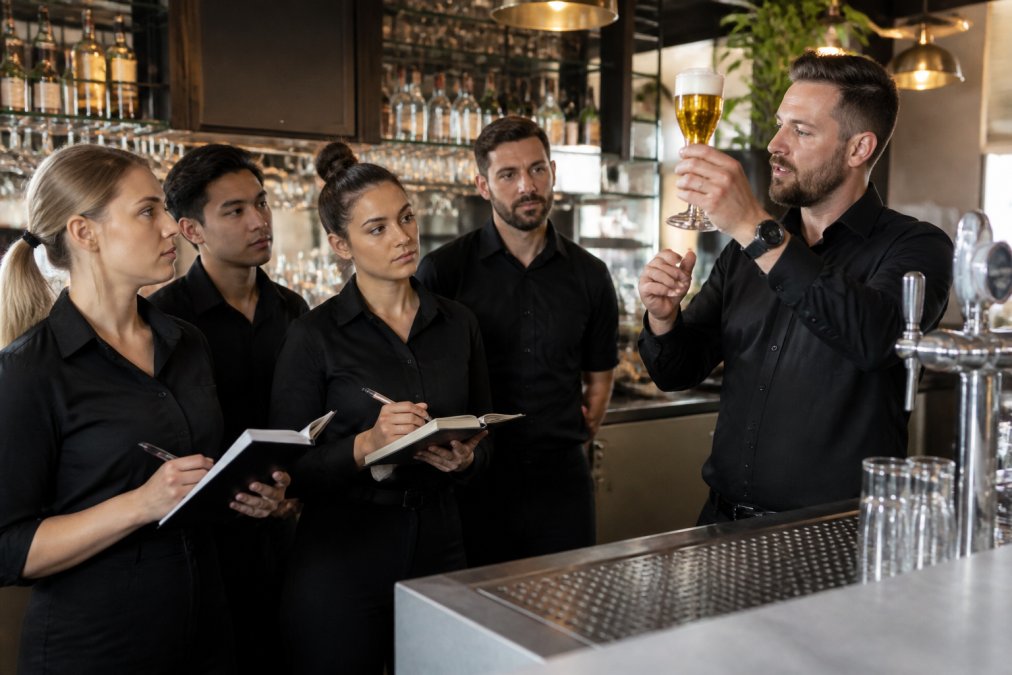
Shift management is where consistency either thrives or falls apart. Assign one experienced staff member per shift as the "pour champion", their job is to spot-check pours from other staff members. Not constantly, just periodically. A quick visual check: does that drink look like it hit the line? If not, a quiet word. This peer accountability keeps everyone sharp.
During high-pressure service, reduce variables. If you have five different glass shapes in use, staff will struggle to maintain consistency across all of them. During peak service, limit yourself to one or two glassware types. This reduces cognitive load and keeps accuracy high.
Finally, track your metrics. Every few weeks, do a calibration audit on a sample of glasses. Document the results. If you notice accuracy drifting, you know you need to reinforce training. If you notice one staff member consistently over-pouring, you can address it directly with data rather than assumption.
Consistency in pouring is a habit, and habits form through repetition and feedback. The infrastructure, the etched pour lines, makes the habit easier to build and maintain.
Accurate pour lines aren't a luxury feature for hospitality venues, they're a fundamental control system that protects your margins, ensures compliance, and allows your staff to work with confidence.
The Glassware Company specializes in custom-etched glassware designed specifically for hospitality applications. Our team works with you to determine the exact pour line placement for your standard measures, ensuring your glassware is calibrated correctly from day one. With years of experience working with wineries, breweries, and restaurants, we understand the demands of high-volume service and the importance of consistency. Request a quote today and discover how custom-etched glassware can transform your venue's operational efficiency and bottom line.
Frequently Asked Questions
Why are accurate pour lines important for legal compliance in hospitality?
Accurate pour lines ensure venues meet standard drink measures Australia requires under hospitality regulations. Consistent pours protect venues from serving breaches and demonstrate duty of care to patrons. Custom glassware with etched pour lines creates a visible standard that staff reference during service, reducing the risk of non-compliance and supporting responsible service practices across shifts.
How does over-pouring affect profit margins in a bar or restaurant?
Over-pouring directly erodes cost of goods sold and reduces profitability. A single extra 10 ml per serve, repeated across 100 drinks per shift, represents significant inventory variance and waste. The impact of over-pouring on profit compounds across weeks and months, turning small inconsistencies into measurable revenue loss. Accurate pour lines and calibration eliminate this leakage and improve beverage cost control.
Does glass shape really influence how accurately staff can pour?
Yes. Glassware geometry significantly affects pour accuracy. Wider glasses create visual bias, making pours appear smaller than they are, so staff over-pour to compensate. Tapered or narrow glasses reduce this perception error. Custom glassware with etched pour lines counteracts this psychological bias by providing a physical reference point, helping staff achieve consistency regardless of glass shape.
What's the difference between jigger measurement and free pouring?
Jigger measurement uses a calibrated tool to dispense exact volumes, eliminating human error and ensuring precision. Free pouring relies on visual estimation and counting, which introduces variability and is prone to over-pouring under pressure. Hospitality venues typically achieve better beverage consistency and cost control with jiggers, though custom glassware with clear pour lines can improve free-pouring accuracy when staff are well trained.
This article was written using GrandRanker