 ultimate-guide
Custom Beer Glass Minimum Order Requirements Explained
Table of Contents
- What Minimum Order Quantities Mean for Custom Beer Glass Orders
- Custom Engraved Beer Glasses for Small Quantity Orders
- Beer Glass Printing Methods Comparison: Engraving, Etching, and Screen Printing
- Design File Requirements for Custom Beer Glassware
- Lead Times for Custom Promotional Products: What to Expect
- Types of Custom Beer Glass Styles and Capacity Options
- Sustainability, Sourcing, and Care for Custom Glassware
- Conclusion
Last Updated: August 5, 2026
What Minimum Order Quantities Mean for Custom Beer Glass Orders
A custom beer glass order requires understanding minimum order quantities. MOQs exist because setup costs for artwork preparation, screen printing frames, or laser etching are fixed regardless of volume. Spread across 24 glasses, those costs are painful. Spread across 144 or more, they become manageable.
At The Glassware Company, we field this question constantly: "What's your minimum?" MOQs vary depending on the branding method, glass style, and whether you're working with an existing design or starting from scratch.
Screen printing typically carries higher MOQs than laser engraving because it requires physical setup of stencils and inks for each colour. Laser engraving involves digital file setup and can accommodate smaller batches without the same cost penalty.
MOQ vs. Cost-Efficiency: Finding the Right Batch Size
The biggest mistake buyers make is treating the MOQ as the target quantity rather than the floor. Ordering exactly at the minimum often produces the highest per-unit cost. Volume pricing tiers typically reward orders at 50, 100, 250, and 500+ units with progressively lower per-unit costs.
The right batch size depends on three factors: intended use (one-off event vs. regular reorders), storage capacity, and design longevity. For businesses that reorder the same design regularly, establishing a consistent batch size and reorder cadence eliminates guesswork and often outperforms large annual orders on both cost and storage grounds.
Do MOQs Differ Between Screen Printing and Laser Engraving?
Yes. Screen printing MOQs are higher because each colour requires a separate screen. Laser engraving uses a digital file and CNC laser, so setup cost is lower and the minimum viable batch is smaller.
For custom engraved beer glasses in small quantities, laser engraving is the more practical path. For large promotional runs where cost-per-unit matters most and the design is bold and simple, screen printing often wins on total price.
Custom Engraved Beer Glasses for Small Quantity Orders
Custom engraved beer glasses for small quantity orders are the preferred solution for clients needing flexibility without sacrificing quality. Laser engraving permanently etches your design into the glass surface, with no ink to fade, peel, or wash off. The result is a clean, tactile finish that reads as premium.
Small-run engraving suits scenarios where personalisation matters more than volume: a gift for a key client, a limited-edition brewery release, or branded glasses for a boardroom. The per-unit cost is higher than bulk screen printing, but the minimum investment is lower and the quality is often superior for detailed artwork.
When a Small Run Makes Sense
Small runs make sense when the design is tied to a specific event, date, or milestone: corporate gifting for a client anniversary, a wedding with a bespoke monogram, or a sports club's premiership season. Ordering 500 units would leave you with 480 you cannot use.
For commercial venues, the calculus shifts. A taproom serving hundreds of pints per week needs volume. The per-unit savings from a larger batch quickly exceed the carrying cost of holding extra stock.
Beer Glass Printing Methods Comparison: Engraving, Etching, and Screen Printing
Three distinct techniques dominate the custom beer glass market, and choosing the wrong one is an expensive mistake.
Laser engraving uses a focused beam to remove material from the glass surface, creating a frosted, tactile mark. The result is permanent and unaffected by washing. It works best with single-colour logos, text, and detailed line art.
Sandblast etching uses pressurised abrasive media through a stencil to create a deep, matte finish. It produces a similar aesthetic to laser engraving but allows for larger surface coverage. Etching suits crests, emblems, and designs with significant surface area.
Screen printing applies ink through a mesh stencil directly onto the glass, then cures it in an oven. It supports full-colour artwork and is cost-effective at high volumes. The trade-off is durability: printed finishes are more susceptible to wear in commercial dishwashing environments than engraved or etched finishes.
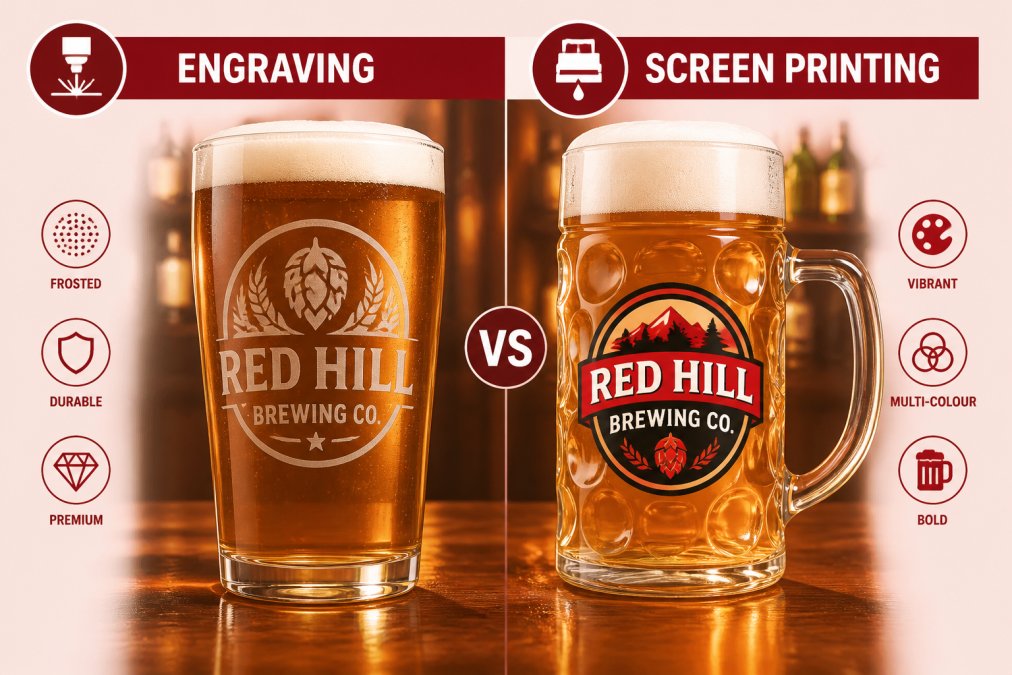
Branding Durability: Which Method Lasts Longest in a Commercial Dishwasher?
Commercial dishwashers run at high temperatures with caustic detergents. Over hundreds of cycles, inferior branding methods degrade visibly.
| Branding Method | Durability in Commercial Dishwasher | Best For | Colour Options |
|---|---|---|---|
| Laser Engraving | Permanent, unaffected by washing | Detailed logos, fine line art | Single tone (frosted) |
| Sandblast Etching | Permanent, unaffected by washing | Crests, large surface designs | Single tone (matte) |
| Screen Printing | Moderate, may fade over time with heavy use | Full-colour artwork, high volume | Full colour |
Laser engraving and sandblast etching are permanent because they remove or alter the glass surface itself rather than applying a coating. Screen printing applies a layer of ink subject to abrasion over time.
For commercial venues running glasses through industrial dishwashers daily, engraving or etching is the more reliable long-term investment. For event merchandise with lighter use, screen printing delivers excellent value and visual impact.
Design File Requirements for Custom Beer Glassware
Most production delays and artwork revisions trace back to files submitted in the wrong format. Getting this right upfront saves time, money, and frustration.
Vector files are the standard. Formats accepted by most professional glassware suppliers include:
- AI (Adobe Illustrator), preferred for most engraving and etching work
- EPS, widely compatible across production systems
- SVG, suitable for digital workflows and laser systems
- PDF, acceptable when fonts are outlined and no live effects are embedded
Raster files like JPEG, PNG, and BMP are not suitable for engraving or etching without being redrawn as vectors. A logo saved as a PNG from a website will not produce clean results on glass. If your only file is raster, a professional redraw is required before production begins.
Resolution matters for screen printing. If artwork includes photographic elements or gradients, supply files at a minimum of 300 DPI at the intended print size.
Colour specifications: For screen printing, supply Pantone (PMS) colour codes rather than RGB or CMYK values. Glass printing inks behave differently from paper inks, and matching to a Pantone reference gives the best chance of accurate colour reproduction. For engraving, colour is not applicable; the finish is determined by glass material and etch depth.
According to Printing Industries Association of Australia, consistent file preparation standards are one of the most significant factors in reducing production errors and turnaround delays.
A proofing process is standard practice for reputable suppliers. You should expect to receive a digital proof for approval before any glass enters production. Do not proceed with a supplier who skips this step.
Lead Times for Custom Promotional Products: What to Expect
Lead times for custom promotional products vary by branding method, order volume, and current production capacity. Understanding realistic timelines is essential for event planning and avoiding costly rush fees.
As a general guide across the industry:
- Standard production: Many suppliers work to a 10-15 business day production window after artwork approval
- Shipping: Add transit time depending on your location within Australia, typically 2-5 business days for metro areas and longer for regional destinations
- Rush orders: Some suppliers accommodate expedited production for an additional fee, depending on current capacity
The critical path is artwork approval, not order placement. Production cannot begin until your proof is signed off. Delays in reviewing and approving artwork are the most common reason orders miss deadlines.
For events with fixed dates, work backwards from your required delivery date and add buffer time for artwork revisions. If your event is six weeks away, place your order now. If it is three weeks away, contact your supplier immediately to confirm whether your timeline is achievable.
According to Australasian Promotional Products Association, lead time expectations for custom branded merchandise have become one of the top buyer concerns, with many clients underestimating the time required for artwork approval, production, and freight within Australia.
Types of Custom Beer Glass Styles and Capacity Options
Choosing the right glass style affects the drinking experience, the perceived value of your brand, and the practical durability of your branded merchandise.
Pint Glasses, Steins, Schooners, and More
The Australian market uses distinct glass sizes that differ from UK and US conventions. Understanding local capacity standards matters when specifying glassware for licensed venues.
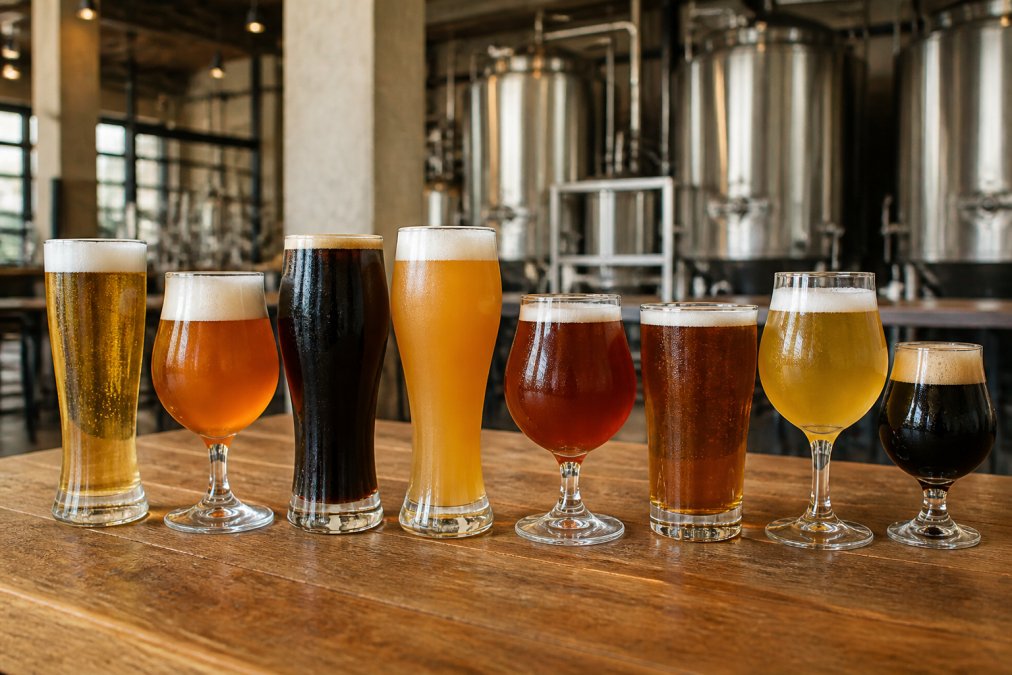
Pint glass (570 ml): The standard full pint in Australia. Tall, straight-sided or slightly tapered, with excellent surface area for branding. Suited to both engraving and screen printing.
Schooner (425 ml): The most common serve size in many Australian states. Shorter than a pint, slightly wider at the top. A practical choice for high-volume taprooms.
Pot / Middy (285 ml): A half-pint serve, common in Queensland and Victoria. Compact and stackable, reducing storage and handling costs.
Beer stein: Typically 500 ml or 1 litre, with a handle. Associated with craft beer festivals and premium merchandise. The handle and body provide generous branding surface area, and the weight conveys quality.
Pilsner glass: Tall and tapered, designed to showcase colour and carbonation. Popular in craft taprooms and as a premium gift item.
Tulip and IPA glasses: Curved to concentrate aroma, increasingly popular in craft taprooms and as premium merchandise for beer enthusiasts.
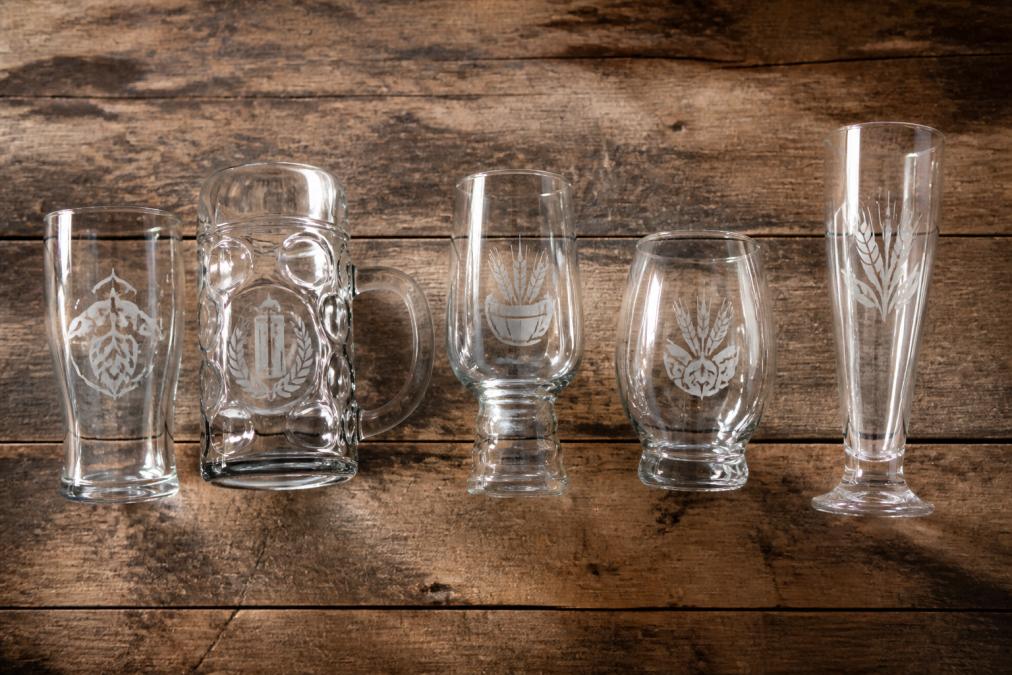
Each style carries different MOQ considerations. Steins are a more specialised item and may have higher minimum quantities than standard pint glasses, which are produced in larger volumes.
Sustainability, Sourcing, and Care for Custom Glassware
The promotional products industry faces pressure to improve environmental credentials, and glassware is one of the more defensible categories. Glass is infinitely recyclable, does not leach chemicals into beverages, and has a long usable life compared to single-use alternatives.
When evaluating a glassware supplier, ask about their sourcing practices. Glassware manufactured to recognised quality standards will carry consistent wall thickness, uniform capacity, and predictable behaviour in commercial environments. According to Australian Packaging Covenant Organisation, businesses sourcing promotional and hospitality products are increasingly expected to demonstrate consideration of end-of-life recyclability and supply chain transparency.
A well-made, engraved beer glass used weekly for five years generates a fraction of the waste of equivalent single-use branded items.
Care recommendations for custom glassware:
- Engraved and etched glasses: Dishwasher safe in both domestic and commercial machines. No special handling required.
- Screen-printed glasses: Dishwasher safe, but commercial cycles with high-caustic detergents will accelerate wear. Hand washing extends the life of printed finishes.
- Storage: Stack only glasses designed for stacking. Rim-to-rim stacking of non-stackable glasses causes chipping and breakage.
- Inspection on delivery: Check your order on receipt. Document any transit damage immediately.
Sustainability extends to batch sizing. Ordering more than you need creates waste, particularly for event-specific designs. The most sustainable order is the one that matches your actual demand.
Custom glassware procurement involves more decisions than most buyers anticipate. Getting the branding method wrong costs money. Getting the timeline wrong costs relationships. Getting the file format wrong costs both.
The Glassware Company brings years of industry experience to every order, with expertise in laser engraving and etching across a large range of glass styles, from pint glasses and schooners to steins and pilsners. Our team manages the proofing process carefully, ensuring your artwork is accurate before a single glass enters production.
Request an online quote from The Glassware Company and get a clear picture of what your order requires, what it will cost, and when it will arrive.
Frequently Asked Questions
What are the standard minimum order quantities for custom beer glasses in Australia?
Minimum order quantities for custom beer glasses in Australia vary by branding method and supplier. Laser engraving and etching typically carry lower MOQs, making them suitable for small batches of 12 to 50 units, while screen printing generally requires larger runs to offset setup costs. The Glassware Company works with a range of order sizes to suit breweries, events, and corporate clients. Request an online quote to confirm the MOQ that applies to your chosen glass style and branding method.
Can I order custom engraved beer glasses in small quantities for a wedding or event?
Yes. Laser engraving and etching are well suited to smaller personalised runs, which makes them a practical choice for weddings, milestone events, or tasting room merchandise where you do not need hundreds of units. Small quantity orders do carry a higher per-unit cost than bulk runs, but they avoid the risk of excess stock. Discuss your event date, glass style, and artwork with The Glassware Company early to confirm lead times and the minimum that applies to your order.
What is the typical lead time for bulk custom beer glass orders?
Lead times for custom promotional products depend on order volume, the branding method selected, and current production schedules. In Australia, standard turnaround for custom beer glassware typically ranges from two to four weeks after artwork approval. Rush production is sometimes available but may affect pricing. If your event has a fixed date, factor in artwork proofing time and domestic shipping when planning. Submit your brief as early as possible and ask The Glassware Company about current turnaround times when requesting a quote.
Are laser-engraved beer glasses dishwasher safe for commercial use?
Laser engraving and sandblast etching physically alter the glass surface rather than adding a coating on top, so the branding does not fade, peel, or wash away in a commercial dishwasher. This makes engraved glassware the preferred choice for breweries, taprooms, and hospitality venues with high-cycle dishwashers. Screen-printed finishes can also be produced to a high durability standard, though the longevity depends on the ink system and curing process used. Confirm the expected durability of your chosen method with The Glassware Company before placing your order.
This article was written using GrandRanker