 how-to
Why Custom Glassware Logos Fade Fast (And How to Stop It)
Table of Contents
- The Real Reason Custom Glassware Logos Fade So Quickly
- Laser Etched vs Screen Printed Glassware: Which Lasts Longer?
- Material-Specific Durability: Does Glass Type Affect Logo Longevity?
- Commercial Dishwasher Safe Glassware: What the Label Actually Means
- How to Wash Branded Glassware Without Damaging the Logo
- Can You Restore Faded Logos on Custom Glassware? DIY Options Explained
- Why Branding Quality Reflects on Your Business
- Conclusion
Last Updated: August 6, 2026
The Real Reason Custom Glassware Logos Fade So Quickly
Custom glassware logos fade because decoration sits on top of the glass surface rather than becoming part of it. Most printed logos use topical application techniques, ink, vinyl, or ceramic coatings applied to the exterior surface. These materials bond through adhesion rather than physical integration, making them vulnerable to heat, chemical exposure, and mechanical wear.
The two biggest culprits are commercial dishwashers and their detergents. Both attack surface-applied branding in different ways, accelerating logo degradation far faster than hand washing alone.
How Dishwasher Heat Causes Thermal Degradation
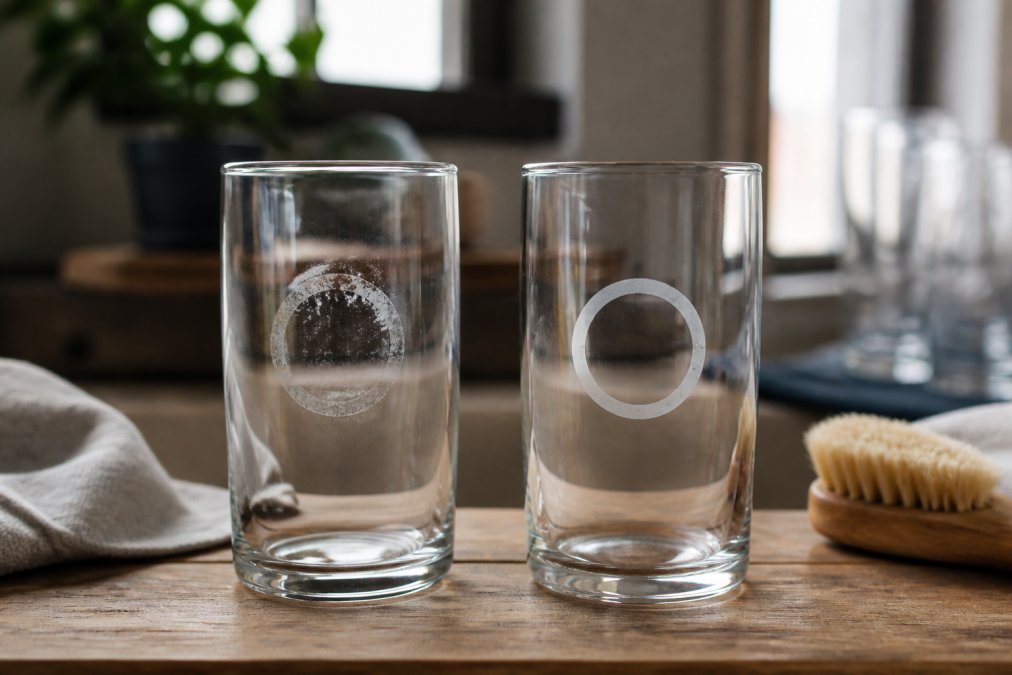
Commercial dishwashers in Australian hospitality settings typically operate at 60-82°C, with sanitising rinse cycles reaching even higher. Printed logos expand and contract with each wash cycle at a different rate than the glass beneath them. Over repeated cycles, this differential expansion creates microscopic stress fractures in the adhesion layer. Edges lift first, colours dull, then sections peel or flake. Vinyl decals are particularly heat-sensitive; the adhesive backing softens under sustained high temperatures, causing warping, bubbling, or separation.
Why Dishwasher Detergent Attacks Printed Logos
Commercial dishwasher detergents use alkaline compounds and surfactants to cut through grease and food residue. These same chemicals interact with binding agents in screen-printed inks and adhesive layers beneath vinyl decals, dissolving the chemical bond holding decoration to glass. The detergent attacks the interface between decoration and glass, precisely where surface-level branding is most vulnerable. According to Food Standards Australia New Zealand guidance on commercial kitchen equipment, commercial cleaning agents are required to be chemically aggressive to remove organic residues.
Laser Etched vs Screen Printed Glassware: Which Lasts Longer?
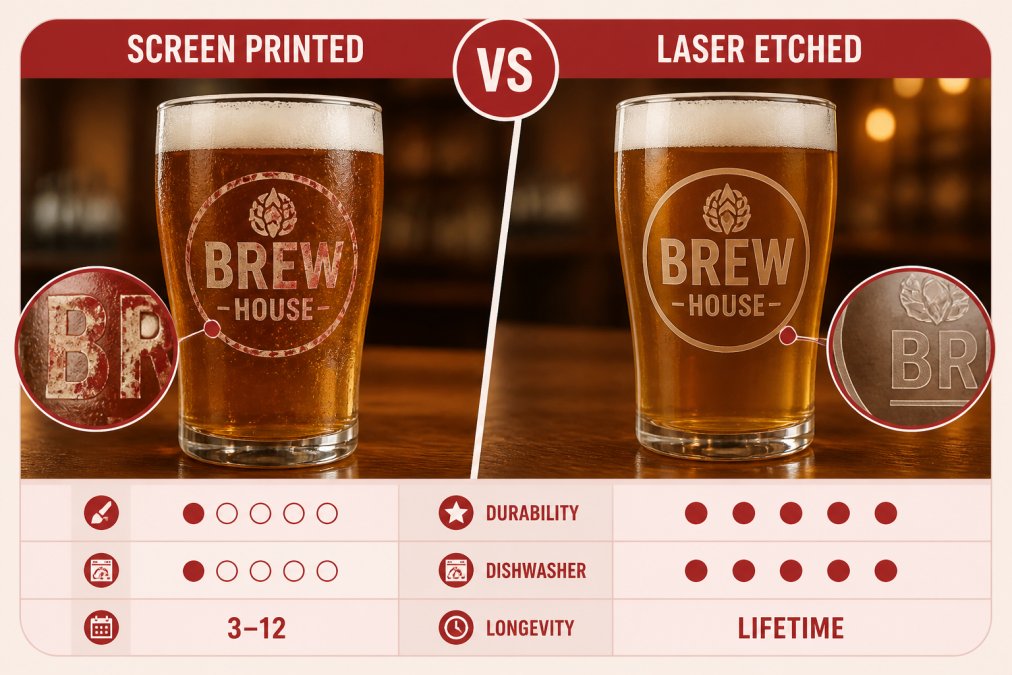
Laser engraving lasts significantly longer than screen printing or vinyl decals because it creates a physical surface change rather than a topical application.
Screen Printing and Vinyl Decals: Surface-Level Branding
Screen printing applies ink through a mesh stencil onto the glass surface, then cures it with UV light or heat. The ink remains a separate material sitting on top of the glass. Vinyl decals are adhesive stickers whose longevity depends entirely on adhesive quality and surface preparation. Both produce sharp results initially, but screen-printed glassware is generally not considered commercial dishwasher safe after extended use. Many manufacturers recommend hand washing only to preserve design integrity. For high-volume venues, this is a significant operational constraint.
Laser Engraving: A Physical Surface Change That Cannot Wash Off
Laser engraving directs a concentrated beam at the glass surface, causing controlled fracturing or frosting of the material itself. There is no ink, adhesive, or coating. The design becomes part of the glass, making it completely immune to the chemical and thermal forces that destroy printed logos. Dishwasher heat cannot dissolve what is not there. Detergent cannot attack a non-existent adhesion layer.
The trade-off is that laser engraving typically produces single-colour, frosted results rather than full-colour artwork. For logos built around shape, line work, and typography, laser engraving delivers genuinely permanent results.
Material-Specific Durability: Does Glass Type Affect Logo Longevity?
The base material affects how well any branding method performs. Borosilicate glass has a lower thermal expansion coefficient than standard soda-lime glass, meaning it expands and contracts less dramatically under heat. Printed logos on borosilicate glass tend to outlast the same decoration on cheaper alternatives.
Crystal glass responds differently to laser engraving than standard glass, producing finer, more detailed frost due to its softer, more uniform composition. Tempered glass presents challenges for laser engraving because the tempering process introduces internal stresses that can interact unpredictably with laser energy.
For promotional drinkware in high-volume commercial settings, borosilicate glass combined with laser engraving represents the most durable outcome available.
Commercial Dishwasher Safe Glassware: What the Label Actually Means
"Dishwasher safe" refers to the glass itself, not the decoration applied to it. A glass can be rated for repeated machine washing without cracking while the printed logo degrades after a fraction of those cycles. The rating speaks to substrate integrity, not decoration longevity. According to Standards Australia information on product labelling and consumer goods, product labelling must accurately represent the properties of the product as sold, but decoration applied after manufacture is generally considered separately.
For imprinted drinkware, the practical question is whether the logo survives, not whether the glass does. Screen-printed and vinyl-decorated pieces will lose their decoration over time in commercial wash conditions. Laser-engraved pieces genuinely are dishwasher safe in the complete sense: both glass and decoration survive repeated machine washing without degradation.
How to Wash Branded Glassware Without Damaging the Logo
The best washing approach depends entirely on the decoration method used. Laser-engraved pieces require no special handling. Printed and vinyl-decorated pieces require care to extend their usable life.
Hand Washing: Best Practice for Printed or Vinyl-Decorated Pieces
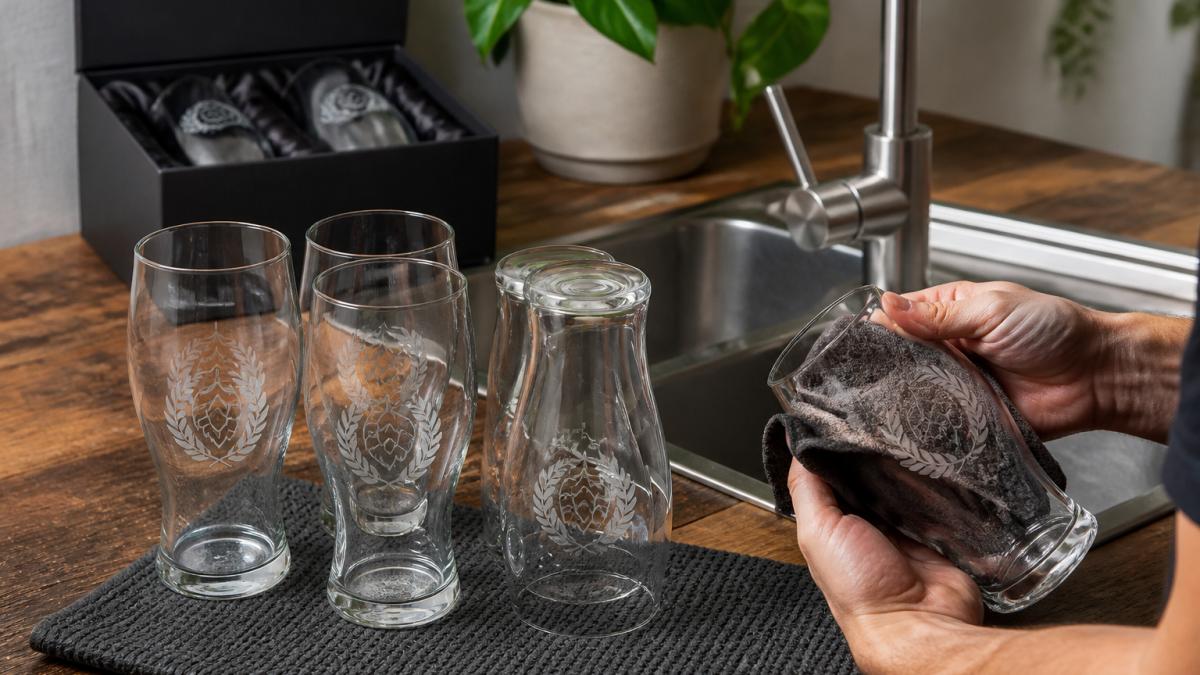
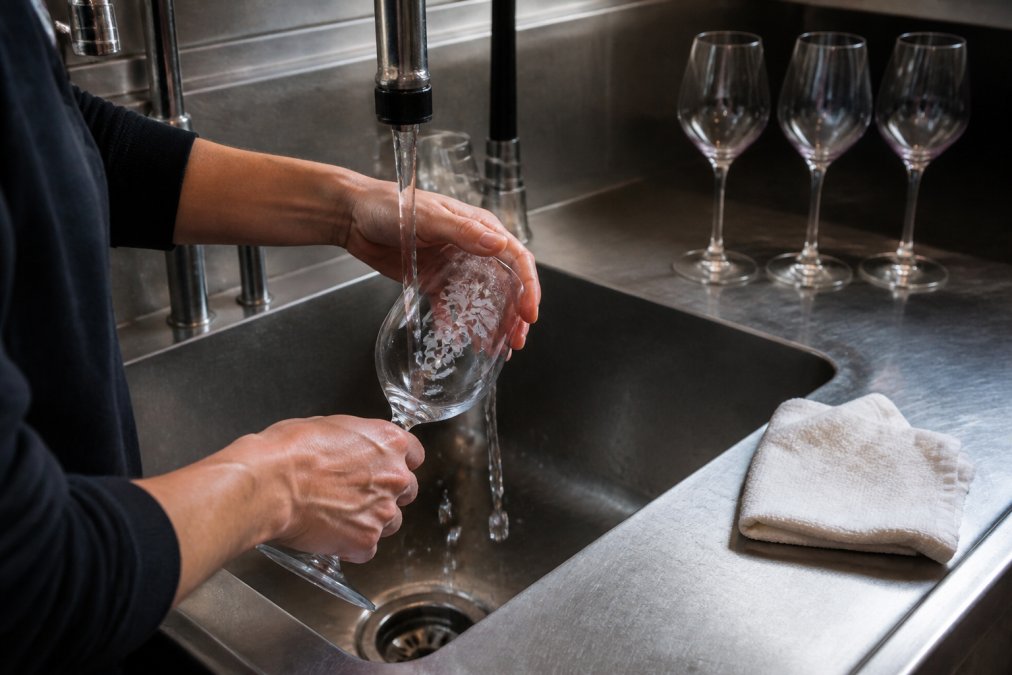
Hand washing is the most effective way to extend the life of screen-printed or vinyl-decorated custom glassware.
Hand washing protocol for decorated glassware:
- Use warm water, not hot. Temperatures above 45°C soften vinyl adhesive and stress ink bonds.
- Choose mild, pH-neutral dish soap. Avoid heavy-duty degreasers or antibacterial formulations.
- Use a soft cloth or non-abrasive sponge. Do not use scouring pads or steel wool.
- Wash the decorated surface gently with light pressure.
- Rinse thoroughly with cool water.
- Air dry or pat dry with a soft cloth.
Machine Washing: Settings That Extend Design Integrity
If machine washing is unavoidable for printed pieces, gentler settings reduce degradation rates. Select the lowest available wash temperature (ideally below 60°C), use the shortest adequate cycle, avoid high-pressure spray settings, use glassware-specific detergent, and load glasses so the decorated surface avoids direct spray arm contact. These adjustments extend the number of wash cycles before visible fading begins.
Can You Restore Faded Logos on Custom Glassware? DIY Options Explained
Restoring a faded printed logo is rarely practical. Once adhesion has broken down, there is no reliable DIY method to re-bond the original decoration.
For vinyl decals that have lifted at edges, careful re-pressing with gentle heat from a hair dryer set to low can temporarily re-adhere sections, but this does not address underlying adhesion failure. For screen-printed logos that have faded but remain structurally intact, food-safe paint pens can touch up specific areas, though results rarely match original quality.
Complete removal of failed vinyl decals is achievable with warm water and gentle peeling. Residual adhesive clears with isopropyl alcohol on a soft cloth. Once removed, the glass can be re-decorated professionally.
Choosing laser engraving from the outset extends functional product life significantly, reducing replacement frequency and associated environmental cost. As noted by Sustainability Victoria guidance on reducing commercial waste, extending product lifespan is one of the most effective strategies for reducing commercial waste output.
Why Branding Quality Reflects on Your Business
A faded logo is not just an aesthetic inconvenience. It signals the standards your business applies to everything it touches.
A winery presenting guests with a glass bearing a cracked or peeling logo undermines premium positioning. A corporate client receiving a promotional gift where artwork has degraded before use will not remember the gesture favourably. Promotional product ROI depends on longevity. A piece of branded glassware that retains design integrity for years generates far more brand exposure per dollar spent than a piece that fades after one season.
The upfront cost of professional laser engraving, compared to cheaper printed alternatives, looks different when calculated across actual usable lifespan. Research from Australasian Promotional Products Association industry guidance indicates that branded merchandise maintaining quality over time consistently outperforms short-lived alternatives in recall and brand association metrics. Glassware that looks sharp after two years is still working for your brand. Glassware with a faded logo works against it.
| Branding Method | Dishwasher Safe | Colour Options | Typical Lifespan in Commercial Use | Best For |
|---|---|---|---|---|
| Laser Engraving | Yes (fully) | Single tone (frosted) | Lifetime of the glass | Commercial venues, permanent branding |
| Screen Printing | No (hand wash only) | Full colour | 6-18 months with care | Short-term promos, low-wash environments |
| Vinyl Decals | No (hand wash only) | Full colour | 3-12 months with care | Events, temporary branding, low volumes |
| High-Temperature Firing | Yes (fully) | Limited colour range | Lifetime of the glass | Long-run corporate gifting |
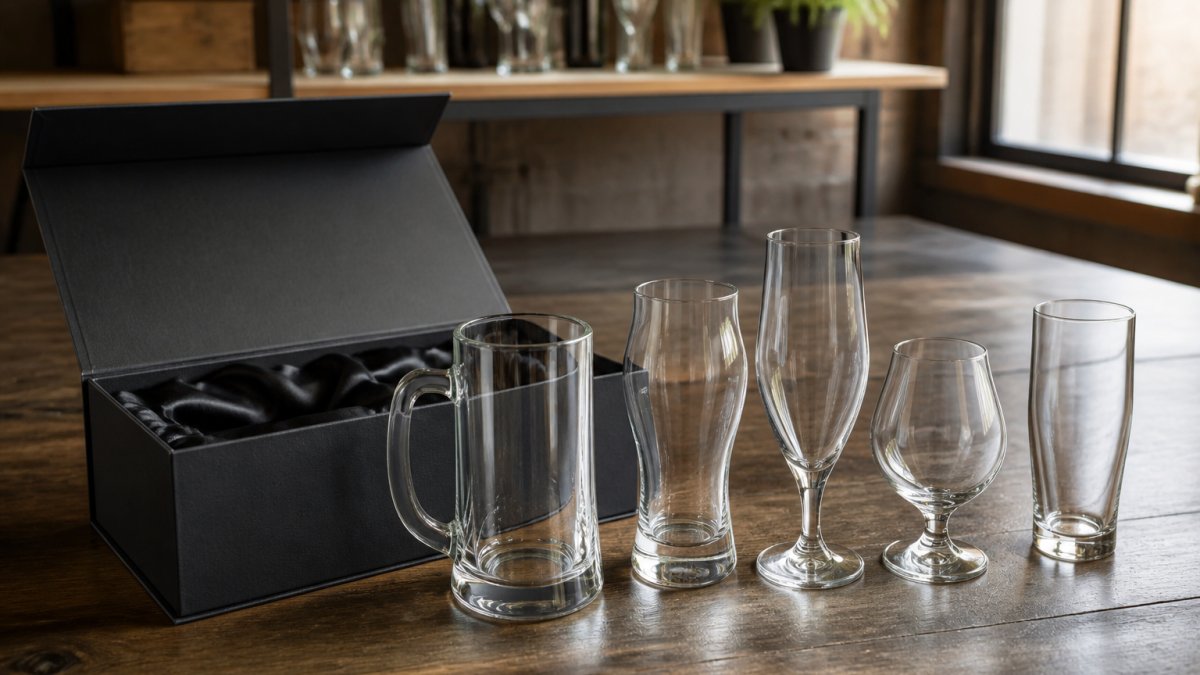
Choosing the right decoration method from the start is the most effective way to protect your brand investment in custom glassware. If your glassware will face commercial dishwasher conditions, hand washing restrictions create real operational problems. The Glassware Company specialises in laser etching and engraving that produces permanent, wash-resistant decoration across a large range of styles, from beer steins to champagne flutes. Request an online quote and let our team help you choose the right method for your specific use case.
Frequently Asked Questions
Does laser etching on glassware wear off over time?
Laser engraving does not wear off because it creates a permanent physical change to the glass surface itself, rather than sitting on top of it as a topical application. The process removes a thin layer of material, leaving a frosted or recessed mark that cannot be stripped by wash cycles, dishwasher detergent, or mechanical wear. Properly engraved custom glassware logos produced by a professional-grade process will maintain their design integrity for the full life of the glass.
Is glass etching considered a permanent branding solution?
Yes. Glass etching and laser engraving are widely regarded as permanent branding solutions because the decoration becomes part of the glass structure rather than a coating applied to it. Unlike screen printing or vinyl decals, which rely on ink adhesion or adhesive bonding to the surface, an etched or engraved mark cannot peel, fade, or wash away. This makes etched custom glassware logos the preferred choice for commercial hospitality, corporate gifting, and promotional drinkware that will see regular use.
Why does dishwasher detergent damage printed glassware logos?
Commercial dishwasher detergents contain alkaline compounds and enzymes designed to break down organic matter and grease. These same chemicals attack the ink or adhesive layer that bonds printed logos and vinyl decals to the glass surface. Combined with high-temperature water cycles, the repeated chemical interaction weakens the bond with every wash, causing decal peeling, colour loss, and gradual fading. Glassware with surface-applied decoration rather than engraved branding is particularly vulnerable to this form of thermal degradation.
Can you repair or restore faded logos on drinking glasses?
Fully restoring a faded printed logo is not straightforward. For vinyl decals, the original decal can sometimes be removed cleanly and replaced, though colour matching across batches can be difficult. Screen-printed logos that have partially worn cannot be touched up reliably without professional equipment. Laser engraving cannot be added over an existing print without first removing it. The most practical solution is to treat faded branded glassware as an opportunity to reorder with a more durable engraved or etched finish from the outset.
This article was written using GrandRanker