 how-to
How to Design Custom Beer Glasses for Branding
Table of Contents
- Why Custom Beer Glasses Work Harder Than Other Merch
- Matching Glass Style and Size to Your Brand
- Beer Glass Logo Design: Getting the Artwork Right
- Choosing Your Customisation Method: Etching vs Screen Printing
- How Custom Engraved Beer Glasses Are Made
- Ordering Branded Pint Glasses: Quantities, Proofing, and Turnaround
- Custom Glassware Gift Boxes: Presentation That Matches the Glass
- Caring for Your Branded Glassware
- Frequently Asked Questions
Last Updated: October 6, 2026
Why Custom Beer Glasses Work Harder Than Other Merch
Custom beer glasses are branded drinkware etched or printed with your logo, message, or artwork for breweries, venues, and events.
That repeat use is the point: a glass sits on the table, gets photographed, and goes home with the guest.
Below, we'll walk through glass style, logo artwork, decoration methods, proofing, quantities, and care, in the order you'll make each decision.
Matching Glass Style and Size to Your Brand
The right glass style depends on what you serve and how. A taproom pouring pale ales needs a different vessel from a corporate client sending a gift pack.
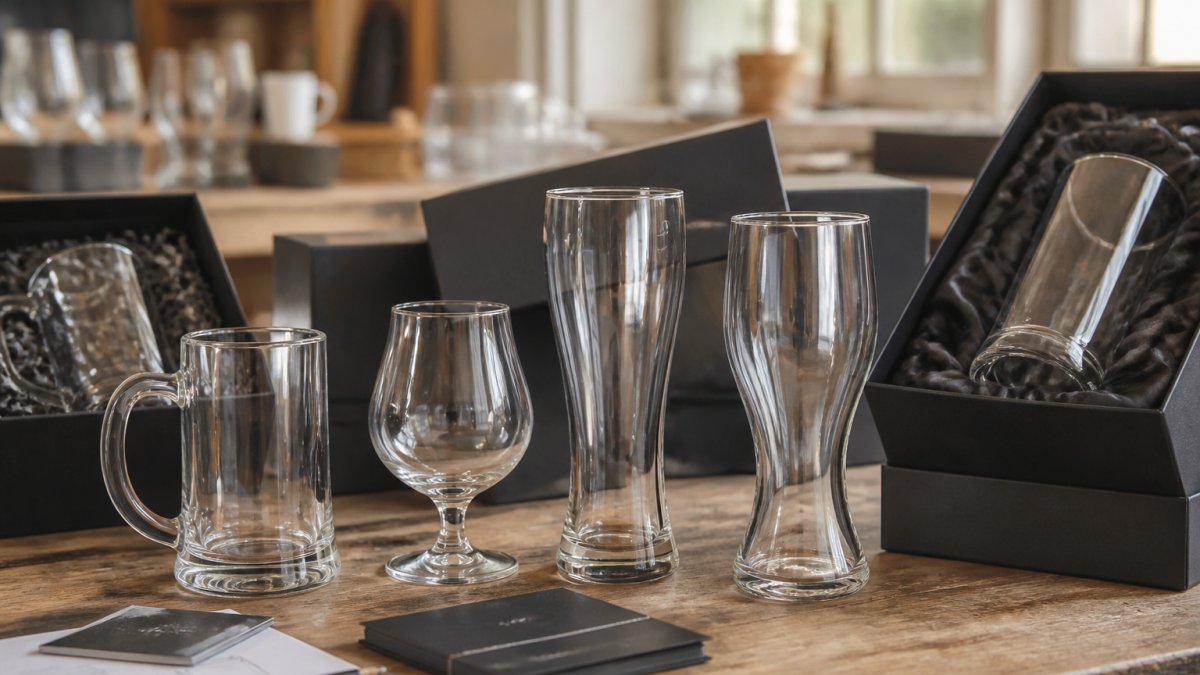
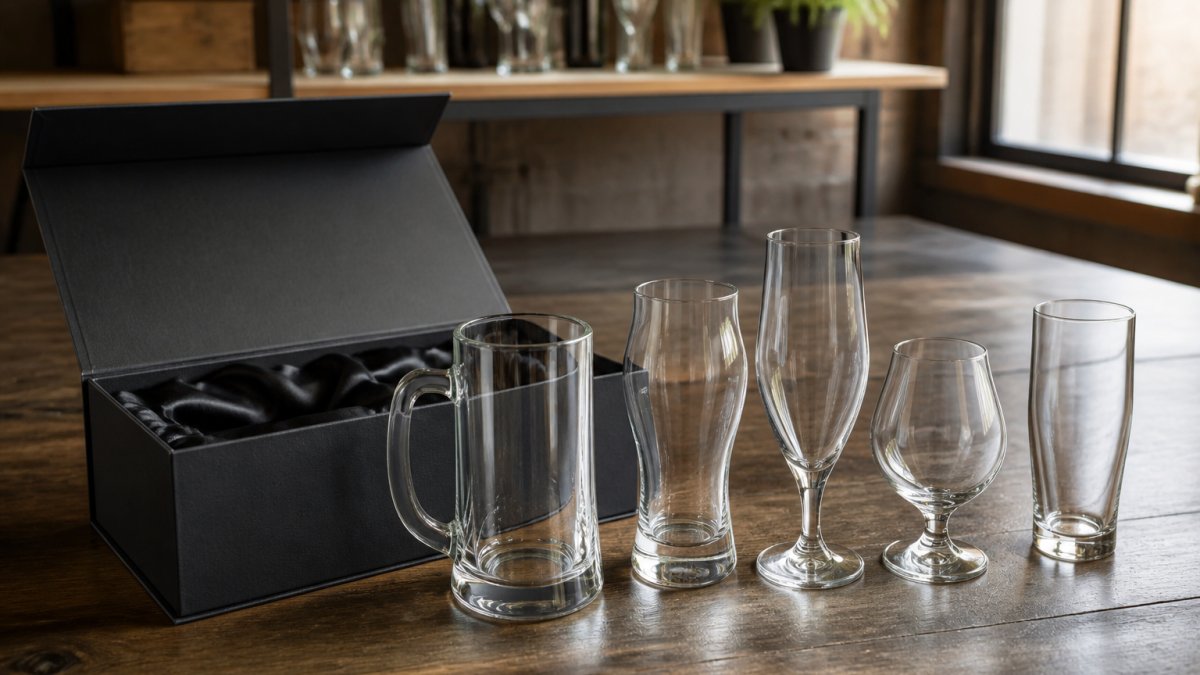
Pint glasses, mugs, and steins: what suits your venue
Pint glasses are the workhorse: they suit busy taprooms, high-volume service, and standing events, and they stack well in storage.
Beer mugs and steins carry more presence. A heavy mug with a sturdy base feels like a gift, not a giveaway.
Tasting glassware in smaller sizes works for paddles, flights, and sampler sets. Breweries use these constantly for guided tastings.
Match the glass to the moment:
- High-volume taproom service: pint glasses
- Retail merchandise and gifts: mugs and steins
- Tastings and flights: small tasting glasses
- Corporate gifting: a mixed set in a gift box
Handle or no handle: practical considerations
Handles look traditional and feel substantial, but they change how a glass stacks and ships. Handleless glasses nest better and take up less shelf space. If storage is tight, go handleless.
A handle also gives you a second surface for your logo, but it's a curved, awkward one. Keep the main logo on the body and treat the handle as optional real estate.
Beer Glass Logo Design: Getting the Artwork Right
Your beer glass logo design lives or dies on the artwork file: a low-resolution image pulled from a website looks soft on glass, while vector artwork stays crisp.
File formats and resolution for print-ready artwork
Vector files are the gold standard. They scale to any size without losing sharpness.
- Best: AI, EPS, or PDF vector files
- Acceptable: high-resolution PNG or TIFF at 300dpi or above
- Avoid: screenshots, social media images, and anything under 300dpi
If you only have a low-resolution logo, a redraw is usually the fix. It costs a little time upfront and saves a reprint later.
Positioning and sizing your design on the glass surface
Give your design room to breathe. A logo crammed against the rim looks like an afterthought.
A few practical rules to consider:
- Leave a clear margin between the design and the rim or base
- Keep the design sized so it reads from across a table
- Centre it on the flattest part of the glass surface
- Check how it looks wrapped around a curved surface, not just flat
Choosing Your Customisation Method: Etching vs Screen Printing
Etching and screen printing are common ways to brand glassware, and they produce very different results. Etching cuts or bonds a permanent mark into the glass surface; screen printing lays ink on top of it. The question is which fits your brand, budget, and how the glass will be used.
How the methods compare in practice
| Factor | Etching / engraving | Screen printing |
|---|---|---|
| Appearance | Frosted, tonal, subtle; reads best in one colour | Bold, opaque, high contrast; supports multiple colours |
| Durability | Permanent surface change; survives repeated commercial washing | Ink sits on the surface; can fade, crack, or lift with harsh washing |
| Colour range | Effectively one tone (the frosted mark) | Wide, though each colour adds a screen and cost |
| Detail | Fine linework and small type hold well | Very fine detail can fill in; better for solid shapes and larger type |
| Setup | Digital stencil or mask; low setup for small runs | A screen per colour; setup amortised across volume |
| Best run size | Small to medium, including one-offs and gift sets | Medium to large volume runs |
| Ideal use | Logos, gifts, premium runs, venue glassware | Multi-colour designs, promotional volume, event giveaways |
A simple decision framework
Work through these questions in order:
- How many colours is your logo? One colour or a single-tone mark suits etching.
- How will the glass be washed? Commercial dishwashers, day after day, favour etching.
- How many units do you need? Small runs and one-offs are often more economical etched.
- What impression are you after? Etching reads as premium and permanent.
- Will you reorder? Etched artwork reproduces consistently because the mark is cut, not printed.
Combining both methods
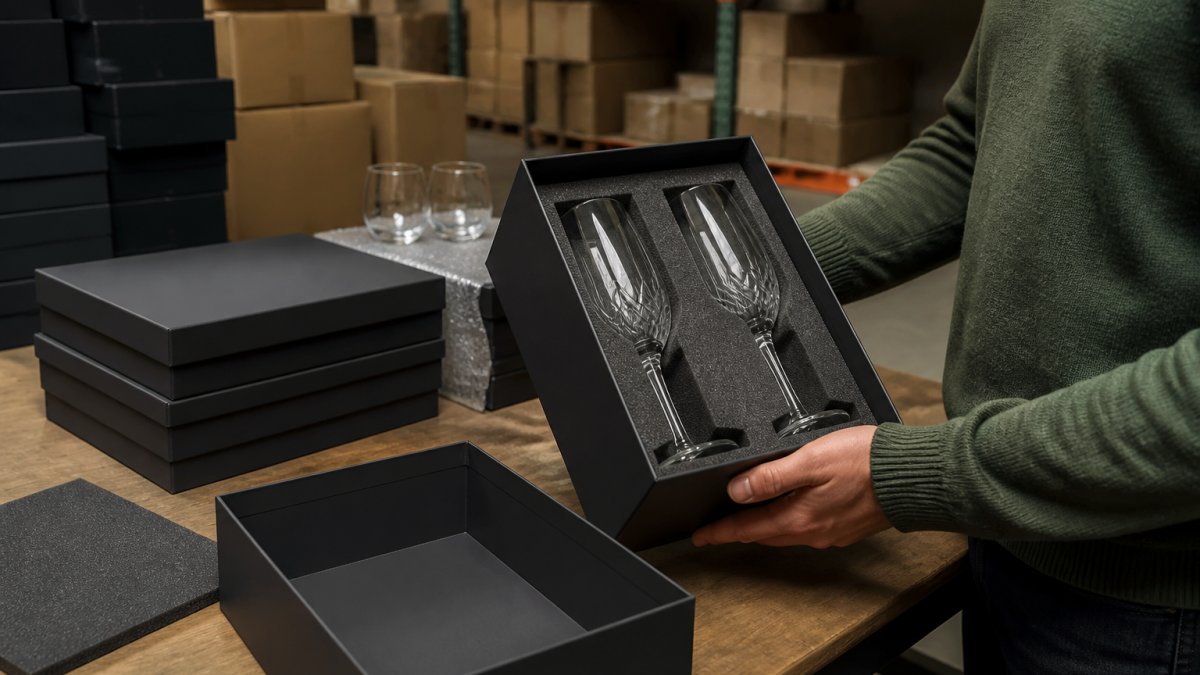
If you are presenting etched glassware as a gift, our custom manufactured gift boxing service is designed for exactly that pairing: etched and branded glassware in a box built around your brand, with an approximate 28 working day turnaround.
How Custom Engraved Beer Glasses Are Made
Custom engraved beer glasses are made by masking the glass, applying your design as a stencil, then etching the exposed surface so the mark becomes permanent.
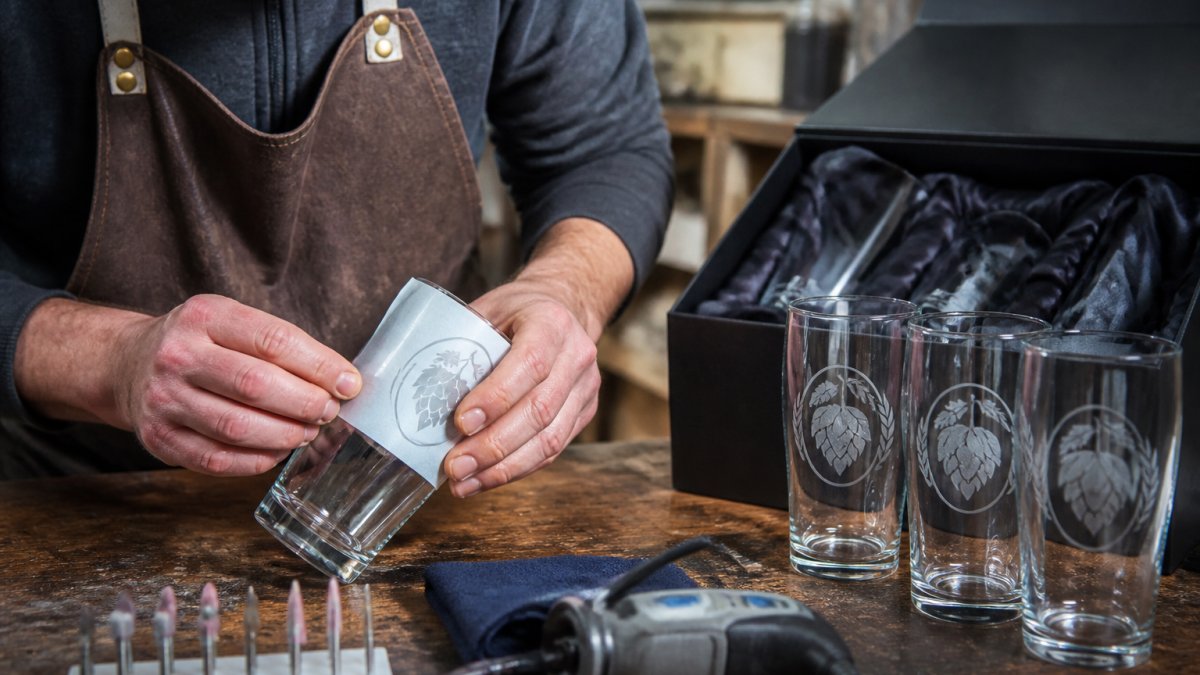
Here's the process, start to finish:
- Clean the glass surface thoroughly so the mask bonds properly
- Apply masking or contact paper across the area to be decorated
- Cut your design into a stencil and press it onto the glass
- Apply etching paste to the exposed glass and let it work
- Remove the mask and clean the glass
- Inspect the finished piece before it goes into the run
The stencil stage is where most DIY attempts go wrong: a stencil that lifts at the edges lets etching paste bleed and blurs the logo.
Ordering Branded Pint Glasses: Quantities, Proofing, and Turnaround
Branded pint glasses usually run on a minimum order quantity, and pricing scales with volume. Exact minimums vary by style, decoration method, and artwork complexity, so confirm early. What most guides skip is the practical detail: what makes a file print-ready, what a proof should show, and where the cost sits.
Artwork specifications that avoid production delays
Before anything is quoted, your artwork needs to be production-ready. The checklist most suppliers work to:
- Format: vector files (AI, EPS, PDF) are preferred because they scale without losing sharpness. High-resolution PNG or TIFF at 300dpi or above is acceptable for simpler marks.
- Resolution: anything under 300dpi will look soft on glass. Screenshots and social media images are almost always too low.
- Colour: for screen printing, supply spot colour references (Pantone is the common standard) rather than RGB values. For etching, supply a single-tone version of the mark.
- Line weight: very fine lines can fill in on print or disappear on etch. A minimum line weight of around 0.5pt is a safe floor; thicker is safer on curved surfaces.
- Safe area: keep the design clear of the rim and base by a comfortable margin so it does not look cramped or get worn by handling.
- Text: convert type to outlines so fonts do not substitute on the production file.
If you only have a low-resolution logo, a redraw is usually the fix. It costs a little time upfront and saves a reprint later.
What a proof should show you
Proofing protects you. Before production, approve a digital proof showing exactly how your artwork sits on the glass. Ask these questions before you sign off:
- Does the proof show the design on the actual glass shape, not a flat rectangle?
- Is the sizing right for the intended viewing distance?
- Is the safe area respected on the curved surface?
- Will the same artwork reproduce consistently on a reorder?
For larger runs, request a physical sample or pre-production proof to check alignment, colour, and finish in the hand rather than on a screen. Approve a digital proof first, then sign off a physical sample before the full run begins.
Where the cost sits
Custom glassware pricing is built from a few components, and understanding them helps you compare quotes like for like:
- Setup: stencils or digital prep charged once per design, amortised across the run, so it weighs more heavily on small orders.
- Per-unit decoration: the cost of etching each glass, which falls as quantity rises.
- Glassware base cost: varies by style, size, and whether the glass is stocked or sourced.
- Freight and packaging: glass is heavy and fragile, so shipping and protective packaging are real line items. Custom gift boxing adds a packaging component but also lifts the perceived value of the set.
- Reorders: usually cheaper than first orders because setup is already done, provided the artwork is unchanged.
Quantities and turnaround
Minimum order quantities vary by style and method. If you are ordering for a fixed event date, confirm lead times before you commit, and flag rush needs early.
Turnaround depends on quantity, decoration method, and current production load. For gift-boxed etched glassware, our custom manufactured gift boxing service runs on an approximate 28 working day turnaround, so build that into your event planning rather than assuming a standard lead time.
Custom Glassware Gift Boxes: Presentation That Matches the Glass
A branded glass deserves packaging that matches it.
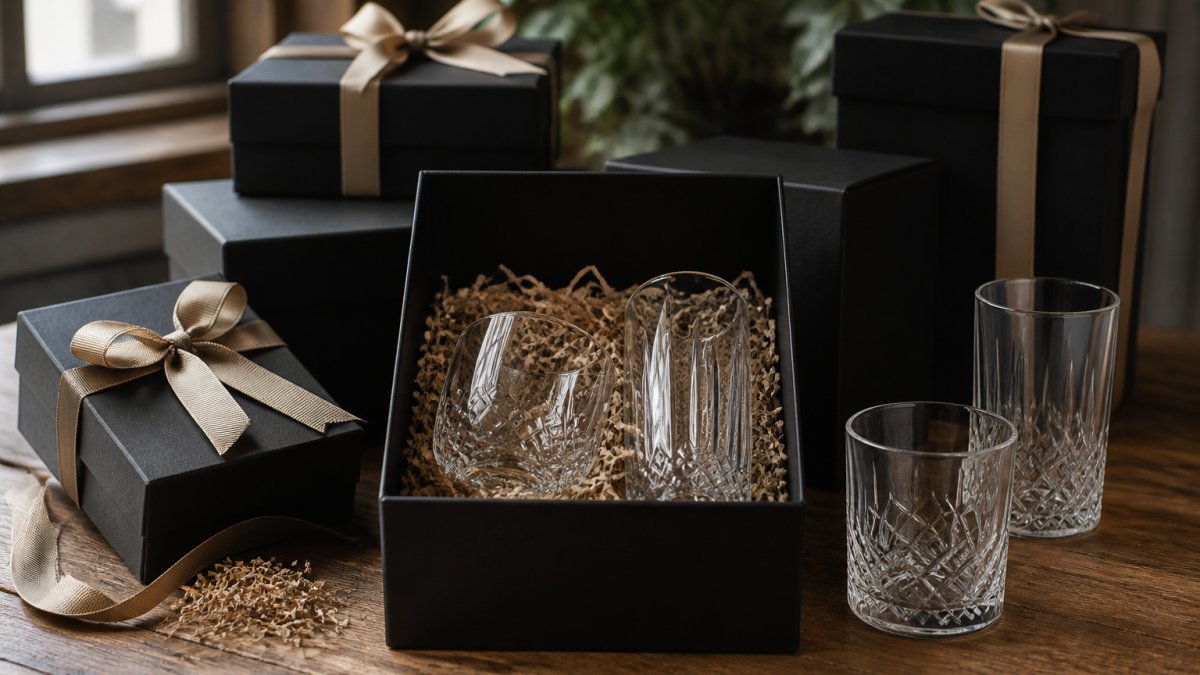
A gift set is judged before the glass is lifted out, and a plain cardboard carton undercuts a beautifully etched mug.
Gift boxes suit client appreciation packs, wedding favours, conference giveaways, and retail merchandise. Pair them with a custom message on the glass itself, and the set feels considered rather than assembled.
Caring for Your Branded Glassware
Properly etched glassware handles normal washing well, but a few habits keep it looking sharp for years.
Keep your branded glassware in good shape:
- Wash by hand where you can,
- Use a gentle cycle and avoid harsh abrasives on the decorated area
- Skip scouring pads, which dull the glass surface
- Store glasses so they don't knock against each other
- Check a sample from each batch if you wash commercially
At The Glassware Company, we handle the whole process, from artwork checks and etching through to custom gift boxing for a polished final presentation.
Get started with The Glassware Company and request an online quote for your next run of custom beer glasses.
Frequently Asked Questions
What artwork works best on a custom beer glass?
Simple, high-contrast designs work best. Logos with clear lines and minimal fine detail reproduce well on curved glass surfaces. Avoid gradients, tiny text, and complex illustrations that lose definition when scaled down. Supply vector files (AI, EPS, or PDF) where possible, or high-resolution PNGs at 300 DPI minimum. If your logo has thin strokes, consider a simplified version for glassware.
How do I choose between etched and printed beer glasses?
Etching creates a permanent, frosty white mark that never fades, even in commercial dishwashers. It suits premium branding and giftware. Consider your budget, design complexity, and how often the glasses will be washed before deciding.
Can you buy branded beer glasses in small quantities?
Minimum order quantities vary. If you need a limited batch for a tasting event or small team, ask about short-run options. Ordering slightly more than needed also covers breakages and gives you spares for future events.
How should I prepare a logo for glass engraving?
Convert text to outlines, remove backgrounds, and supply a single-colour or simplified version of your logo. Vector files are ideal. If your logo includes fine details, create a version with thicker lines. Check that the design reads clearly when scaled to roughly 4 to 6 centimetres wide, which is typical for glassware. Your supplier can provide a proof before production.