 how-to
Custom Gift Boxing for Etched Glassware: 2026 Guide
Table of Contents
- Why Custom Gift Boxing Changes How Etched Glassware Lands
- Box Materials Compared: Rigid Board, Solid Pine and Plywood
- Branded Glassware Packaging: Logo Placement and Artwork Upload
- Bespoke Gift Box Manufacturing: What the Process Looks Like
- DIY Protective Packaging Techniques for Etched Glassware
- Corporate Gift Presentation Ideas That Get Reused
- Sustainability, Care and Keeping Etched Glassware Gift-Ready
- Conclusion: Getting Custom Gift Boxing Right
- Frequently Asked Questions
Last Updated: October 3, 2026
Why Custom Gift Boxing Changes How Etched Glassware Lands
Custom gift boxing for etched glassware means presenting laser-etched or engraved drinkware inside a purpose-built presentation box rather than a standard carton.
Etched glassware is a fragile, personal purchase, and a corporate client receiving a branded decanter set forms an impression in the first ten seconds.
Below, we break down box materials, branding options, manufacturing timelines and DIY techniques worth knowing.
Box Materials Compared: Rigid Board, Solid Pine and Plywood
This section compares how rigid board, solid pine and plywood actually behave when holding etched glassware, so you can match the material to the glass rather than defaulting to whatever the supplier stocks.
Rigid Board: The Volume Workhorse
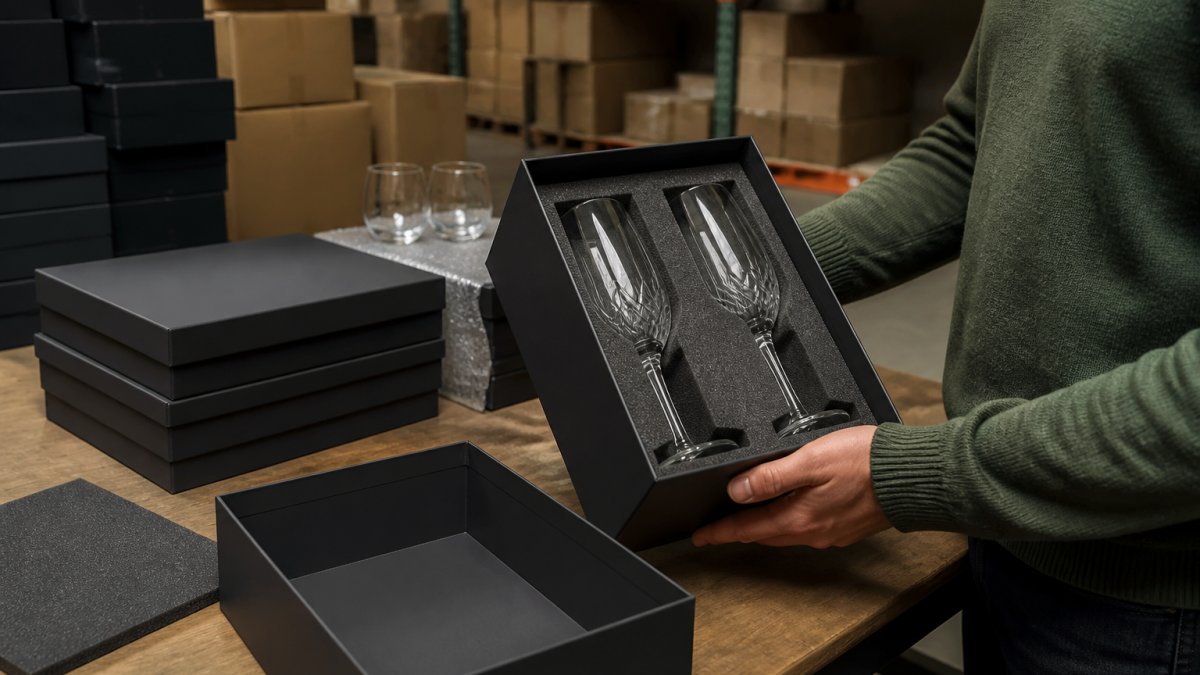
Rigid board is a thick, laminated greyboard wrapped in printed paper or specialty stock. It keeps its structure when opened and is the most common choice for corporate gifting runs because it takes print, foil stamping and embossing cleanly.
- Durability: good for single glasses and light sets; it protects against scuffs and minor knocks but not heavy impact
- Weight: light, which keeps freight costs down on large orders
- Aesthetic: fully customisable via print, so it can carry a brand pattern or a plain matte finish
The foam insert does the protective work here, not the board. A rigid box with a poorly cut insert offers less protection than a cheaper box with a well-fitted one.
Solid Pine: The Keepsake Option
Solid pine lids turn a gift box into a piece of furniture. The grain is warmer and more traditional than plywood, and it takes laser-etched branding with good contrast.
- Durability: high structural rigidity; supports heavier decanter sets without flexing
- Weight: noticeably heavier than board, which affects freight on bulk orders
- Aesthetic: premium, tactile, ages visibly over time
The trade-off is cost and weight, and on a single etched wine glass pine adds protection the glass does not need.
Plywood: The Stable Middle Ground
Plywood is an engineered timber made from layered veneers. It is lighter and more dimensionally stable than solid pine, resisting warping and swelling in humid conditions, and cheaper to produce at volume.
- Durability: good; less prone to cracking than solid timber
- Weight: lighter than pine, heavier than board
- Aesthetic: clean, modern, uniform grain; takes laser etching well
How to Choose
A simple rule: match the material to the glass and the occasion.
| Material | Protection Level | Weight | Relative Cost | Best Glassware |
|---|---|---|---|---|
| Rigid board + foam | Medium | Light | Lowest | Single glasses, flutes, volume runs |
| Plywood lid | Medium-high | Medium | Mid | Matched sets, corporate orders |
| Solid pine lid | High | Heavy | Highest | Decanter sets, premium gifts |
For clients who want the box and the glassware handled as one job, our custom manufactured gift boxing service for etched and branded glassware covers material selection, insert cutting and assembly on approximately a 28 working day turnaround.
Timber Options: Solid Pine and Plywood Lids
Solid pine and plywood lids turn a gift box into a keepsake box. Solid pine gives a warmer, more traditional grain and takes laser-etched branding well; plywood is lighter, more dimensionally stable and cheaper at volume. Neither suits every glass: a heavy decanter set benefits from a timber lid for structural support, while a single etched wine glass is often better served by rigid board with a foam insert, because timber adds weight and cost without adding protection.
Branded Glassware Packaging: Logo Placement and Artwork Upload
Branded glassware packaging works best when logo placement is decided before the box is manufactured. The box, the foam and the glass are one system.
For logo placement, options include:
- Lid top: the most visible spot, best for corporate gifting where the box sits on a desk
- Lid interior: a subtler placement that surprises the recipient on opening
- Side panel or spine: useful for retail shelf display or tasting room counters
Artwork upload should happen early. A vector file gives the cleanest result for laser etching and printing on rigid board; a low-resolution logo will suffer in etching depth and edge quality, so ask for a proof before production.
Bespoke Gift Box Manufacturing: What the Process Looks Like
Bespoke gift box manufacturing follows a predictable sequence, which helps you plan around event dates.
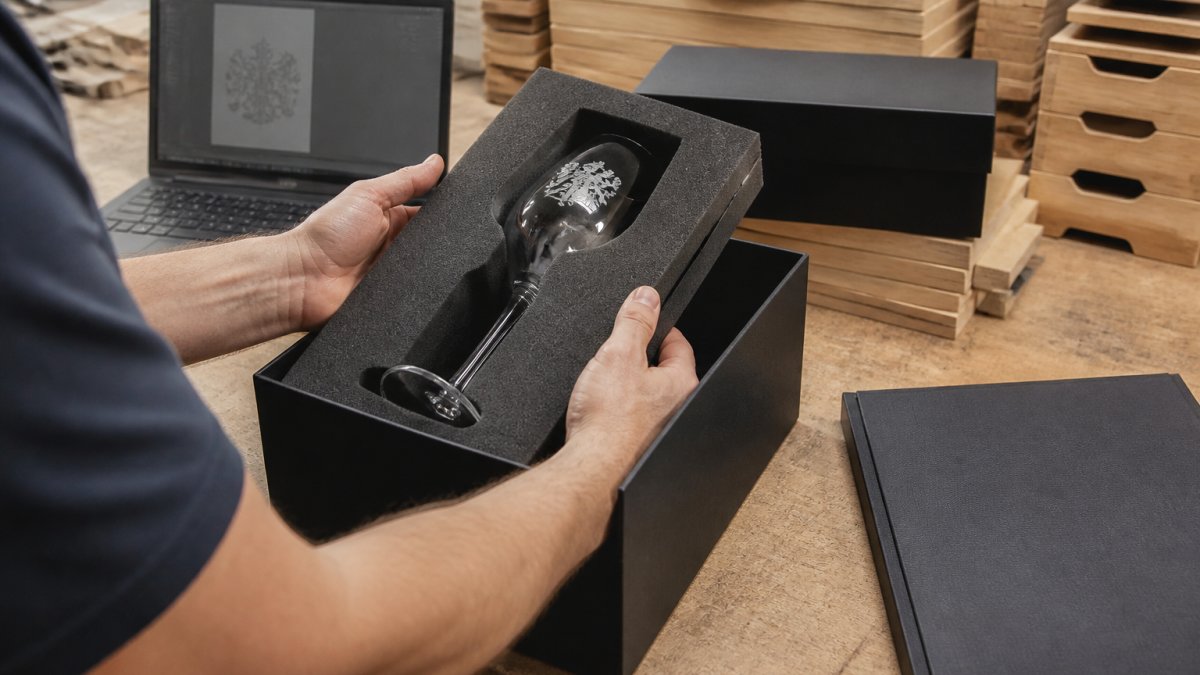
Most projects move through these stages:
- Brief and quote: you share glassware type, quantity, deadline and branding
- Artwork upload and proofing: our team prepares a proof for your approval
- Material selection: rigid board, solid pine or plywood lid, plus foam specification
- Production: glasses are etched or engraved, boxes are manufactured and inserts cut
- Assembly and dispatch: glassware is fitted into the box and packed for delivery
Our custom manufactured gift boxing service for etched and branded glassware runs on approximately a 28 working day turnaround, assuming artwork is approved promptly. If your event is closer, talk to us about a rush order early.
DIY Protective Packaging Techniques for Etched Glassware
If you are packing etched glassware in-house for a small run or tight deadline, these techniques prevent breakage and scuffing. The principle behind all of them: stop the glass moving, and stop hard surfaces touching it.
The Double-Box Method
The most effective DIY technique is double-boxing: place the glass in a padded inner carton, then suspend that carton inside a larger outer box with cushioning on all six sides.
- Inner carton: sized so the glass has roughly 25-50mm of padding on every side
- Outer box: at least 75mm larger than the inner carton on each dimension
- Suspension: the inner carton should not touch the outer box walls; fill the gap with crumpled paper, foam peanuts or air pillows
The inner carton absorbs the first impact, the suspension absorbs the second. A single box, however well padded, transfers impact straight to the glass.
Corner and Edge Protection
Corners take the hardest hits in transit. Foam corner guards absorb impact better than flat padding because they deform progressively rather than transferring force directly.
- Use pre-formed foam corners on all eight corners of the inner carton
- For stemware, add a foam collar around the bowl and a foam block under the base
- Never rely on bubble wrap alone at corners; it compresses flat under load
Wrapping Etched Surfaces
Etched glass scuffs more easily than smooth glass because the etched surface is slightly raised and matte, and abrasion against paper or other glass dulls it over time.
- Wrap each glass individually in acid-free tissue paper; acid in standard tissue can discolour the etching over years of storage
- Avoid newspaper, which transfers ink and is abrasive
- Do not let two etched glasses touch, even briefly; the contact points scuff
Vertical Packing for Stemware
Stemware should be packed upright, never on its side. The stem is the weakest point and bears no lateral load when vertical; laying a wine glass flat puts the full weight of the bowl on the stem, and a single jolt can snap it.
- Pack stemware upright in individual cells or with foam dividers
- If upright packing is not possible, remove the stem load by supporting the bowl and base separately
Filling the Void
Any empty space lets the glass move, and movement is what breaks glass. Fill every gap.
- Crumpled kraft paper is cheap and effective for large voids
- Foam peanuts work well but shift over time; combine with paper for stability
- Air pillows are light but puncture easily; use them for outer voids, not around the glass itself
When DIY Stops Working
DIY packing is viable for small runs, one-off gifts and tight deadlines. It stops being viable when consistency matters. Across a large corporate order, hand-packed boxes vary in presentation quality, and inconsistent presentation undermines the gift more than a plain box would.
That is when a manufactured box earns its cost. Our custom manufactured gift boxing service for etched and branded glassware produces identical foam inserts and box finishes across a run, on approximately a 28 working day turnaround, so every recipient opens the same experience.
Corporate Gift Presentation Ideas That Get Reused
Corporate gift presentation ideas live or die on one question: will the recipient keep the box? A keepsake box gets reused, extending your brand's visibility.
Ideas that tend to work:
- Timber-lidded keepsake box: recipients reuse it for jewellery, pens or barware
- Matched set: pair a decanter set with whiskey stones in a single rigid gift box
- Occasion labelling: a birth year or anniversary date laser etched into the lid
| Box Option | Best For | Branding Method | Reuse Potential |
|---|---|---|---|
| Rigid board with foam insert | Single glasses, volume runs | Print, foil stamp | Medium |
| Solid pine lid | Decanter sets, premium gifts | Laser etching | High |
| Plywood lid | Larger corporate orders | Laser etching | High |
| DIY double-box | Small runs, tight deadlines | Label or sticker | Low |
Sustainability, Care and Keeping Etched Glassware Gift-Ready
Sustainability and care both come down to material choices and handling. A reusable keepsake box avoids the single-use packaging problem entirely.
For the glassware itself, the care routine protects the etching:
- Hand wash where possible, using warm water and a mild detergent
- Avoid abrasive sponges, which dull the etched surface over time
- Position glasses so they do not knock against each other in the dishwasher
Glassware durability depends heavily on how it is washed and stored: a quality etching holds up under normal use.
Conclusion: Getting Custom Gift Boxing Right
The gap between a forgettable gift and a memorable one is usually the box, not the glass.
At The Glassware Company, we handle etching, engraving and presentation as one job, from beer steins, wine glasses and champagne flutes through to the finished box.
Request an online quote and we will walk you through materials, branding and timelines for your next run.
Frequently Asked Questions
What materials are best for protecting etched glassware in transit?
Rigid board with a custom-cut foam insert is a reliable base for shipping etched glassware, because the foam holds each piece in a fixed position and stops glass-on-glass contact. Solid pine adds crush resistance for heavy decanter sets, while plywood lids can keep weight down for larger runs.
How long does bespoke gift box manufacturing take for glassware?
Turnaround depends on box complexity, artwork approval and quantity. As a guide, The Glassware Company's custom manufactured gift boxing service for etched and branded glassware runs at approximately 28 working days from artwork sign-off to dispatch. That covers foam cutting, box assembly and any logo printing or etching on the box itself. If your event is inside that window, ask about rush options before you commit to a design, because foam tooling and timber work cannot be compressed indefinitely.
Can custom gift boxes be branded with a company logo?
Yes. Logos can be printed, foil-stamped or laser-etched onto rigid boxes, timber lids and inserts, and the same artwork can carry across to the glassware itself. Send vector files (AI, EPS or PDF) at the correct size, and ask for a physical or digital proof before production. If you reorder the same design each quarter, keep your approved artwork file on record so colours and engraving depth stay consistent batch to batch. The Glassware Company can quote branding on both the glass and the box in one request.
How do I keep etched glassware looking good after the gift is opened?
Laser-etched glassware is durable, but a few habits protect the finish. Wash by hand where possible, or use a commercial dishwasher cycle with a mild detergent and no abrasive powders. Avoid stacking glasses directly against each other, and dry with a soft cloth rather than a scourer. If the glassware lives in its keepsake box between uses, line the cutout with the original foam insert. These steps keep the etching crisp and the glass clear for years of reuse.