 how-to
Choose the Right Engraving Style for Corporate Logos
Table of Contents
- Understanding Engraving Styles for Corporate Logos
- Laser Etching vs Sandblasting for Glassware
- Best Practices for Corporate Logo Engraving
- Material Compatibility and Durability
- Engraved Corporate Gift Presentation Ideas
- Choosing the Right Branding Method for Your Merchandise
- Common Mistakes to Avoid When Engraving Corporate Logos
- Frequently Asked Questions
Last Updated: September 23, 2026
Understanding Engraving Styles for Corporate Logos
Choosing the right engraving style corporate logos directly affects how your brand appears, its durability, and how recipients perceive the gift's quality. The wrong choice can undermine even excellent glassware.
Not all engraving methods are equal. Your choice depends on your logo's complexity, budget, timeline, and how the glassware will be used.
Laser Etching vs Sandblasting for Glassware
The two dominant engraving techniques are laser etching and sandblasting. Understanding each is essential before committing to a design.
Laser Etching: Precision and Detail
Laser etching uses a focused beam to vaporise a thin glass layer, creating a frosted mark at 0.1-0.3mm depth.
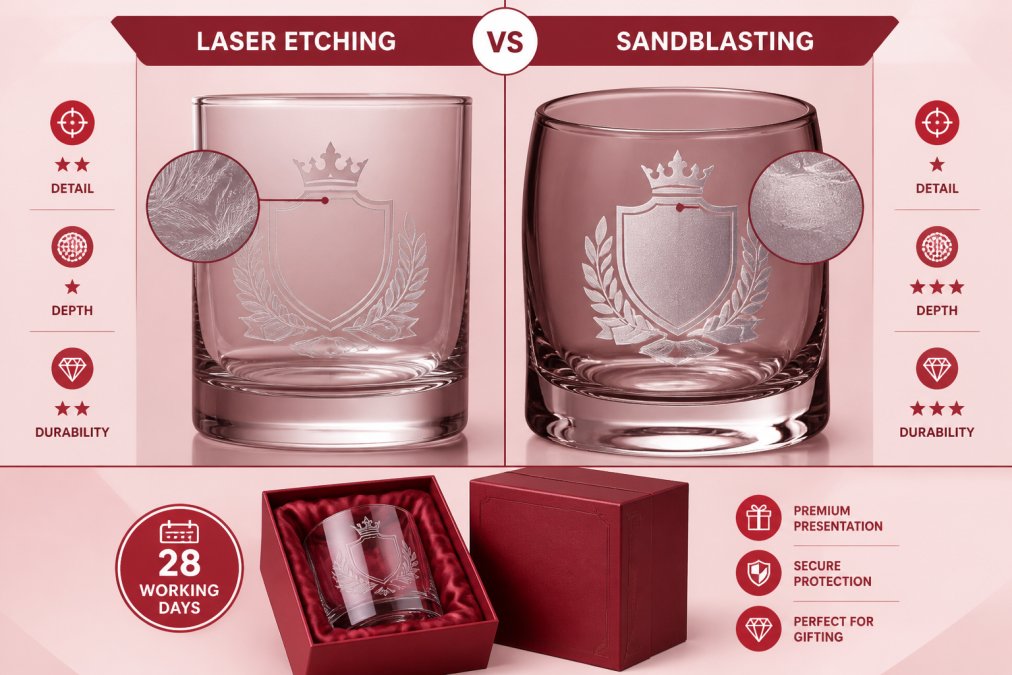
Laser etching excels at fine detail, small text, and complex logos. It's fast with no setup time between items, making small orders cost-effective.
The trade-off is visual contrast. Laser marks appear subtle and may feel too delicate for logos requiring bold impact.
Durability is excellent. The mark is permanent because it is part of the glass itself. It will not fade, peel, or wear away, even under repeated commercial dishwashing.
Sandblasting: Depth and Contrast
Sandblasting forces sand particles at high pressure, creating a frosted finish at 0.5-1.5mm depth with pronounced visual effect.
Sandblasted designs have dramatic contrast and tactile quality, you can feel the engraved area. This creates a premium impression many corporate clients prefer.
The downside is detail limitation. Fine lines and small text blur; logos must be simplified. Many approve artwork on screen only to find the sandblasted version loses critical detail.
Sandblasting requires setup time and masking per design, adding fixed costs that impact small orders.
Durability matches laser etching. The frosted finish is permanent and will not fade or wear.
Best Practices for Corporate Logo Engraving
Success depends on understanding what your design can and cannot do. The most common mistake is underestimating simplification needs.
Logo Simplification and Resolution Requirements
Your logo will not look on glass as it does on screen.
Logos designed for print or digital use contain fine details and colour gradations that engraving cannot reproduce. Complex logos lose detail or become illegible.
Simplify by working with your designer to create an engraving-specific version: remove unnecessary detail, thicken lines, increase spacing. Create a bold, graphic version.
Laser etching retains more detail than sandblasting, but simplification improves reliability and sharpness across lighting conditions.
Use vector files (AI, EPS, PDF), they're scalable and precise. Raster images (JPG, PNG) lose quality when enlarged and must be redrawn as vector.
Text Readability and Font Selection
Text must be larger and bolder than expected. Small, delicate fonts will not engrave clearly.
For laser etching, text should be at least 3mm tall; for sandblasting, aim for 5mm or larger.
Sans-serif fonts work best; serif fonts blur or fill in. Choose fonts with consistent stroke weight and good spacing.
Request a sample piece before production to verify text readability. Working with an experienced engraving partner is essential.
Material Compatibility and Durability
Material choice signals your brand's values. Glass type, thickness, surface finish, and sourcing affect both technical outcome and strategic message.
Glass Type and Visual Contrast
Clear glass engraves beautifully with sharp contrast. Coloured glass works but visual impact depends on colour and method.
Dark glass (cobalt blue, forest green, amber) provides strong contrast with both methods. Light colours offer less contrast and may look washed out with laser etching; sandblasting is stronger for light glass due to deeper texture.
Textured or frosted glass can make engraved designs less distinct. Smooth, polished glass is ideal for maximum contrast.
Thickness, Durability, and Structural Integrity
Thickness matters for sandblasting. Very thin glass (under 2mm) risks micro-fractures; laser etching works safely on any thickness.
Aim for at least 3mm thickness for durability and premium feel. Thicker glass (4-5mm) suits high-value gifts or heavy commercial use.
Engraved glassware withstands commercial dishwashing and thermal shock indefinitely. The engraving is permanent because it's part of the glass structure, making it an effective corporate gift that lasts as long as the brand relationship.
Sustainability and Environmental Considerations
Glass is inherently sustainable: 100% recyclable, infinitely reusable, and non-toxic. Unlike printed merchandise that degrades, engraved glassware has a long lifespan, reducing waste.
Engraving is low-impact. Laser etching uses focused energy with minimal waste; sandblasting dust is captured responsibly. Neither uses chemical solvents or inks.
Engraved Corporate Gift Presentation Ideas
Presentation matters as much as engraving. Packaging and context shape the recipient's perception of value and lasting impression.
The Psychology of Tactile Branding in Presentation
Engraving creates tactile experience that printed merchandise cannot match. Recipients feel the texture, subtle frosted quality or pronounced raised texture, activating sensory memory and making the gift more memorable.
Custom Gift Boxing as Strategic Brand Extension
Many corporate clients choose custom manufactured gift boxes to elevate the entire experience. The Glassware Company offers bespoke custom manufactured gift boxing for etched and branded glassware, with approximately 28 working day turnaround. This creates a cohesive, premium unboxing experience that extends your brand message beyond the glassware itself.
Custom boxing serves multiple strategic functions:
- Brand Consistency: Branded boxes reinforce your organisation's visual identity and professionalism. The recipient sees your logo and colours before they even touch the glass, priming them to associate the gift with your brand.
- Perceived Value: A well-designed custom box signals that the gift was thoughtfully sourced and professionally presented. This elevates the perceived value of the glassware itself, even if the glass cost less than the packaging.
- Unboxing Ritual: The act of opening a custom box creates a moment of anticipation. This ritual makes the gift memorable and increases the likelihood the recipient will photograph and share the unboxing experience, extending your brand's reach.
- Protection and Durability: Custom boxes designed specifically for glassware include protective padding that keeps the engraved piece safe during transit and storage, ensuring the recipient receives a flawless gift.
Presentation Context and Messaging
The presentation context shapes how the gift is received and remembered.
Design Considerations for Maximum Impact
When planning your presentation strategy, consider how engraving style corporate logos and glassware colour interact with the custom box design:
- If you've chosen sandblasting for bold, dramatic contrast, the custom box should complement that premium tactile feel with high-quality materials (textured cardboard, magnetic closures, custom tissue).
- If you've chosen laser etching for subtle elegance, the box design should be similarly refined, minimalist, sophisticated, with restrained colour palettes.
- Colour coordination: Match the custom box colours to your brand palette, but ensure they do not compete visually with the engraved glassware. The glass should be the focal point when the box is opened.
Choosing the Right Branding Method for Your Merchandise
The decision between laser etching and sandblasting ultimately depends on your specific needs. Neither is universally "better", each excels in different situations.
Budget-Based Decision Matrix
| Factor | Laser Etching | Sandblasting |
|---|---|---|
| Detail Capability | High - fine lines and small text work well | Medium - requires logo simplification |
| Visual Impact | Subtle, elegant frosted effect | Bold, dramatic textured finish |
| Setup Costs | Minimal - no per-design setup fee | Higher - requires masking for each design |
| Best for Small Orders | Yes - cost-effective from 1 unit | Less ideal - setup costs add up |
| Durability | Excellent - permanent, no fading | Excellent - permanent, no fading |
| Tactile Feel | Smooth glass with frosted mark | Textured, raised engraved area |
Laser etching makes sense if your logo contains fine detail, you want a subtle elegant effect, or you're ordering in small quantities. It's the choice for logos that need precision.
Timeline and Production Considerations
Turnaround time affects your decision. Laser etching is faster because there's no setup between items. A small order can be completed in days. Sandblasting requires masking time, so timelines are longer, especially for complex designs.
Common Mistakes to Avoid When Engraving Corporate Logos
The most frequent problems we see stem from unrealistic expectations about how logos will appear when engraved.
Frequently Asked Questions
What is the difference between laser etching and sandblasting for glassware?
Laser etching uses a focused laser beam to create fine, precise marks on glass with minimal depth, ideal for detailed logos and fine text. Sandblasting propels abrasive material at high pressure to carve deeper into the substrate, producing greater visual contrast and a frosted appearance. Laser etching suits intricate corporate logos with fine lines, while sandblasting works better for bold designs and maximum permanence in high-use environments like commercial dishwashers.
How do I ensure my corporate logo remains legible when engraved on glassware?
Simplify your logo by reducing fine details and converting it to vector graphics before engraving. Ensure sufficient contrast between the engraved area and the glass substrate, use sans-serif fonts for text, and maintain a minimum text size appropriate to your chosen engraving method. Test your design on a sample piece first, and avoiding thin lines or tiny text ensures readability after engraving.
What makes engraved corporate gifts more memorable than printed alternatives?
Engraved glassware creates a tactile, permanent impression that recipients interact with directly. Unlike printed branding that can fade or peel, engraving becomes part of the glass surface itself, lasting the lifetime of the item. This permanence signals investment in quality and strengthens brand recall. The tactile nature of handling an engraved glass reinforces your brand identity each time the recipient uses it, making it a far more impactful corporate gift than temporary printed merchandise.
What's the typical turnaround time for custom-engraved corporate glassware?
Standard production timelines vary depending on order volume, engraving method, and customisation complexity. For bespoke corporate orders with custom artwork, allow time for design approval, artwork preparation, and production. Rush orders may be available at additional cost. Custom manufactured gift boxing with etched and branded glassware offers a premium presentation option with approximately 28 working days turnaround. Contact The Glassware Company for a quote and specific timeline based on your project requirements.
Choosing the right engraving style for corporate logos requires balancing design complexity, visual impact, budget, and timeline. The Glassware Company works with corporate clients to navigate these decisions every day. We help you simplify your logo, select the method that best suits your brand, and create glassware that makes a lasting impression. Get in touch for a consultation, and we'll walk you through the process with samples and expert guidance tailored to your specific needs.