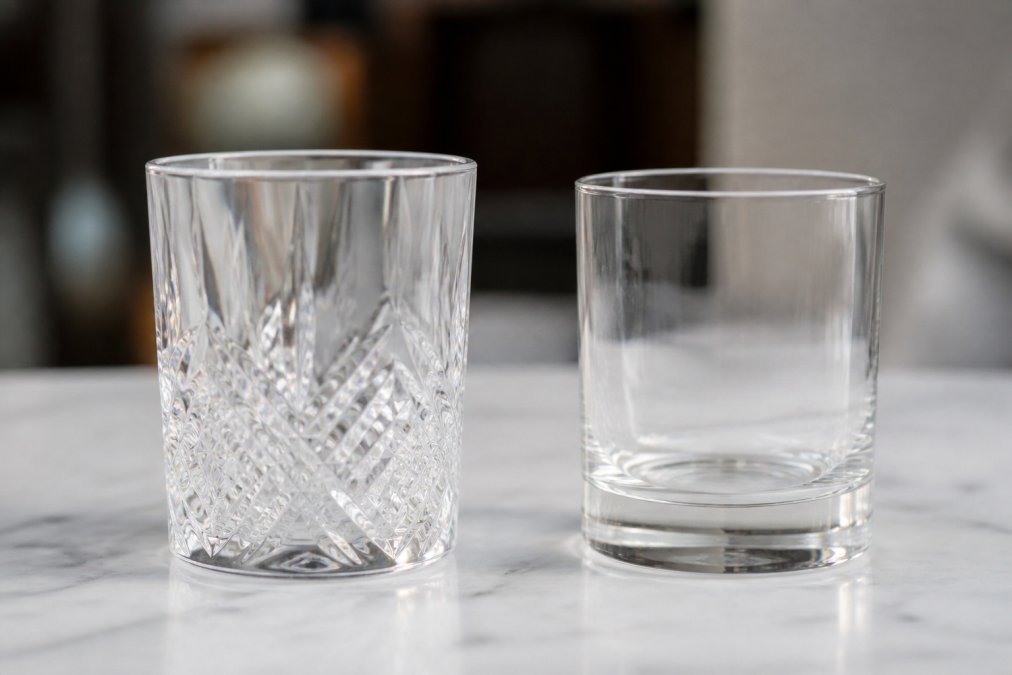
 comparison
Crystal vs Glass Drinkware for Corporate Gifting
Table of Contents
- Crystal vs Glass Drinkware: Key Differences at a Glance
- Chemical Composition and What It Means for Your Gift
- Clarity, Brilliance and Optical Quality
- Durability and Practicality in Commercial Settings
- Custom Glassware for Corporate Hospitality: Engraving and Branding
- Engraved Glassware for Business Gifts: Durability and Presentation
- Branded Crystal Wine Glasses: Premium Positioning and ROI
- Cost, Sustainability and Long-Term Value
- Frequently Asked Questions
Last Updated: September 18, 2026
Crystal vs Glass Drinkware: Key Differences at a Glance
When comparing crystal vs glass drinkware, crystal offers superior optical quality, weight, and prestige; glass provides durability and affordability for high-volume events. The choice depends on your gifting strategy and budget. A C-suite executive gift demands crystal. A large-scale conference giveaway calls for durable glass.
Chemical Composition and What It Means for Your Gift
Crystal and glass are fundamentally different materials, and understanding why matters for durability and appearance.
Glass is primarily silica fused with soda ash and limestone, creating a stable, durable product that resists thermal shock and frequent washing. Crystal contains lead oxide or mineral compounds (titanium, barium in lead-free versions) that increase refractive index, making it denser and more brilliant but more fragile under thermal stress. The mineral content explains crystal's sparkle and weight, but also its susceptibility to thermal shock, rapid temperature changes that cause cracking.
For corporate gifting, this means: crystal suits elegant, occasional-use pieces (wine glasses for executive gifting). Glass handles daily commercial use (hospitality venues, high-traffic events, outdoor functions).
Clarity, Brilliance and Optical Quality
Crystal outperforms glass in optical clarity and light refraction. The difference is immediately visible.
Crystal's higher refractive index bends light more dramatically, creating sparkle and brilliance that catches the eye. Hold a crystal glass to light and you'll see prismatic effects, rainbow-like light dispersion, that standard glass simply cannot replicate. This optical superiority is why crystal commands premium pricing and conveys luxury.
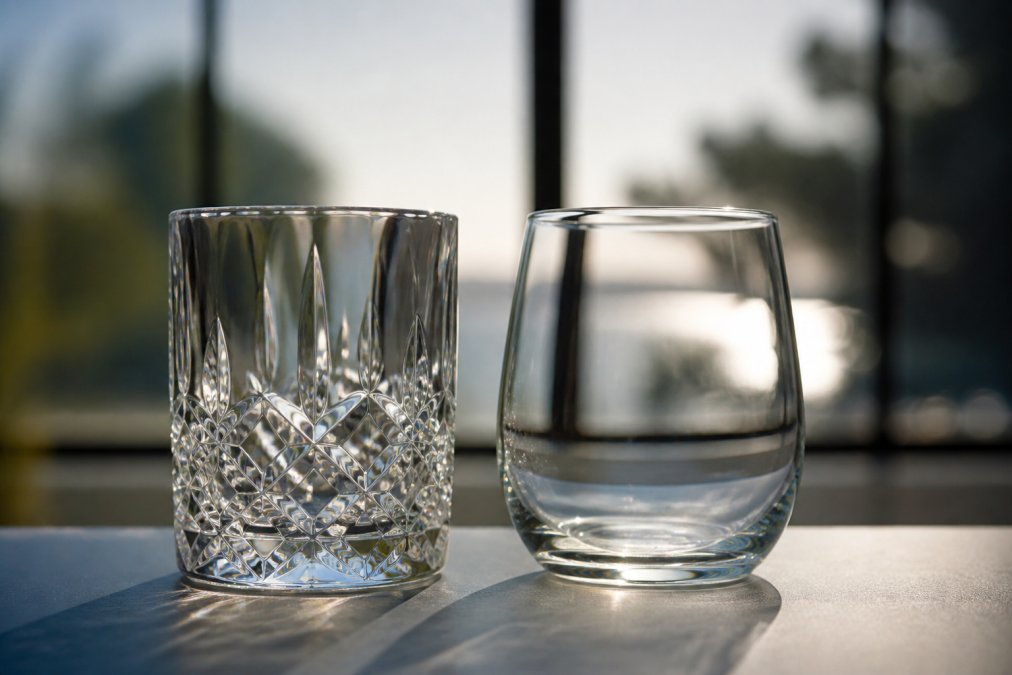
Glass is optically clear but lacks the depth and sparkle. It transmits light without bending it significantly. For most users, this is perfectly adequate, the drinkware looks clean and professional. But it doesn't create that "wow" moment.
For corporate gifting, optical quality matters when the recipient will display the piece or use it in visible settings. A crystal wine glass on an executive's desk or bar signals thoughtfulness and quality. A glass tumbler in a conference room is functional and forgettable.
The trade-off: crystal's brilliance comes with fragility. Thermal shock, pouring hot liquid into a cold crystal glass, can cause cracking. Glass handles temperature swings without issue.
Durability and Practicality in Commercial Settings
Glass handles high-frequency use, thermal stress, and dishwasher cycles without degradation; crystal is more fragile, particularly to thermal shock from rapid temperature changes. For corporate gifting, durability depends on context: an engraved crystal wine glass for a retiring executive will be treasured and used occasionally, while a branded glass tumbler at a 500-person conference will see heavy, unpredictable use. Most quality glass is dishwasher-safe.
Custom Glassware for Corporate Hospitality: Engraving and Branding
Engraving cuts a permanent groove into the material's surface and works equally well on crystal and glass. Etching uses acid or abrasive methods to frost the surface; it's slightly less durable than engraving but holds up well on both materials. For corporate hospitality, engraving is the gold standard, permanent, elegant, and communicating investment in quality. When sourcing custom glassware, verify the vendor's proofing process with a digital mockup or sample before production to ensure your logo appears correctly positioned, sized, and rendered with clarity.
Engraved Glassware for Business Gifts: Durability and Presentation
Engraved glassware transforms a functional item into a keepsake. Deep engraving on crystal lasts indefinitely; shallow engraving on either material is more prone to wear with frequent use. For business gifts, presentation matters: quality glassware should arrive in protective packaging. Consistency across batches is critical, work with a supplier who maintains strict quality control. Rim thickness also affects perception: a thin, delicate rim feels premium; a thick, rounded rim feels sturdy and practical.
Branded Crystal Wine Glasses: Premium Positioning and ROI
Crystal wine glasses are positioned as premium corporate gifts, but ROI calculation requires rigour. Most gifting decisions are made on intuition rather than measurable outcomes, creating risk for procurement teams.
When Crystal Gifting Delivers ROI
Crystal wine glasses generate measurable return in selective, high-relationship contexts:
-
Executive departures and retirements: A personalised crystal wine glass becomes a keepsake displayed prominently, creating ongoing brand visibility.
-
Key client milestone gifts: A bespoke engraved crystal glass marks significant milestones (10-year partnership, major contract renewal), reinforcing relationships in industries where executive relationships drive business.
-
Board and shareholder recognition: Gifting premium crystal to board members or major shareholders signals organisational value and creates persistent brand association through display in professional settings.
When Crystal Gifting Wastes Budget
-
Large-scale events (100+ recipients):
-
Transactional relationships: If the recipient won't use or display the glass regularly, crystal's premium positioning is wasted.
-
High-breakage environments: In hospitality venues or shared offices, thermal shock and handling damage mean crystal may chip or crack within months, wasting the premium investment.
Measuring ROI: A Framework
-
Recipient lifetime value:
-
Display likelihood: Will the recipient display the piece professionally? If yes, brand visibility justifies premium cost; if stored away, glass is sufficient.
-
Usage frequency and environment: Occasional use in controlled settings (home, executive dining) favours crystal; frequent use in unpredictable environments (commercial kitchen, event venue) favours glass.
-
Relationship stage: Crystal works best at inflection points (major partnership beginning, end of tenure, significant milestone); for steady-state relationships, glass maintains professional positioning without overspending.
Practical ROI Example
Cost, Sustainability and Long-Term Value
Unit Cost and Scale Economics
Packaging and Shipping: The Hidden Cost of Fragility
Breakage and Replacement Risk
Sustainability and Circular Economy Considerations
Glass sustainability:
- Infinitely recyclable without degradation
- No toxic materials in standard soda-lime glass
- Recycling infrastructure widely available across most regions
- Environmental impact of recycling: minimal energy requirement compared to virgin glass production
Crystal sustainability:
- Lead-free crystal (titanium, barium, or other mineral-based) is recyclable but requires specialist handling in some regions
- Lead-containing crystal presents recycling challenges; many local councils do not accept it in standard recycling streams
- Recycling infrastructure for lead crystal is limited, meaning many pieces end up in landfill
- Environmental impact: higher embodied carbon due to mineral extraction and processing
- Durability advantage: if a crystal piece is treasured and used for decades, its per-year environmental impact is lower than a glass piece replaced every 5 years
Total Cost of Ownership: A Practical Framework
TCO formula: (Unit cost + Engraving/customisation + Packaging + Shipping) × Quantity + (Estimated breakage rate × Replacement cost)
Example: 150-unit gifting programme
Crystal option:
- Unit cost: £50
- Engraving: £5
- Packaging: £5
- Shipping (per unit): £3
- Subtotal per unit: £63
- Total for 150 units: £9,450
- Estimated breakage (3%): 4.5 units × £63 = £284
- Total TCO: £9,734
Glass option:
- Unit cost: £12
- Engraving: £2
- Packaging: £1
- Shipping (per unit): £1
- Subtotal per unit: £16
- Total for 150 units: £2,400
- Estimated breakage (0.5%): 0.75 units × £16 = £12
- Total TCO: £2,412
Calculate total cost of ownership including packaging, shipping, and estimated breakage. For large-scale programmes (100+ units), glass often delivers better ROI. For selective, high-value gifting (under 25 units), crystal's premium positioning may justify the cost premium if recipients are likely to display and treasure the piece.
Frequently Asked Questions
Is crystal drinkware better than glass drinkware for corporate gifts?
It depends on your gifting strategy and budget. Crystal offers superior clarity, brilliance and a premium feel that signals prestige, ideal for executive-level client appreciation. Glass is more practical for high-volume promotional giveaways and venues where durability under heavy use matters most. Crystal's refractive index creates a distinctive aesthetic elegance that reinforces brand identity, whilst glass prioritises functional design and cost efficiency. For long-term impression and perceived value, crystal wins; for scalability and everyday durability, glass is the pragmatic choice.
How do I choose between crystal and glass for client appreciation gifts?
Consider three factors: recipient tier (executives favour crystal; broader audiences suit glass), intended use (display versus daily use), and budget per unit. Crystal works best for milestone recognition or high-value client relationships where you want the gift to be kept and displayed. Glass suits larger recipient groups or venues where the glassware will see frequent dishwasher cycles and thermal shock. Both materials accept engraving and logo application excellently; crystal's superior optical quality makes logos appear more refined, whilst glass's durability makes it safer for busy hospitality settings.
What are the durability differences between crystal and glass for daily use?
Glass has an edge in thermal shock resistance, it tolerates rapid temperature changes better. Crystal's lower thermal tolerance means it can crack if moved from hot to cold water abruptly. For venues like breweries or hospitality settings with heavy daily use, glass's durability and shatter resistance make it the safer investment. Crystal is better suited to executive boardrooms or display-focused gifting where daily wear is minimal.
Does crystal glassware offer better branding opportunities for logos?
Yes. Crystal's superior clarity, refractive index and light dispersion make engraved or etched logos appear sharper and more refined. The premium finish of crystal reinforces brand prestige and creates a stronger tactile experience, recipients notice the weight and feel immediately. Glass accepts engraving equally well from a technical standpoint, but the aesthetic impact is less striking due to lower optical quality. For bespoke gifting where your logo or artwork is the focal point, crystal's superior light transmission ensures your branding makes a lasting visual impression.