 comparison
Engraving vs Screen Printing for Corporate Merchandise
Last Updated: October 23, 2026
Quick Summary
Engraving vs screen printing for corporate merchandise comes down to whether the mark is cut into the product or laid on top of it. Engraving removes material for a permanent recessed mark that suits premium drinkware and small runs, while screen printing applies ink for strong colour at volume.
- Engraving avoids screen setup charges entirely, so short runs of premium pieces often quote better than buyers expect.
- Screen printing carries a setup fee per colour, per design, so a four-colour logo means four times the setup work.
- Engraved glassware holds up to repeated commercial washing because the mark is a physical change to the glass.
- Ask whether the printer retains your screens between orders, because held screens let reorders skip setup entirely.
- Custom manufactured gift boxing for etched glassware has a turnaround of approximately 28 working days.
Table of Contents
- Engraving vs Screen Printing: The Core Difference
- How Each Branding Method Works on Product Surfaces
- Durability, Wear Resistance and Fade Resistance
- Engraved Glassware: Finish, Feel and Perceived Quality
- Screen Printed Glassware: Colour Options and Logo Complexity
- Cost Drivers, Setup Fees and Order Quantity
- Matching the Method to Your Custom Branded Glassware Range
- Presentation and Packaging: Custom Glassware Gift Boxes
- Frequently Asked Questions
Engraving vs Screen Printing: The Core Difference
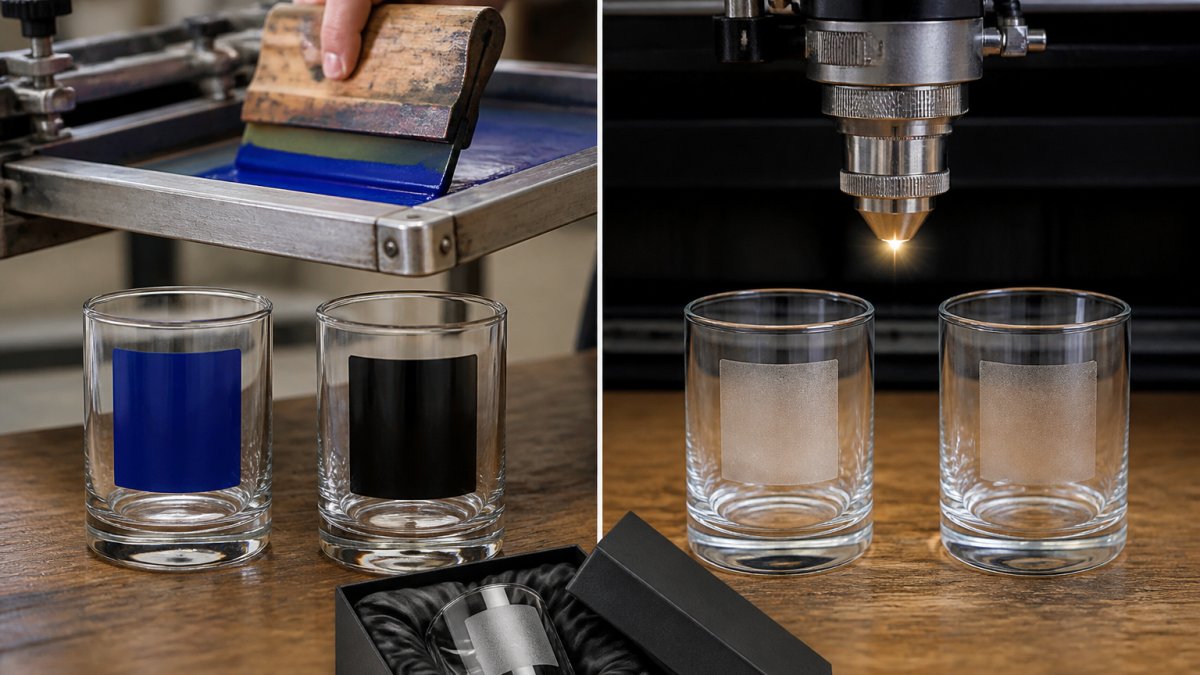
Engraving vs screen printing for corporate merchandise comes down to one question: do you want a mark cut into the product or ink laid on top of it? For a head-to-head comparison of these two methods on glassware specifically, see Screen Printing vs Laser Engraving: Which Suits Your Glassware.
At The Glassware Company, we work with both methods across our range, and the choice shapes everything downstream: how the piece feels in the hand, how it survives a commercial dishwasher, and how the artwork must be prepared.
The common assumption is that printing is always cheaper. That holds for large runs of simple designs. It falls apart with multi-colour artwork, small quantities, and anything that needs to look premium on a boardroom table.
How Each Branding Method Works on Product Surfaces
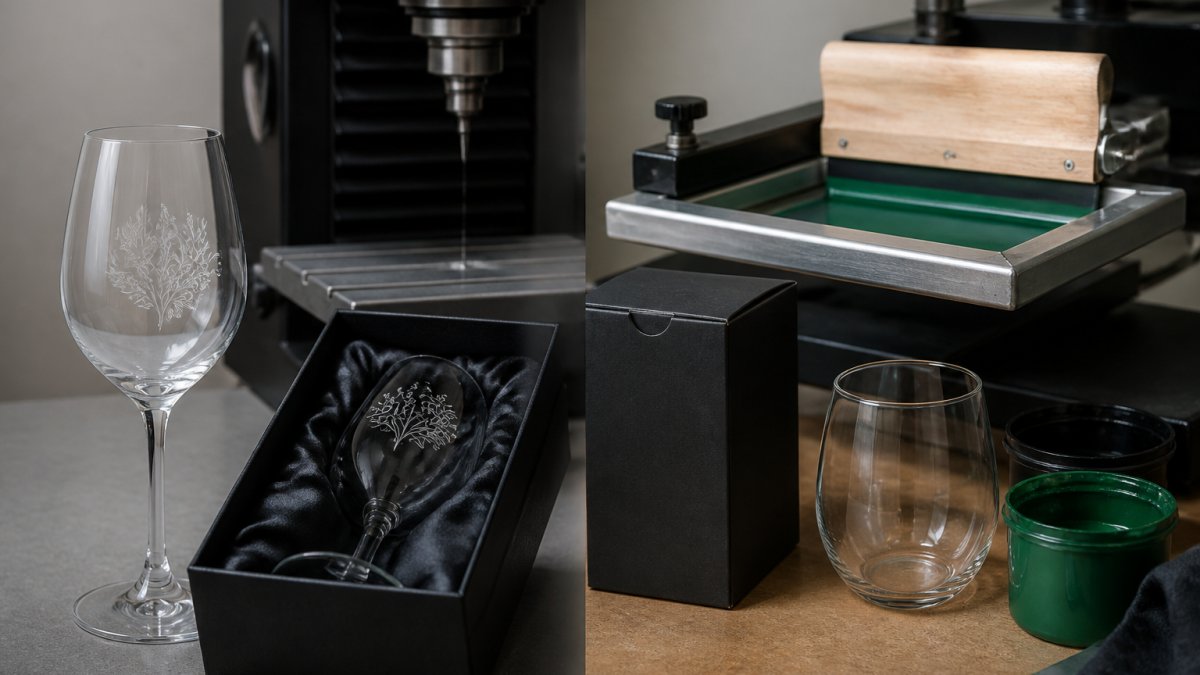
Laser engraving uses a focused beam to remove a thin layer of the material, cutting the design directly into glass, metal, or timber.
Screen printing builds a stencil on a mesh screen for each colour in the design, then presses ink through it onto the product surface.
That difference explains most of what follows. Engraved marks cannot peel or chip because there is nothing applied to peel.
Durability, Wear Resistance and Fade Resistance
Engraved glassware holds up to repeated commercial washing because the mark is a physical change to the glass, not a layer sitting on it. There is no ink to fade, crack, or lift at the edges.
Screen printing is durable when it is done properly, and most quality printers cure inks to a standard that survives normal use. For deeper guidance on print durability on custom glasses, including testing and maintaining print longevity, see our how-to guide.
A practical rule: if the item will be washed daily in a busy venue, engraving removes an entire category of risk. If it is a giveaway that lives in a cupboard, printed durability is rarely the deciding factor.
Engraved Glassware: Finish, Feel and Perceived Quality
Engraved glassware reads as premium because the mark is tactile. Run a thumb across an etched logo and you feel it.
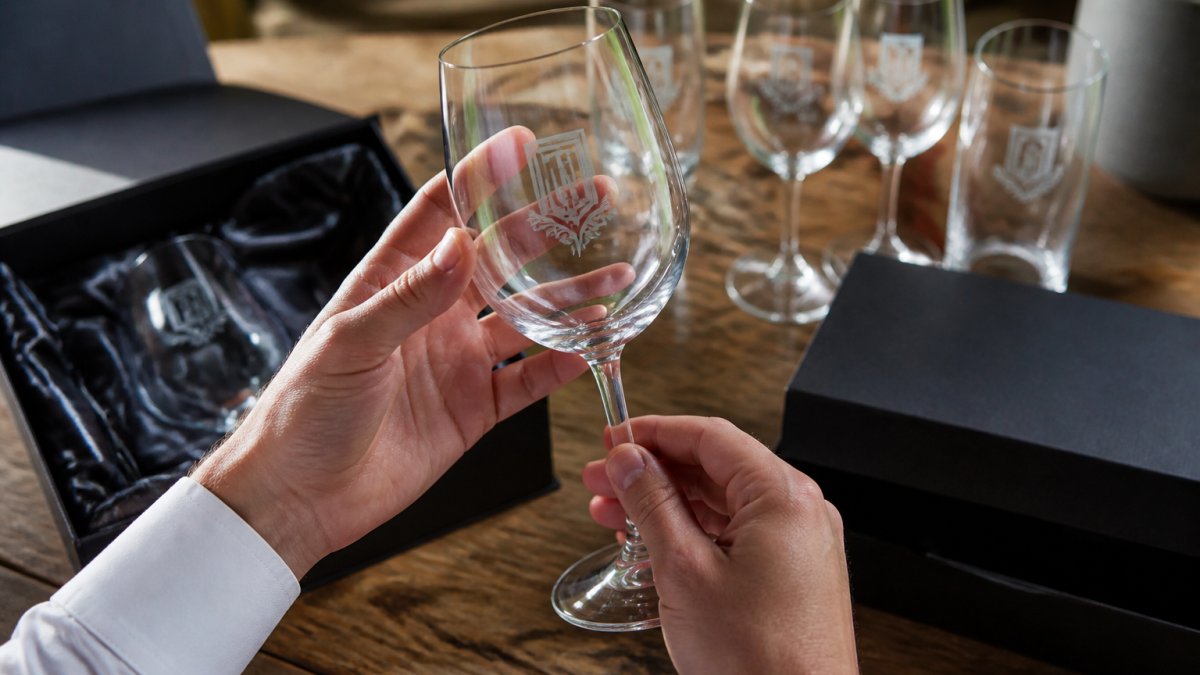
The finish varies by technique. Deep engraving leaves a crisp, slightly frosted cut. Shallower etching produces a softer, more subtle mark.
Where engraving gives ground is colour. You get the tone of the material and the frost of the cut, nothing more.
Screen Printed Glassware: Colour Options and Logo Complexity
Screen printed glassware wins on colour reproduction. Multiple ink colours, brand-matched tones, and detailed graphics are all achievable, which makes it the stronger choice when the logo itself carries the identity.
The trade-off is complexity cost. Each colour in the design means another screen, another setup, and another alignment step, as Perfect Etch's comparison of laser engraving and screen printing notes.
Detailed artwork with gradients and photographic elements is also better suited to digital decoration methods than to either engraving or multi-screen printing, as Kornit's overview of screen printing alternatives explains. If you are weighing logo complexity for engraving versus printing, our guide to designing professional logos for glass engraving covers how to prepare artwork that engraves well.
Cost Drivers, Setup Fees and Order Quantity
Cost is where the two methods diverge most sharply, and where most quotes get misread. The headline unit price rarely tells the full story; the total cost of ownership across a campaign, including setup, artwork, reorders, and failure rates, is the number worth comparing. For a fuller breakdown of what drives pricing, see our cost comparison of custom printed glassware.
The cost drivers that actually move the quote
- Setup charges. Engraving typically avoids screen setup charges entirely because there is no screen to burn and register. Screen printing carries a setup fee per colour, per design, which covers screen preparation, registration, and press setup. On a one-colour logo the setup is modest; on a four-colour logo it is four times the work before a single unit is produced.
- Artwork and proofing. Both methods need production-ready artwork, but the requirements differ. Engraving needs vector line work with adequate line weights and spacing; screen printing needs colour-separated files with each colour on its own layer. Redrawing a low-resolution logo into a printable or engraveable file is a real cost, and it is usually quoted separately.
- Minimum quantities. Screen printing has a practical minimum below which setup dominates the unit price. Engraving is more forgiving at small quantities because there is no screen cost to amortise, which is why short runs of premium pieces often quote better than buyers expect.
- Colour count. Each additional screen colour adds setup, a pass through the press, and an alignment step. Multi-colour logos can therefore be cheaper to engrave in a single tone than to print in full colour at low volume.
| Cost factor | Engraving | Screen printing |
|---|---|---|
| Setup charges | Minimal, no screens | Per colour, per design |
| Artwork charges | Vector line work required | Colour-separated files required |
| Small quantities | Economical | Setup dominates unit cost |
| Large volumes | Higher unit cost | Strong cost-efficiency |
| Multi-colour artwork | No penalty | Adds setup and passes |
| Reorders | Consistent, no new screens | New screens unless held |
| Best value at | Small to mid runs | High-volume single designs |
Total cost of ownership, not just unit price
The cheaper unit price is not always the cheaper campaign. A printed giveaway that fades or lifts after a few washes may need replacing within the campaign window, which erodes the saving.
What to send for an accurate quote
We quote each job against your artwork and quantity rather than publishing a rate card. To get a like-for-like comparison between engraving and screen printing, send the logo file, the product and quantity, the number of colours, the deadline, and whether you expect reorders.
Matching the Method to Your Custom Branded Glassware Range
Custom branded glassware rarely suits one method across the whole range. The useful question is not which technique is better in the abstract, but which technique matches the piece, the quantity, the logo, and how the item will be used after it leaves your hands.
| Product category | Engraving fit | Screen printing fit | Deciding factors |
|---|---|---|---|
| Wine glasses, decanters, champagne flutes | Strong | Moderate | Tactile premium finish, dishwasher exposure, gift presentation |
| Beer steins, mugs, tumblers | Strong | Strong | Volume vs permanence; colour complexity of the logo |
| Metal goods (bottles, flasks, keyrings) | Strong | Moderate | Coating adhesion, curved surfaces, abrasion in pockets and bags |
| Textiles (apparel, caps, totes) | Not applicable | Strong | Engraving does not apply to fabric; ink choice and cure matter |
| Promotional giveaways at scale | Moderate | Strong | Unit cost, colour count, acceptable lifespan |
| Boardroom and client gifts | Strong | Moderate | Perceived quality, personalisation, packaging |
A few practical rules sit behind that matrix.
- Drinkware for venues: engraving removes the daily-wash risk category entirely. If the glass will go through a commercial dishwasher several times a week, the mark is a physical change to the glass rather than a coating that can lift at the edges.
- Drinkware for giveaways: screen printing usually wins on unit cost once quantities climb, provided the logo is simple and the colour count is low. A one- or two-colour mark on a high-volume run is where printing is most comfortable.
- Metal goods: both methods work, but the surface coating matters. Powder-coated bottles and flasks can chip at the edges under either method if the substrate is not prepared properly, so ask for a production sample on the actual product rather than a generic swatch.
- Textiles: screen printing is the established method and engraving does not apply. Ink type, cure temperature, and fabric blend determine how the print survives washing, so specify the wash standard you expect the garment to meet.
- Mixed orders: it is common to engrave the premium pieces and print the volume pieces in the same campaign. That keeps the gift-tier items feeling considered while the giveaway tier stays within budget.
For buyers weighing a switch, the question is not which method is better. It is which method matches how the item will be used, washed, and kept, and whether the logo can be simplified enough to suit the cheaper method without losing its identity.
Presentation and Packaging: Custom Glassware Gift Boxes
Presentation decides whether branded glassware reads as a gift or as stock. A well-engraved glass in a plain mailer loses most of its impact before the lid comes off.
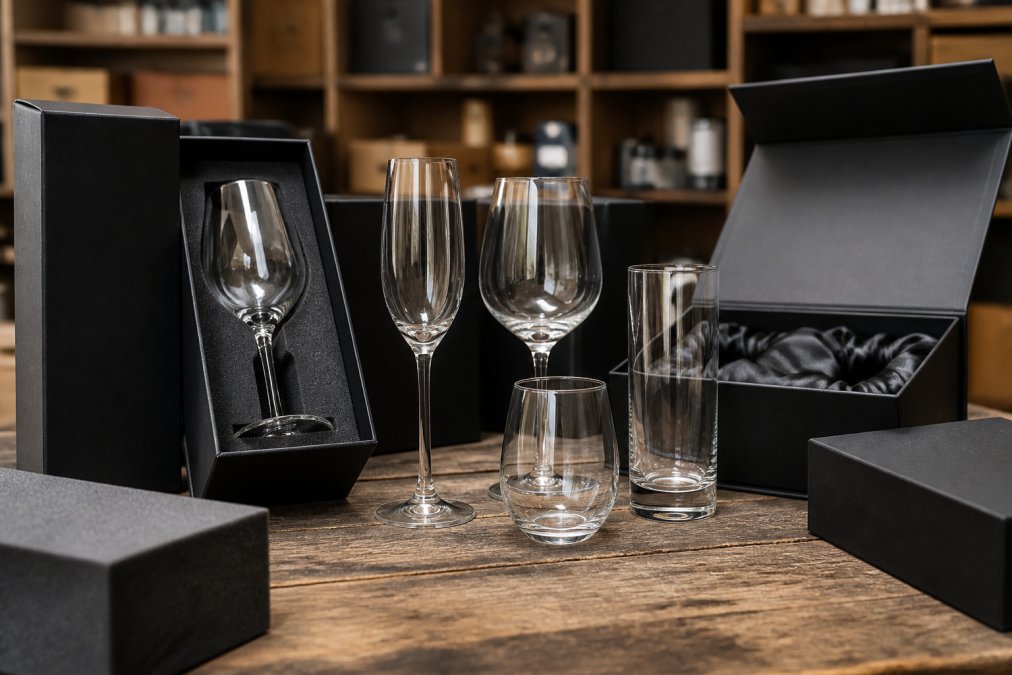
We offer custom manufactured gift boxing for etched and branded glassware, produced to fit the piece and finished to match the brand. Our custom gift boxing for etched glassware guide covers the options in detail.
Choosing between engraving and screen printing for corporate merchandise is really a question about how the item will live after it leaves your hands.
At The Glassware Company, we produce both across a large range of styles, from beer steins to champagne flutes, with proofing before production and consistent reorders on the same design.
Frequently Asked Questions
What is the difference between engraving and screen printing on glassware?
Engraving removes a thin layer of the glass surface to create a permanent frosted mark, so there is no ink to chip or peel. Screen printing applies ink through a mesh screen onto the surface, which allows bright solid colours and multi-colour logos. Engraving gives a subtle, tactile finish that suits metal, glass and drinkware, while screen printing suits flatter surfaces and larger apparel runs. The right choice depends on your design, product and order size.
Which lasts longer on corporate glassware: engraving or screen printing?
Engraved glassware generally holds up longer because the mark is part of the glass rather than a coating on top of it. There is no ink layer to fade, scratch or wear away through washing. Screen printed glassware can still perform well, but the ink sits on the surface and may dull over time with repeated commercial washing. If the glasses will be used daily in a venue, engraving is usually the safer long-term option.
Is screen printing cheaper than engraving for large orders?
It depends on the design and quantity. Screen printing carries setup fees for creating screens, and those fees can rise with each additional colour, but the unit cost often drops across large volumes. Engraving avoids ink and screen setup, so it can suit both small and large quantities without the same colour-based setup charges, though production takes longer per unit. Ask for a quote that separates setup from unit cost so you can compare the true total.
Can glassware be both engraved and screen printed?
Yes. Some projects combine the two, for example an engraved logo with a screen printed colour accent or event date. This works when you want the permanence and tactile finish of engraving alongside a specific brand colour that engraving alone cannot reproduce. It adds production steps and cost, so confirm the artwork and proofing carefully before the run begins. Your supplier can advise whether the combination suits the product surface.
Which branding method is better for detailed logos on glassware?
Engraving handles fine linework, crests and detailed logos well because the laser follows the artwork precisely, producing a crisp frosted mark. Screen printing is better for bold, simple logos and solid colour blocks, and complex artwork with gradients or photographic detail can be difficult to reproduce. If your logo has thin lines or intricate text, ask for a proof of the engraved mark before committing to a full order.