 comparison
Cost Comparison of Custom Printed Glassware
Table of Contents
- What Actually Drives the Cost of Custom Printed Glassware
- Screen Printing vs Laser Engraving Glassware: Cost and Durability
- Bulk Custom Glassware Pricing: Small Batch vs Industrial Scale
- Minimum Order Quantities for Promotional Glassware
- Hidden Fees Checklist for Custom Glassware Orders
- Turnaround Times, Rush Services, and Design File Requirements
- Sustainability, Glass Thickness, and Material Quality
- Frequently Asked Questions
Last Updated: September 16, 2026
What Actually Drives the Cost of Custom Printed Glassware
The cost of custom printed glassware comes down to four variables: glassware style, order volume, printing method, and artwork setup. Get those right and pricing becomes predictable; get them wrong and you pay twice, once on the invoice, again when the glasses fail in service.
This guide from The Glassware Company breaks down what each variable costs, where suppliers bury fees, and how to compare quotes on equal terms.
Glassware Style and Capacity
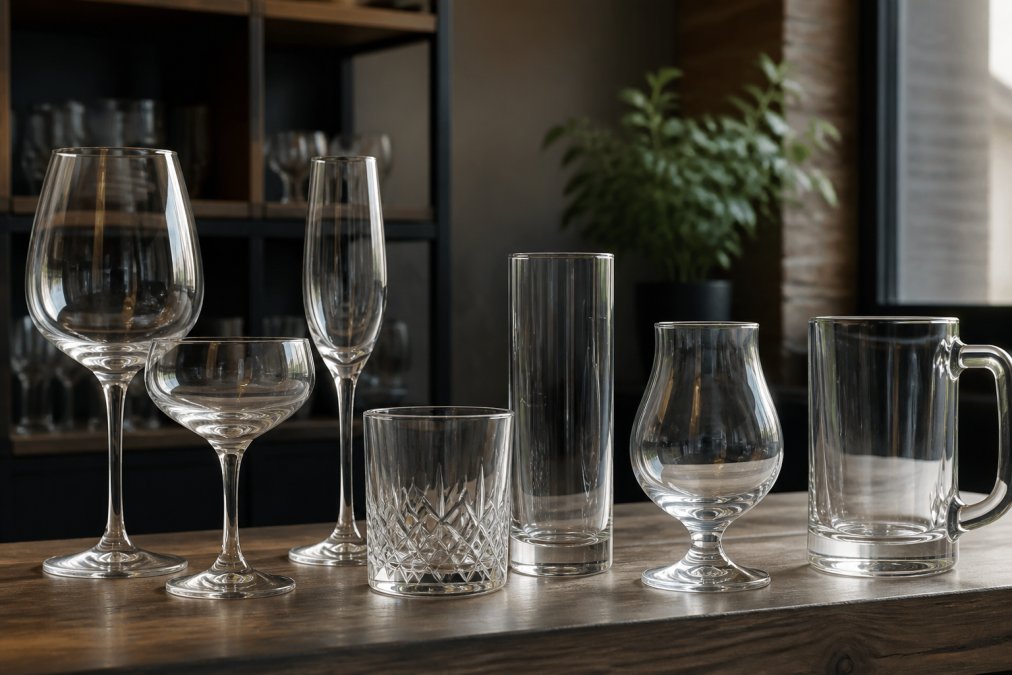
A tumbler is a straight-walled vessel, usually 300-500ml, for spirits, water and mixed drinks. A beer stein is a heavier, handled mug, typically 500ml or larger, built for repeated taproom service.
Style drives base unit price more than any other factor. A 400ml beer glass costs more to make and ship than a 200ml shot glass, and thicker bases, heavier walls, handles, stems and non-standard shapes all raise material and packing costs.
A stemmed wine glass suits a winery tasting room but is the most fragile to freight; a sturdy tumbler or stein survives a season of sporting club use.
Order Volume and Unit Price
Unit price falls as volume rises, but not in a straight line. The first jump, from samples to a few hundred units, delivers the biggest saving because it spreads setup across more pieces; later tiers shave off smaller amounts.
Order in the largest tier you can genuinely use, dead stock costs more than the per-unit saving is worth.
Screen Printing vs Laser Engraving Glassware: Cost and Durability
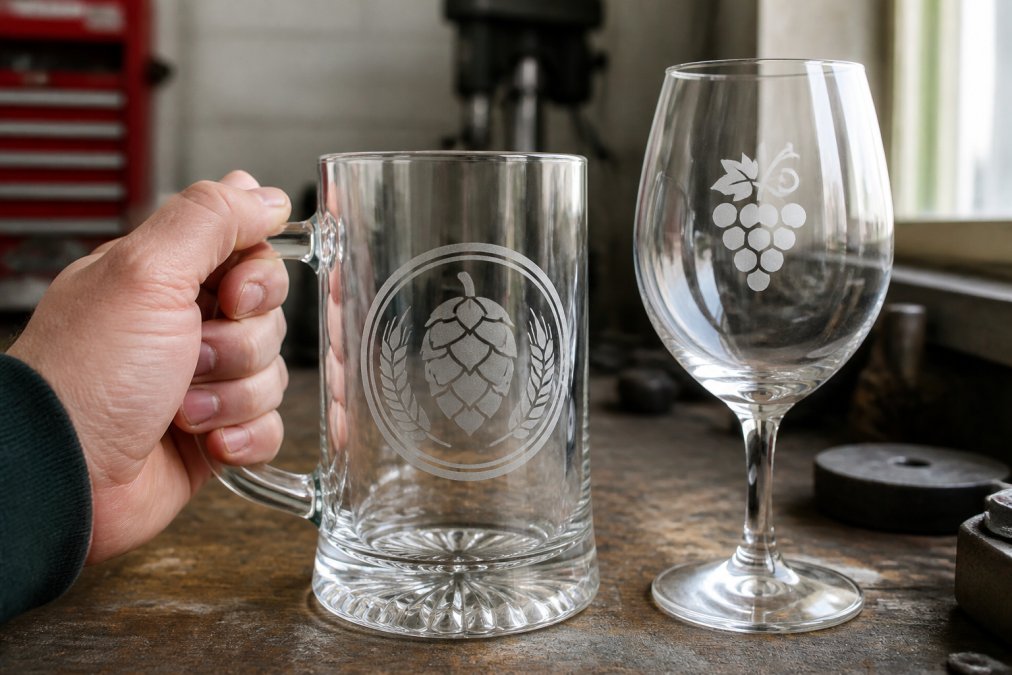
Screen printing sits on the surface. Laser engraving cuts the design into the glass and will not wash off.
That distinction explains why venues with commercial dishwashers choose engraving while high-volume giveaways choose screen printing.
Cost Breakdown by Printing Method
Here is how the main methods compare on the factors that move your invoice, style, volume and artwork complexity all shift the final number.
| Method | Setup cost (indicative) | Unit cost trend | Durability | Best for |
|---|---|---|---|---|
| Screen printing | One-off screen charge per colour, typically a modest fixed fee | Lowest at high volume; falls sharply past a few hundred units | Surface print, can wear under commercial washing | Bulk giveaways, events, multi-colour logos |
| Laser etching | One-time file conversion to vector; no per-colour charge | Higher, roughly flat per piece regardless of volume | Cut into glass, permanent | Wineries, breweries, corporate gifts |
| Sandblasting | Per-design stencil fee | Mid-to-high; labour-intensive | Deep, permanent | Premium gift sets, low-volume prestige runs |
| Decal / transfer | Low setup | Low per unit | Moderate, can peel over time | Short-run promotions, photographic designs |
Screen printing pushes ink onto the glass through a mesh screen; each colour needs its own screen. Laser etching removes a thin layer of glass with a focused beam for a frosted, tactile mark, no ink, ideal for single-colour logos and fine detail.
The Crossover Point: When Does Each Method Win?
The practical question is at what volume screen printing overtakes laser etching on total cost.
Print Durability and Dishwasher Safety
A common mistake is assuming "dishwasher safe" applies to the print. It does not, the glass may be dishwasher safe while the print is not.
The key is ink adhesion. Screen-printed designs with properly cured, glass-specific inks hold up in domestic machines but degrade faster under the higher temperatures and stronger detergents of commercial units. Laser etching has no ink to lose, making it the safer choice for daily commercial dishwashing.
Ask your supplier directly: is the print rated for commercial dishwashing, or domestic only? Get it in writing before you order 500 pieces. If the answer is vague, assume domestic only and budget for replacement.
Bulk Custom Glassware Pricing: Small Batch vs Industrial Scale
Bulk custom glassware pricing is not simply "more units, less money." Small batches and industrial-scale runs follow different economics.
Setup Costs and How They Spread
Setup covers the work done before a single glass is printed: preparing artwork, creating engraving files, and running a test piece.
- Laser etching setup: a one-time file conversion to a vector format the machine reads
Minimum Order Quantities for Promotional Glassware
Minimum order quantities exist because short runs are inefficient to set up and pack.
A small brewery with a handful of taps does not need thousands of glasses. The right question is not "what is the minimum?" but "what is the smallest run that avoids a punitive setup charge?"
Hidden Fees Checklist for Custom Glassware Orders
Before approving any order, confirm each of these in writing:
- Artwork or file preparation fee
- Freight, and whether it is to a dock or inside delivery
- Breakage allowance and who absorbs breakages in transit
- Rush or expedite surcharge
- Reorder setup fee, if any
- Minimum billing amount per order
Ask for the full breakdown before you commit.
Turnaround Times, Rush Services, and Design File Requirements
Standard turnaround for custom printed glassware typically runs several weeks from artwork approval, not from the day you enquire. The clock starts only once your design is signed off, so slow proofing is the most common cause of blown deadlines.
Rush services carry a surcharge and depend on stock availability. If your event is close, confirm the style is in stock and the print method can be completed in the window. Laser etching is often faster on short runs because there is no screen to produce.
What Artwork Problems Actually Cost You
The most common cost triggers:
- Low-resolution logo: a raster file from a website or old business card usually needs redrawing into vector format.
- Missing or non-standard fonts: if your logo uses an unlicensed font, the supplier may redraw the letterforms or substitute a close match, which changes your brand mark.
- Gradients, drop shadows and photographic elements: these generally cannot be etched without conversion to halftone or line art.
- Multiple colour separations: each colour in a screen-printed design needs its own separation and screen. A four-colour logo is four setup charges, not one.
- Colour matching to a brand standard: if your brand colour must match a specific reference, the supplier may need to mix a custom ink, chargeable, and worth paying once and recording.
Vector artwork is built from mathematical paths rather than pixels, so it scales to any size without losing sharpness. Suppliers need vector files, usually .ai, .eps or .svg, for clean etching and printing. If all you have is a low-resolution logo, send the highest-quality source file and ask for the redraw fee up front.
Colour Drift on Reorders, and How to Prevent It
Laser etching sidesteps this entirely: the mark is a frosted white, not a colour, so there is no ink to mix and no batch variation.
Rush Surcharges and How They Are Priced
Before you accept a rush quote, confirm:
- Whether the surcharge is flat or a percentage, and what it applies to (unit price only, or the full order including freight)
- Whether the rush window is measured from artwork approval or order placement, the difference can be days
- Whether the chosen glassware style is in stock, because a rush on out-of-stock glass is not a rush at all
- Whether the rush fee is refundable if the supplier misses the date
For anything with a hard event date, order standard turnaround and hold a buffer rather than pay a rush premium and still risk the deadline.
Sustainability, Glass Thickness, and Material Quality
Glass is one of the more recyclable packaging materials in circulation, and reusable branded glassware avoids single-use waste by design. But material quality varies, showing up in wall thickness and thermal shock resistance.
Thicker walls and a weighted base mean a more durable glass, which matters through a commercial dishwasher or at an event.
Frequently Asked Questions
What is the average cost per unit for custom printed glassware?
There is no single average because the unit price depends on the glassware style, order quantity, and logo complexity. For a quote tailored to your design and quantity, request an online quote from The Glassware Company.
Does the printing method affect the price of custom glassware?
Yes. Laser engraving and etching produce a permanent mark that will not fade, which suits premium glassware and long-term branding. The right choice depends on your design detail, the glassware style, and how long you need the branding to last.
Are there minimum order quantities for custom printed glasses?
Minimum order quantities for promotional glassware vary by supplier and product. Small runs are possible but the setup cost is spread across fewer units, so the per-unit price is higher. Ask your supplier directly about their minimums and whether they offer small-batch options.
Is it cheaper to buy custom glassware in bulk?
In most cases, yes. Bulk custom glassware pricing reduces the per-unit cost because artwork preparation is shared across a larger run. Glassware itself is also cheaper per unit at higher volumes. If you expect to reorder the same design, placing a larger initial order usually delivers better value than several small orders.