 listicle
Alternatives to Standard Wine Tasting Glasses
Table of Contents
- Why Move Beyond Standard Wine Tasting Glasses
- Universal Wine Glasses vs. Varietal-Specific Options
- Eco-Friendly Custom Wine Glasses Alternatives
- Stemless and Shatterproof Alternatives for High-Traffic Events
- Premium Glassware Gift Boxing Services for Branded Options
- Bespoke Etched Wine Glasses for Events and Corporate Branding
- Comparison Table: Key Alternatives to Standard Tasting Glasses
- Choosing the Right Alternative for Your Needs
- Frequently Asked Questions
Last Updated: September 24, 2026
Why Move Beyond Standard Wine Tasting Glasses
The choice of glassware shapes how wine reveals itself. Standard tasting glasses, the ISO 3591 specification type, are engineered for technical assessment in professional settings. But they're not the only option, and for many situations, they're not the best one.
Corporate events, wineries, and hospitality venues face a real tension: you need glassware that performs, looks intentional, and reflects your brand. Standard glasses solve the performance part. They don't solve the identity part. That's where alternatives to standard wine tasting glasses become essential.
The Glassware Company works with venues and corporate clients who've moved beyond one-size-fits-all glassware. They've discovered that the right alternative, whether universal crystal, stemless options, or custom-etched designs, does something standard glasses can't: it creates a memorable experience while maintaining the sensory performance that matters.
Below, we'll walk you through the most practical alternatives to standard wine tasting glasses, how they compare on the factors that actually matter, and how to choose the right one for your specific use case.
Universal Wine Glasses vs. Varietal-Specific Options
Not every tasting needs multiple glass shapes. Universal wine glasses challenge the assumption that you need separate vessels for Cabernet, Chardonnay, and Champagne.
A universal glass works because it balances competing demands. The bowl shape sits somewhere between the narrow flute and the broad Burgundy bowl, wide enough to expose aromatics, but not so wide that it loses them. Lead-free crystal options like Gabriel-Glas StandArt and Zalto Denk'Art have proven this principle at scale. They reduce your inventory footprint while maintaining tasting accuracy.
The trade-off is real, though. A universal glass performs well across wine types but optimally for none. If your venue specialises in a single varietal, say, a Shiraz-focused tasting room, a varietal-specific glass still edges ahead. But for corporate events, mixed wine flights, and hospitality settings where flexibility matters more than specialisation, universal glasses win.
How bowl shape affects aeration and aromatics
Bowl geometry directly controls how volatile compounds release from the wine. A wider bowl exposes more surface area to air, accelerating aeration. A narrower bowl concentrates aromatics toward the nose, intensifying olfactory perception on the first inhale.
Standard tasting glasses use a specific bowl ratio, roughly 1:1.2 (width to height), to balance these forces. Universal alternatives maintain similar proportions. The difference is subtle but measurable: hand-blown options like Zalto tend to have slightly thinner walls, which means faster thermal conductivity and marginally faster aeration. Machine-made glasses like Riedel Veritas are more durable but fractionally slower to warm and release aromatics.
For professional tastings, this distinction matters. For client appreciation events and hospitality service, the difference is imperceptible to most drinkers.
Lead-free crystal and material quality considerations
Lead crystal was the standard for decades because lead's refractive index creates brilliance and its lower melting point allows thinner walls. Modern lead-free alternatives, borosilicate glass, soda-lime crystal, and proprietary blends, now perform nearly identically.
The practical advantage of lead-free is durability. Lead crystal can develop micro-fractures in commercial dishwashers. Lead-free crystal resists this. For venues running high-volume service, lead-free is the sensible choice. For collectors and fine-dining establishments where glasses see hand-washing only, the distinction matters less.
Gabriel-Glas, Zalto, and Riedel all use lead-free formulations.
Eco-Friendly Custom Wine Glasses Alternatives
Sustainability in glassware starts with material longevity. A glass used for 10 years has a lower environmental footprint per use than one replaced annually. That's why durable, timeless design beats trendy glassware you'll discard.
Stemless and Shatterproof Alternatives for High-Traffic Events
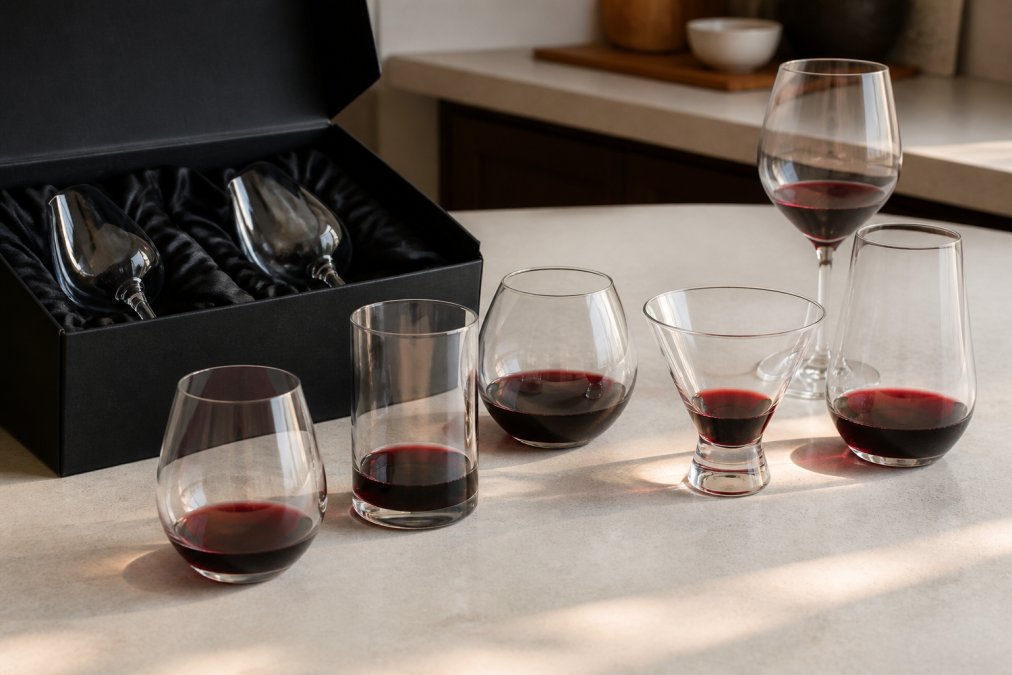
Stemware is elegant but fragile. A broken stem means a ruined glass. For outdoor events, poolside service, or high-energy hospitality venues, stemless options eliminate this risk entirely.
Thermal conductivity and hand-warming concerns
Glass conducts heat from your hand into the wine. This is by design in standard tasting, it's why you hold the bowl in professional settings. But for casual service or outdoor events, hand-warming can be undesirable, especially with delicate white wines or sparkling wines meant to stay cold.
Premium Glassware Gift Boxing Services for Branded Options
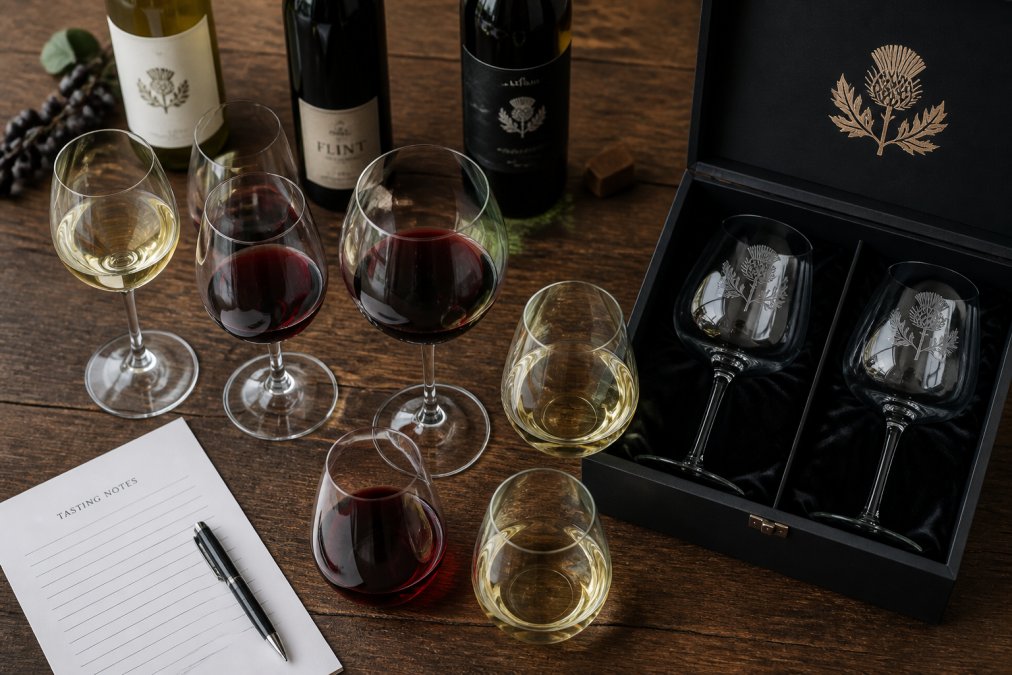
Custom glassware becomes a gift when it's presented intentionally. The Glassware Company offers custom gift boxing specifically designed for etched and branded glassware, with approximately 28 working days for manufacturing and finishing.
Bespoke Etched Wine Glasses for Events and Corporate Branding
Etching transforms glassware into branded assets. Unlike printed labels that fade and peel, etched designs are permanent. They survive dishwasher cycles, years of use, and the kind of handling that destroys cheaper alternatives.
Customisation options and artwork approval processes
The etching process begins with artwork approval. You provide your design, and the team produces a proof for your review. This step matters: what looks good on screen doesn't always translate to glass at scale. The approval process ensures your vision is accurate before production begins.
Durability and dishwasher safety for etched designs
Etched designs are chemically bonded to the glass surface. They don't fade, chip, or wear away with use. Commercial dishwashers won't damage them. This durability is why etched glassware becomes a long-term asset rather than disposable merchandise.
Comparison Table: Key Alternatives to Standard Tasting Glasses
| Option | Best For | Key Advantage | Primary Trade-off |
|---|---|---|---|
| Gabriel-Glas StandArt | Universal tasting, corporate events | Lead-free crystal, single glass replaces multiple shapes | Slightly higher cost than entry-level alternatives |
| Zalto Denk'Art | Fine dining, collector-grade service | Hand-blown clarity and aesthetic appeal | Fragile; requires careful handling |
| Riedel Veritas | Professional venues, high-volume service | Machine-made consistency, durability | Requires storage space for multiple varietal shapes |
| IKEA Dyrgrip | Budget-conscious hospitality, high-turnover venues | Extremely cost-effective, easily replaceable | Lacks optical clarity of crystal |
| Glasvin Home | Home enthusiasts, mid-range hospitality | Lightweight, good value for build quality | Limited retail availability in some regions |
| Rastal Harmony | Outdoor events, casual service, high-traffic venues | Stemless stability, reduced breakage | Hand-warming effect on wine temperature |
| Rowdy Crowd Tritan | Glass-free zones, poolside, festivals | Shatterproof, durable for transport | Doesn't deliver glass sensory experience |
| The Glassware Company Custom Etched | Corporate branding, winery events, hospitality venues | Permanent etching, professional customisation, premium gift boxing available | Requires 28 working day lead time |
Choosing the Right Alternative for Your Needs
The best alternative depends on three variables: your use case, your budget, and your timeline.
Professional tasting flights versus casual service
A tasting flight is a curated experience. You're guiding someone through wines intentionally. This demands glassware that supports that narrative. Standard tasting glasses are designed for this. Universal alternatives like Gabriel-Glas or Zalto maintain that precision while offering flexibility. The rim thickness, bowl geometry, and material quality all matter because they directly affect how the wine tastes.
Storage, transport, and ergonomics for long-form tasting
Long tasting sessions, three hours or more, demand ergonomic glassware. Your hand will hold the glass repeatedly. The stem should be comfortable, the bowl weight balanced, and the overall design not tiring to grip.
Frequently Asked Questions
What are the main advantages of universal wine glasses over varietal-specific tasting glasses?
Universal wine glasses simplify glassware collections by accommodating red, white, and sparkling wines in a single design. Their bowl shape is engineered to balance aeration and aromatics across multiple wine profiles, reducing the need to store numerous varietal-specific shapes. This makes them practical for events, restaurants, and home use where space or budget constraints exist. However, they represent a compromise rather than optimisation for any single wine type.
How do eco-friendly custom wine glasses alternatives compare to standard crystal options?
Eco-friendly custom wine glasses alternatives use sustainably sourced materials and lead-free formulations that reduce environmental impact during manufacturing and disposal. They perform comparably to standard crystal in terms of clarity and thermal conductivity, though some may have slightly thicker walls. For corporate events and branded service, eco-conscious options signal environmental responsibility to clients and guests, aligning with sustainability commitments. Performance differences are minimal for most tasting scenarios.
Are stemless wine glasses suitable for professional wine tasting events?
Stemless glasses work well for casual tastings and high-traffic hospitality settings where durability and ease of handling matter. However, professional sommelier-led tastings typically require stemmed options because holding the stem prevents hand warmth from affecting wine temperature and allows clearer observation of the wine's colour and clarity. Stemless designs are ideal for outdoor events, picnics, or venues where breakage is a concern, but they sacrifice some sensory control in formal tasting environments.
What is the difference between bespoke etched wine glasses for events and mass-produced branded alternatives?
Bespoke etched wine glasses for events are custom-manufactured with precision laser etching of your logo or artwork, ensuring professional presentation and brand consistency. They typically include premium gift boxing services (approximately 28 working days turnaround) for striking first impressions at corporate functions, winery tastings, or client appreciation events. Mass-produced alternatives lack this customisation and often arrive in standard packaging. Bespoke options cost more but create memorable, high-quality branded experiences that reflect your organisation's commitment to excellence.
How do I ensure custom etched glassware will withstand regular dishwasher use without fading?
Quality etched glassware uses precision laser engraving that bonds the design to the glass surface rather than applying a surface coating. This method resists fading through repeated washing cycles and commercial dishwasher exposure. When sourcing custom options, confirm the provider uses laser etching rather than screen printing or paint application. Request samples tested through multiple dishwasher cycles, and discuss durability guarantees. Professional providers like The Glassware Company maintain strict quality standards to ensure artwork remains crisp and visible long-term.