 how-to
Corporate Gifting Tax: A 2026 Guide for Employers
Table of Contents
- Corporate Gifting Tax: What Employers Need to Know
- Fringe Benefits Tax on Employee Gifts
- Tax Treatment of Gifts to Clients and Business Associates
- Tax Deductibility of Corporate Gifts
- GST Credits on Business Gifts
- Corporate Gift Record-Keeping: Documentation and Compliance
- Practical Examples: Calculating Tax Outcomes
- Frequently Asked Questions
Last Updated: October 12, 2026
Corporate Gifting Tax: What Employers Need to Know
Understanding the tax implications of corporate gifting for Australian employers is essential for anyone selecting branded merchandise or gifts for clients and staff. The rules around what you can deduct, what triggers fringe benefits tax, and how GST applies can feel complicated. But the core principles are straightforward once you know where to look.
At The Glassware Company, we work with corporate clients across Australia who use custom-etched glassware as part of their gifting strategy. Understanding the tax implications can help businesses maximise the benefits of their gifting programs.
This guide walks you through the key tax rules, thresholds, and documentation requirements. We'll cover fringe benefits tax, the $300 minor benefits exemption, deductibility, GST credits, and what records the ATO expects to see.
Fringe Benefits Tax on Employee Gifts
When you give a gift to an employee, fringe benefits tax (FBT) may apply. FBT is a tax on certain benefits you provide to employees in addition to their salary.
The basic rule is simple: if the gift is a fringe benefit, you must declare its value and pay FBT on it. The tax year runs from 1 April to 31 March, and FBT is calculated at the highest marginal tax rate plus Medicare levy.
Not every employee gift triggers FBT, though. Understanding when it applies, and when it doesn't, can save your business money.
The $300 Minor Benefits Threshold
The minor benefits exemption is one of the most useful tools for employers. If a benefit is minor, infrequent, and not part of a pattern of similar benefits, it can be exempt from FBT.
The key threshold is $300 per employee per income year. Benefits valued at $300 or less, provided they are minor and infrequent, do not attract FBT.
What counts as minor and infrequent? The ATO considers:
- One-off gifts rather than recurring benefits
- Gifts given on special occasions (birthdays, service anniversaries, retirements)
- Gifts unrelated to salary sacrifice or other employment arrangements
- Gifts that don't form part of a pattern of similar benefits throughout the year
If you give the same employee multiple gifts in one year, the ATO adds up their total value. If the combined total exceeds $300, FBT applies to the excess. For example, if you give an employee a $200 branded glass set in January and a $150 gift card in September, the total is $350. FBT would apply to the $50 excess.
When FBT Applies to Branded Glassware and Promotional Items
Custom-etched glassware and branded merchandise are often treated as minor benefits if they meet the criteria above. A single set of branded wine glasses worth under $300, given as a one-off gift to mark a milestone, typically qualifies for the exemption.
However, if you distribute the same branded glassware to all employees as part of a uniform benefit program, the rules change. A uniform benefit is one given to all or a defined group of employees. Uniform benefits don't get the minor benefits exemption, they're taxed as fringe benefits regardless of value.
The distinction matters. A branded beer stein given to one employee as a retirement gift is likely minor. The same stein given to every employee at a Christmas party is a uniform benefit and triggers FBT on the full value for each recipient.
To work out FBT, the ATO uses the taxable value of the benefit. For gifts, this is usually the cost to you of providing them. If you purchase custom-etched glassware from The Glassware Company, the taxable value is what you paid.
Tax Treatment of Gifts to Clients and Business Associates
Gifts to clients and business associates are treated differently from employee gifts. They don't trigger fringe benefits tax because the recipient is not an employee.
Instead, the tax question is whether the gift is deductible as a business expense. For a gift to clients or associates to be deductible, it must be incurred in gaining or producing assessable income.
A branded glass set given to a client to strengthen the business relationship is generally deductible, provided:
- You incurred the cost in the course of your business
- The gift is connected to your business activities
- The expense is not private or personal in nature
The value of the gift doesn't matter for deductibility purposes, there's no $300 threshold for client gifts like there is for employee minor benefits. A $500 branded decanter set is just as deductible as a $50 glass.
However, if the gift is entertainment (such as providing a meal or event tickets alongside the gift), different rules apply. Entertainment expenses have their own deductibility limits and conditions. If you're uncertain whether something crosses into entertainment, the ATO's guidance can clarify the boundary.
Tax Deductibility of Corporate Gifts
Corporate gifting tax treatment depends on establishing a clear business purpose and connection. Not every gift you give is deductible, and the ATO scrutinises personal or discretionary gifts closely.
Establishing Business Purpose and Connection
For a gift to be deductible, you must show it was incurred in gaining or producing assessable income. This means the gift must be connected to your business operations.
Examples of gifts with clear business purpose include:
- Branded merchandise given to clients to promote your business
- Custom glassware for hospitality venues, wineries, or breweries to enhance brand presence
- Gifts to business partners or suppliers to maintain relationships
- Promotional items distributed at trade shows or events
- Gifts to employees that qualify as minor benefits
The key is documenting the business reason. Keep a record of:
- Who received the gift and their relationship to your business
- When the gift was given
- What the gift was
- The cost
- The business purpose (e.g., "client appreciation", "event sponsorship", "staff recognition")
If the ATO asks, you need to show the gift was genuinely connected to your business, not a personal expense disguised as a business one.
GST Credits on Business Gifts
If your business is registered for GST, you can claim input tax credits on the GST you pay for business gifts.
When you purchase custom-etched glassware from The Glassware Company, the invoice includes GST (currently 10%). If the glassware is for business purposes and you're registered for GST, you can claim the GST as an input tax credit.
This reduces the net cost of your gift. For example, if branded glassware costs $1,100 (including $100 GST), your input tax credit is $100. Your net cost is $1,000.
The rules are straightforward:
- You must be registered for GST
- The gift must be for business purposes
- You must have a valid tax invoice from the supplier
- The GST must be shown separately on the invoice
Keep your invoices and records of how the gift was used. If you claim input tax credits and later use the gift for private purposes, the ATO may challenge your claim.
Corporate Gift Record-Keeping: Documentation and Compliance
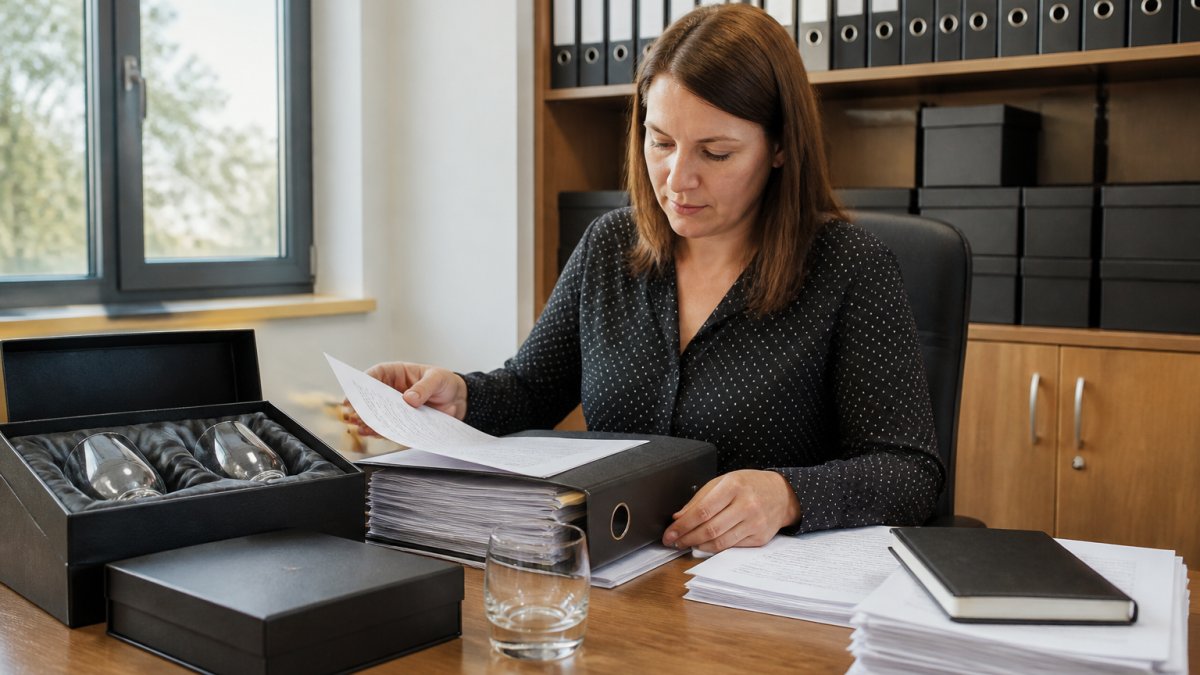
The ATO expects employers and businesses to keep detailed records of gifts and benefits provided. Poor record-keeping is one of the most common reasons the ATO disallows deductions or assesses additional FBT.
What Records to Keep and How Long
For employee gifts, keep records showing:
- Employee name and date of gift
- Description of the gift (e.g., "custom-etched wine glass set")
- Cost or value of the gift
- Date given
- Business or personal occasion (e.g., "retirement", "service anniversary", "Christmas")
- Whether it's part of a uniform benefit or one-off gift
For client and business associate gifts, record:
- Recipient name and business relationship
- Description of gift
- Cost
- Date given
- Business purpose (e.g., "client appreciation", "promotional item")
Keep records for at least five years. The ATO can request records going back this far, and you need to be able to produce them.
ATO Substantiation Requirements
The ATO doesn't require you to lodge a separate gift register, but you must be able to substantiate claims if audited. Substantiation means providing evidence that supports your tax position.
For FBT, you need to show:
- The gift was provided to an employee
- The value (cost to you)
- Whether it qualifies as a minor benefit
- That it was not part of a pattern of similar benefits
For deductions, you need to show:
- The expense was incurred in gaining assessable income
- The business purpose
- The amount paid
- A valid invoice
If you can't substantiate a claim, the ATO will disallow it. This can result in:
- Loss of the deduction
- Assessment of additional FBT
- Interest charges
- Penalties for non-compliance
Keep invoices from suppliers like The Glassware Company. These are your primary evidence of the expense. Store them safely, either in hard copy or scanned digital format.
Practical Examples: Calculating Tax Outcomes
Working through examples helps clarify how the rules work in practice.
Example 1: Employee Retirement Gift
Your business gives a retiring employee a custom-etched crystal decanter set worth $280 from The Glassware Company. This is a one-off gift for a special occasion.
Tax outcome: The gift qualifies as a minor benefit (under $300, one-off, special occasion). No FBT applies. The business cannot claim a deduction for this gift.
Example 2: Branded Glassware for All Staff
Your winery gives every staff member a branded beer stein worth $120 at the annual Christmas party.
Tax outcome: This is a uniform benefit given to all employees. FBT applies to each employee on the full $120 value.
Example 3: Promotional Glassware for Clients
Your business purchases 50 custom-etched wine glasses at $35 each (total $1,750 plus $175 GST) from The Glassware Company to distribute to clients at a trade show.
Tax outcome: The business can claim a deduction for the $1,750 cost. If GST-registered, it can also claim the $175 GST as an input tax credit, reducing the net cost to $1,575.
Example 4: Mixed Gifting Program
A corporate client gives employees individual gifts worth $250 each at the end of year (e.g., a branded glassware set from The Glassware Company).
Tax outcome: Employee gifts under $300 qualify as minor benefits. No FBT. The business cannot claim a deduction for employee gifts. Client gifts are deductible as business expenses.
Corporate gifting tax rules exist to ensure fairness and compliance, but they don't have to be a barrier to thoughtful gifting.
When you work with a supplier like The Glassware Company on custom-etched glassware, you're investing in a gift that reflects your brand and builds relationships.
Frequently Asked Questions
When does a gift to an employee attract fringe benefits tax?
Fringe benefits tax applies to non-cash benefits given to employees. However, gifts under the $300 minor benefits threshold per employee per financial year are generally exempt, provided they are one-off or infrequent gifts. Branded glassware or promotional items often qualify for this exemption. If you give multiple gifts to the same employee throughout the year, their combined value is assessed against the threshold. Entertainment (meals, events) is treated separately under FBT entertainment rules.
Can corporate gifts be tax deductible?
Yes, corporate gifts can be tax deductible if they are directly connected to your business activities and you have a genuine business purpose. The gift must be a legitimate business expense, not a personal benefit. Gifts to clients, customers, or employees used to build relationships or promote your business are generally deductible. However, you must maintain clear records showing the recipient, date, value, and business purpose. Gifts that are excessive or lack a clear business link may be challenged by the ATO.
How do I calculate the $300 minor benefits threshold for employee gifts?
The $300 threshold applies per employee per financial year (1 July to 30 June). Add up the value of all non-cash gifts given to each employee during that year. If the total is $300 or less and the gifts are one-off or infrequent, they are exempt from FBT. The value includes GST. Once you exceed $300 for an employee in a financial year, FBT may apply to the excess amount. If you give multiple gifts (for example, branded glassware at Christmas and a gift card for a milestone), you must total their values to check against the threshold.
What records should I keep for corporate gifts to comply with the ATO?
Keep records showing the recipient's name, date of gift, description of the gift, cost or value (including GST), business purpose, and the relationship (employee, client, or other). For gifts under the $300 minor benefits exemption, document why the gift is one-off or infrequent. Retain these records for five years. For branded glassware or custom promotional items, keep the purchase invoice, proof of delivery, and any approvals or quotes. Clear documentation protects you if the ATO queries the gift's business purpose or FBT treatment.