 how-to
How to Select Durable Stemware for Catering Events
Table of Contents
- Start With Event Type, Formality and Service Flow
- What Commercial Stemware Means in Practice
- Tempered Glass vs Standard Glass: Which Survives a Catering Calendar?
- Matching Glass Shape and Capacity to the Drinks You Pour
- Stemware Care and Maintenance That Cuts Breakage
- Custom Etched Glassware for Events: Durability and Presentation
- Stock Levels, Replacement Planning and Total Cost of Ownership
- Frequently Asked Questions
Last Updated: October 20, 2026
Start With Event Type, Formality and Service Flow
Durable stemware selection starts with the event itself, not the glass. The right glass for a black-tie wedding differs from the right glass for a muddy-field sporting event, and choosing before you know the format is how venues end up with cracked bowls and frustrated staff.
At The Glassware Company, we see this play out with clients every week. So work through three questions first:
- Event type: wedding, conference, tasting, corporate hospitality, or outdoor gathering
- Formality: full table service, buffet, or standing bar service
- Service flow: how glasses move from storage to bar to guest to wash
A formal seated dinner needs elegant stemware with a stable base. A long outdoor event needs shorter stems and thicker bowls. Get these decisions right and the rest of the selection gets simpler.
What Commercial Stemware Means in Practice
Commercial stemware is glassware built for repeated washing, stacking, transport and heavy use, not occasional home entertaining. The difference sits in the material, the joint between stem and bowl, and the rim finish.
A quick definition helps here. Commercial stemware is drinkware designed and manufactured to survive a hospitality venue's daily dishwashing cycle, constant handling and frequent transport without chipping or shattering at the first knock.
That definition matters because a standard retail glass can look identical to a commercial one. The visual match hides a big gap in durability.
Three construction details separate them:
- One-piece pulled stems have no glued joint, so the stem will not snap off at the bowl
- Fire-polished rims close micro-cracks that start chipping
- Thicker bases add stability on crowded bar tops
Check these before you compare anything else.
Tempered Glass vs Standard Glass: Which Survives a Catering Calendar?
Tempered glass wins for catering events on almost every count. The heat treatment puts the outer surface under compression, so the glass resists knocks and thermal shock far better than standard glass. When tempered stemware does break, it tends to shatter into small blunt pieces rather than long, dangerous shards.
Standard glass is cheaper and clearer in the hand. But in a heavy-use venue, the lower upfront price rarely survives a full season of replacement.
Most buying guides stop at that two-way comparison. For catering, the real decision involves three commercial-grade options, and the trade-offs run deeper than impact resistance alone.
The three materials that matter in a catering setting
- Tempered soda-lime glass: heat-treated for impact and thermal-shock resistance. Heavier than crystal, slightly less brilliant, but the most forgiving option for high-volume washing and transport. Break behaviour is blunt fragmentation rather than long shards.
- Standard (untempered) glass: cheaper, lighter, and often clearer in the hand. Prone to cracking under hot wash cycles and to chipping at the rim. Suitable only for low-volume, carefully handled formal settings.
- Crystal (lead-free or leaded): the best clarity, resonance and thinness. Also the most fragile at the rim and stem, the most expensive to replace, and the least tolerant of commercial glasswasher cycles. In catering, crystal is usually reserved for plated formal service with dedicated handling, not standing bar service.
How the three compare across catering criteria
| Factor | Tempered soda-lime | Standard glass | Crystal |
|---|---|---|---|
| Impact resistance | High | Low to moderate | Low |
| Break behaviour | Small blunt pieces | Long sharp shards | Fine shards, often at rim or stem |
| Thermal shock | Tolerates hot wash cycles | Prone to cracking | Poor tolerance |
| Clarity and weight | Slightly heavier, good clarity | Lighter, delicate | Lightest, best clarity |
| Relative upfront cost | Higher | Lower | Highest |
| Replacement availability | Usually broad | Broad | Often restricted to specialist suppliers |
| Best for | Bars, venues, outdoor events | Low-volume formal settings | Plated formal service with dedicated handling |
The cost-of-ownership angle most guides miss
Purchase price is only one line in the ledger. The material that survives a catering calendar is the one that minimises the total of purchase price, expected breakage, washing capacity and replacement availability across the season.
A common pattern in high-volume operations is that tempered soda-lime costs more per glass but breaks less often, washes in standard commercial cycles, and can be reordered from broad stock. Crystal costs the most per glass, breaks most often at the rim and stem, and may need specialist reordering, so its sticker price understates its true cost.
Before you commit, ask your supplier four questions:
- Is the tempering confirmed in writing?
- What wash temperature and cycle is the glass rated for?
- Is replacement stock held locally, and in what quantities?
- Does the rim finish resist chipping after repeated cycles?
Matching Glass Shape and Capacity to the Drinks You Pour
Glass shape and size should follow your drink list, not the other way around. Pour a sparkling wine into a wide red wine bowl and you lose the bubbles and the aroma. Serve a bold red in a small white wine glass and the wine never opens up.
Capacity matters just as much. Oversized bowls encourage over-pouring at bar service, which raises cost and guest risk. Undersized glasses force refills and slow the service flow.
A working guide for a catering bar:
- Champagne flute: narrow bowl, keeps bubbles alive, ideal for toasts
- White wine glass: smaller bowl, keeps the wine cool
- Red wine glass: wider bowl, lets the wine breathe
- Rosé: a medium bowl works for most styles
- Dessert wine: small capacity, since pours are short
- Tumbler: for chilled drinks and spirits where a stem is not needed
Keep two or three glass types per event rather than a full varietal range. Fewer types means simpler inventory, faster service and less breakage.
Stemware Care and Maintenance That Cuts Breakage
Care and maintenance is where most breakage actually happens, not in the guest's hand. Rough dishwashing, careless stacking and poor storage do more damage than any clumsy toast.
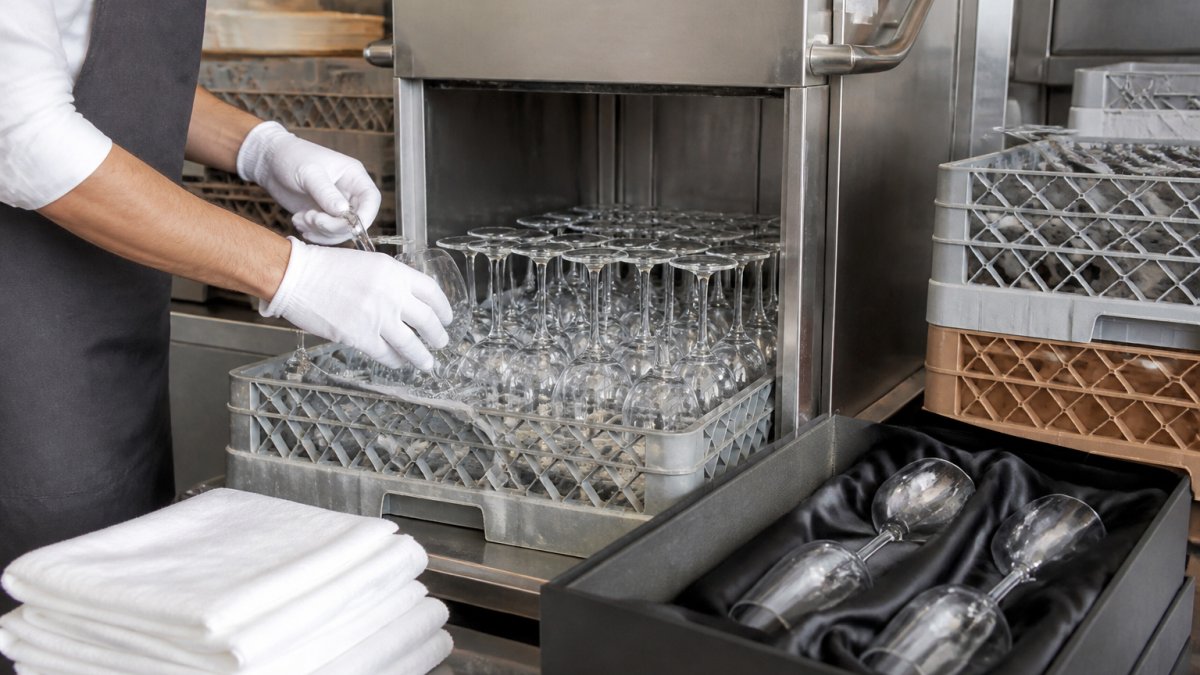
Most guides give a short list of dos and don'ts. The operational detail below is what actually reduces breakage across a catering calendar.
Washing: temperature, cycle and loading
- Use a dedicated glasswasher, not a general dish rack. Glass-specific machines control water pressure and cycle length.
- Run a low-temperature or glass-specific cycle. High-temperature general cycles stress the rim and bowl; check the glass manufacturer's rated wash temperature before setting the machine.
- Load stemware upright in compartmented racks so glasses do not touch during the cycle.
- Never overload the machine to save time. Overloading chips more rims than any other single habit.
- Use a rinse aid formulated for glass to reduce water spotting and the need for hand polishing.
Handling: the three-point hold
Train staff to hold glasses by the base and stem, never the rim. The three-point hold, base, stem and bowl, spreads the load and keeps fingers off the drinking edge. A common pattern is that rim handling accounts for a large share of chips that only appear once the glass reaches the table.
Transport: racks, crates and padding
- Transport in divided crates with padded slots, never loose in boxes.
- Use glass racks that match your glasswasher compartments so glasses move from wash to transport without being handled twice.
- Pad between layers with clean cloths or foam inserts when crates are stacked.
- Label crates by glass type so staff do not dig through mixed stock at the venue.
Storage: dry, stable and out of traffic
- Store upright in a dry, stable area away from bar traffic and doorways.
- Avoid bowl-on-bowl stacking unless a protective mat or rack separates the glasses.
- Keep storage away from heat sources that can stress the glass over time.
A simple breakage log
Track breakage by glass type and by stage, wash, transport, service or storage. The type and stage that break most often tell you whether the problem is shape, handling or machine settings. Review the log after each season and adjust racking, training or stock levels accordingly.
Custom Etched Glassware for Events: Durability and Presentation
Custom etched glassware adds brand presence without sacrificing durability, provided the etching is done properly.
That answers the question we hear most often: will the artwork survive regular washing? A properly etched logo will hold up where a printed or applied decal will not.
At The Glassware Company, we etch and engrave logos and artwork directly onto the glass, and we recommend it for venues that want their brand on the table at every event.
Presentation matters too. Our custom manufactured gift boxing service pairs etched and branded glassware with premium packaging, on roughly a 28 working day turnaround.
Stock Levels, Replacement Planning and Total Cost of Ownership
Total cost of ownership beats sticker price every time. A cheaper glass that breaks twice as often costs more across a season than a durable one bought once.
Plan your stock around realistic breakage, not a perfect world. A sensible approach for a catering operation:
- Buy replacement stock upfront: set aside a buffer of spare glasses per type
- Track breakage by glass type: the type that breaks most is telling you something about shape or handling
- Standardise on fewer types: simpler inventory means faster reordering
- Review after each season: adjust buffer levels using your own breakage data
The cheapest glass is rarely the cheapest to own. Factor in replacement, staff time and the guest experience of a chipped rim, and durable stemware pays for itself.
Selecting durable stemware for catering events comes down to matching material, shape and care to how your events actually run.
If you want glassware that carries your brand and survives the calendar, The Glassware Company can help.
Frequently Asked Questions
What makes wine glasses suitable for commercial use?
Commercial suitability comes down to three things: the glass type, the construction at the join between bowl and stem, and how it handles repeated washing. Durable stemware for catering is usually made from tempered or otherwise strengthened glass, with a one-piece drawn stem rather than a glued join. Look for a pulled stem, a fire-polished rim and a base wide enough to resist tipping on uneven surfaces. Ask suppliers how the glass performs across dishwashing cycles, not just how it looks on a shelf.
Is tempered glass more durable than standard glass?
Tempered glass is heat-treated so it resists impact and thermal shock better than standard annealed glass, which matters when glasses move from a hot wash to a cold bench. The trade-off is the failure mode: tempered glass tends to break into small, blunt fragments rather than sharp shards, which is safer in a crowded venue. Standard glass can chip at the rim more gradually, which often means a glass is pulled from service early. For high-volume catering, tempered or strengthened options usually reduce replacement rates.
How many wine glasses should you plan for a catering event?
A common planning approach is to allow two to three glasses per seated guest for a meal service, plus a buffer for breakage and for guests who switch drinks. Add extra stock for bar service and outdoor areas where glasses get set down on uneven surfaces. Keep a replacement reserve of roughly 10 to 15 per cent of your total, and rotate older stock out of front-of-house use into backup. If you are ordering custom etched glassware, factor the reserve into the same order so future reorders match.
How should caterers wash and store stemware to reduce breakage?
Rack glasses by shape so bowls do not knock together, and use a glasswasher cycle with a cool-down that avoids sudden temperature change. Never stack stemware bowl-in-bowl for storage. Store upright in crates with dividers, or hang by the base in a rack if your venue allows it. Transport glasses in divided crates rather than loose in boxes, and polish with a lint-free cloth held away from the rim. Consistent handling matters as much as the glass itself.