 listicle
7 Best Durable Wine Glasses for Commercial Use in 2026
Table of Contents
- What Makes a Wine Glass Commercial-Grade?
- Quick Comparison: Top Durable Wine Glasses
- 1. Schott Zwiesel Tritan Crystal: The Benchmark for Durability
- 2. Libbey Signature Kentfield: The Cost-Effective Workhorse
- 3. Gabriel-Glas StandArt: The Sommelier's Choice for Simplicity
- 4. Glasvin The Universal: Premium Thin-Walled Durability
- 5. Stölzle Lausitz: German Engineering for High-Volume Service
- 6. GV Home Universal: The Budget-Friendly Entry Point
- How to Prevent Glassware Breakage in Hospitality
- Best Practices for Cleaning Etched Wine Glasses
- Frequently Asked Questions
Last Updated: September 9, 2026
What Makes a Wine Glass Commercial-Grade?
The difference between a glass that lasts a year and one that shatters in week two comes down to material composition and construction, not the brand name printed on the box. Commercial-grade durable wine glasses are engineered to survive the three killers of hospitality glassware: mechanical impact, thermal shock from dishwasher cycles, and the slow clouding that turns crystal clarity into a milky blur.
The Glassware Company supplies etched and engraved stemware to venues across the hospitality sector. In practice, commercial-grade means three things: a lead-free crystal or tempered glass composition that resists breakage, a reinforced stem and foot that handle daily service torque, and a dishwasher-safe rating that survives hundreds of cycles without clarity loss. Most consumer glassware fails on at least one count, which is why venues replace glasses in bulk every few months while a properly specified commercial range can serve for years.
The trade-off is always the same: durable wine glasses thin enough to feel elegant versus thick enough to survive a busy Friday service. The products below solve that equation in different ways, at different price points, tested against the demands of high-volume restaurants, tasting rooms, and event venues.
Quick Comparison: Top Durable Wine Glasses
Before we break down each option, here is the shortlist for fast decision-making. These are the durable wine glasses we recommend for commercial settings, based on durability testing, dishwasher performance, and total cost per glass over a twelve-month period.
| Glass | Material | Best For | Key Trade-off |
|---|---|---|---|
| Schott Zwiesel Tritan | Titanium crystal | High-volume venues | Higher upfront cost |
| Libbey Kentfield | ClearFire glass | Everyday dining rooms | Thicker rim |
| Gabriel-Glas StandArt | Lead-free crystal | Fine dining, one-glass inventory | Premium per-unit price |
| Glasvin The Universal | Hand-blown crystal | Upscale wine bars | Needs careful handling |
| Stölzle Lausitz | Lead-free crystal | Catering and events | Traditional design |
| GV Home Universal | Machine-made crystal | Casual dining | Less refined feel |

The right choice depends on your service style, your budget per glass, and how often you are prepared to replace stock. For custom-etched branding, you will also want a glass that holds its finish through commercial washing, addressed in the maintenance section.
1. Schott Zwiesel Tritan Crystal: The Benchmark for Durability
Schott Zwiesel is the glass every other commercial option gets measured against. Its patented Tritan crystal composition includes titanium and zirconium oxides, giving it exceptional mechanical strength and thermal shock resistance without the lead content that weakens traditional crystal.
What stands out in daily service is the tempered stem, since stem breakage is the most common failure point in commercial stemware. The glasses are dishwasher safe and resist the clouding that plagues soda-lime glass after repeated commercial cycles. If you are running a high-volume restaurant where breakage costs are eating into margins, this is the benchmark.
The honest limitation is price. The initial investment per glass is higher than standard soda-lime options, which stings when stocking a 200-cover dining room. But the breakage rate drops so significantly that most venues recoup the difference within the first few months of service.
2. Libbey Signature Kentfield: The Cost-Effective Workhorse
If Schott Zwiesel is the premium benchmark, Libbey Kentfield is the volume play most mid-range restaurants should start with. The Kentfield range uses Libbey's ClearFire glass composition, delivering better brilliance than standard soda-lime while keeping costs in the practical zone.
The design choices are all about service survival. The reinforced, flat foot gives base stability on tray service and reduces tipping. The drawn stem construction removes the weak seam point that causes breakage in cheaper glasses. It is fully dishwasher safe and holds up to the daily grind of a high-turnover dining room.
What you give up is rim refinement. The rim is noticeably thicker than hand-blown or premium crystal options, which matters if your guests notice mouthfeel. For everyday service where wine is an accompaniment rather than the main event, this is a fair trade for the durability you gain.
3. Gabriel-Glas StandArt: The Sommelier's Choice for Simplicity
Gabriel-Glas StandArt takes a different approach to commercial durability: instead of making one glass stronger, it makes one glass do everything. Designed by sommelier René Gabriel, this universal glass handles all wine varietals, so you stock one shape instead of six.
The operational benefit is significant. A single glass shape simplifies inventory management, reduces storage requirements, and cuts the SKUs you need to track for breakage replacement. The bowl is optimised for aeration and the rim is tapered for a clean pour, performing credibly across reds, whites, and sparkling wines.
It is lead-free crystal, dishwasher safe, and lightweight yet strong. The catch is the per-unit price, which sits above most volume-oriented options. For fine dining venues and wine bars where the glass is part of the presentation, this investment pays off in guest perception and simplified stock management.
4. Glasvin The Universal: Premium Thin-Walled Durability
Glasvin The Universal is for venues that refuse to compromise on the drinking experience. This hand-blown, thin-walled glass feels delicate in the hand but performs far better than its profile suggests.
The optimised bowl promotes aeration, and the ultra-lightweight design delivers the mouthfeel wine professionals look for. For tasting rooms and upscale wine bars where the glass directly affects the guest's perception of the wine, this is a strong contender.
The trade-off is handling. Hand-blown glass, even when well made, requires more careful treatment than machine-made alternatives. You will need staff trained in proper glass handling and a washing protocol that separates these from heavy-duty service ware. If your operation cannot guarantee that care, the durability advantage narrows.
5. Stölzle Lausitz: German Engineering for High-Volume Service
Stölzle Lausitz brings German manufacturing discipline to commercial glassware. These glasses are engineered for consistency, which matters more than you might think when replacing broken stock across multiple service stations.
The lead-free crystal composition offers high resistance to breakage, and the glasses are fully dishwasher safe. What sets Stölzle apart is manufacturing consistency: every glass in a case is virtually identical, so replacement stock matches your original service ware. That consistency also extends to the etching surface, which matters if you are branding your glassware.
The design is more traditional and utilitarian than the premium options. You are not buying these for aesthetic flair, but because they survive catering events, large functions, and the rough handling of high-volume service.
6. GV Home Universal: The Budget-Friendly Entry Point
GV Home Universal is the machine-made sibling of the Glasvin line, designed for venues that need commercial durability without the hand-blown price tag. It is an entry-level professional glass that holds its own in high-traffic environments.
The machine-made construction gives it a durability advantage over hand-blown alternatives, and the universal bowl design works across wine styles. It is dishwasher safe and priced for volume purchasing, making it a sensible option for casual dining venues and bars that go through glass quickly.
The limitation is refinement. Compared to the premium hand-blown line, the finish is less polished and the rim is thicker. For venues where wine is served by the glass at pace rather than presented as a centrepiece, this is a reasonable trade.
How to Prevent Glassware Breakage in Hospitality
Breakage in a commercial setting is rarely random. It clusters around specific moments: the glass run from the dishwasher to the service station, the pour at the bar rail, and the bus tub at the end of service. Understanding where your glasses break tells you what to fix.
Track Breakage by Station, Not Just in Total
Most venues record total breakage per month, which hides the problem. A far more effective method is to track breakage per service station or per section. Assign a numbered bin for broken glass at each station, bar, floor, and dish pit, and tally the counts weekly. A consistent spike at the bar rail, for instance, often points to a poorly designed ice well or a lack of a dedicated dump spot for straws and garnishes, rather than clumsy staff. A spike at the dish pit usually indicates incorrect rack loading or over-tight stacking in the washer.
The Hidden Cost of Breakage: A 12-Month View
To make the business case for higher-quality glassware, you need to calculate the Total Cost of Ownership (TCO), not just the upfront price per unit. A standard soda-lime glass might cost $3.00 per unit, but if your breakage rate is 5% per month, you are replacing the entire inventory every 20 months (cornell.edu). In a 200-cover restaurant with 500 glasses in circulation, that is 25 glasses per month, or 300 per year, an annual replacement cost of $900. A premium titanium-strengthened glass at $8.00 per unit with a breakage rate of 1% per month means you replace only 5 glasses per month, or 60 per year, costing $480 annually. Over 24 months, the 'cheaper' glass costs you $1,800 in replacements, while the premium glass costs $960. The premium option wins on cost alone, before factoring in the labour time spent on receiving and stocking new deliveries.
Ergonomics: The Server's Grip is a Breakage Point
A frequently overlooked factor is server fatigue. A standard wine glass weighs between 400 and 600 grams; a server carrying a tray with six full glasses manages over 3 kilograms of unbalanced weight (the CDC). Heavier, poorly balanced glasses increase drop risk, especially during busy service. When selecting glassware, consider weight distribution: a glass with a heavier foot and lighter bowl is easier to carry because the centre of gravity is lower. Ask your supplier for the weight specification, and have floor staff handle a sample before committing to a bulk order. Their feedback on grip and balance is a practical data point no spec sheet provides.
The Sustainability Angle: Breakage is a Waste Stream
Frequent breakage is not just a cost issue; it is a sustainability issue. Commercial glass is not infinitely recyclable in the same way as consumer bottles (the EPA). Broken bar glass often ends up in landfill because it is contaminated with food waste or is a different composition to standard container glass. Reducing breakage by 2% per month at a busy venue can divert over 100 kilograms of glass waste from landfill annually. This is a tangible metric to include in your venue's sustainability report, and it strengthens the argument for investing in more durable glassware.
A practical handling protocol involves three non-negotiables: never carry more than three glasses in one hand (use a tray for more), never stack stemware on a flat surface (use a dedicated peg rack), and always use a glass rack for transport to and from the dishwasher. These rules address the three primary mechanical impact points: hand-to-tray, tray-to-table, and rack-to-shelf.
Best Practices for Cleaning Etched Wine Glasses
If you are serving custom-etched or engraved glassware, cleaning protocol matters even more. The etching itself does not fade, but the clarity of the surrounding glass depends on how you wash it.
Commercial glasswasher detergents are alkaline and, over time, can leave a film on glass that dulls clarity. The solution is a rinse aid formulated for glassware and a regular descaling schedule for your machine. Etched areas can hold residue more readily than smooth glass, so inspect branded glasses periodically for film build-up.
For venues running etched glassware, we recommend a dedicated wash cycle for branded stock rather than mixing it with heavy-duty service ware. This protects the etching and extends the life of your branded investment. When you are ready to order custom-etched durable wine glasses for your venue, the team at The Glassware Company can guide you through glass selection and artwork proofing before production begins.
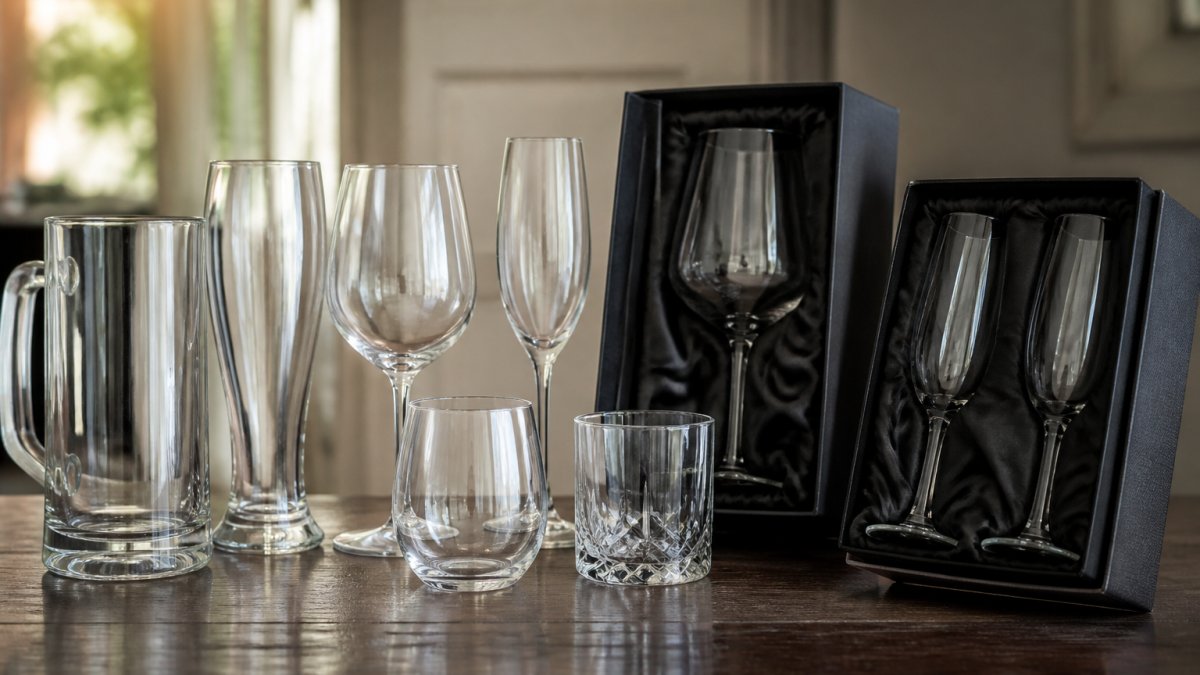
Choosing the right commercial glassware comes down to matching the glass to your service reality. A fine dining room needs thin-walled crystal for presentation, while a high-volume bistro needs reinforced stems that survive the rush. The Glassware Company carries a large range of styles, from beer steins to champagne flutes, and its team has the experience to help you select glassware that balances durability with the branded presentation your guests expect. Get started with a quote today, and we will ensure your artwork is on point and your glassware stands up to the demands of your venue.
Frequently Asked Questions
What are the most durable wine glasses for a busy restaurant?
For high-volume venues, look for machine-made glasses with reinforced construction. Schott Zwiesel's Tritan crystal and Libbey's ClearFire technology offer superior impact and thermal shock resistance. These materials are engineered to withstand the rigours of commercial dishwashers and frequent handling, reducing your breakage rate significantly compared to standard soda-lime glass.
Are crystal wine glasses durable enough for commercial service?
Yes, but only if you choose the right type. Lead-free crystal glasses from brands like Schott Zwiesel and Stölzle Lausitz are treated to be as strong as standard glass while maintaining a thinner rim and clearer appearance. They are dishwasher-safe and can handle commercial use, though they require a higher initial investment than standard glassware.
How can I prevent glassware breakage in my hospitality venue?
Preventing breakage starts with buying durable, commercial-grade glasses. Implement a strict handling routine: avoid over-stacking, use glass racks for transport, and train staff on proper polishing techniques. Check for chips or cracks regularly, as damaged glasses are more prone to shattering.
What is the best way to clean etched wine glasses?
Etched glasses should be rinsed shortly after use to prevent residue from settling in the design. In a commercial dishwasher, use a gentle cycle with a low-alkaline detergent. For hand washing, use warm soapy water and a soft sponge, avoiding abrasive pads that can scratch the etch. Proper cleaning prevents clouding and keeps the etched logo looking sharp.
What is the difference between standard and commercial-grade wine glasses?
Commercial-grade glasses are built to a higher durability standard. They use materials like tempered glass or titanium-reinforced crystal to withstand thermal shock and mechanical impact. They also feature reinforced rims and bases to reduce chipping. While standard glass is fine for home use, commercial-grade is essential for the high turnover and rough conditions of a professional venue.