 how-to
7 Proof Checks Before You Approve a Custom Beer Glass Order
Quick Summary
Before approving a custom beer glass order, check your artwork file format, logo placement on the exact glass shape, the digital proof's decoration method and tolerances, and a physical sample. Then confirm quantity, lead time and commercial terms in writing and inspect the delivery against the approved proof.
- Use vector files such as AI, EPS or SVG where possible.
- Confirm placement against the exact glass shape, since tapered and fluted glasses distort designs.
- Ask suppliers to state decoration method, colour specification and tolerances on the proof itself.
- Approve a physical sample using the same glass and decoration method as the full run.
- Restate quantity, MOQ, setup charges, lead time and revision policy in a written order confirmation.
Table of Contents
- Why Proofing Matters Before a Custom Beer Glass Order Goes to Production
- Checking Your Artwork Requirements Before Submission
- Confirming Beer Glass Logo Placement and Alignment
- Reviewing the Digital Proof for Colour and Decoration Tolerances
- Requesting a Physical Sample Before the Full Run
- Signing Off the Proof: Quantity, Lead Time and Commercial Terms
- Inspecting Your Delivery and Booking Your Next Order
- Frequently Asked Questions
7 Proof Checks Before You Approve a Custom Beer Glass Order
Last Updated: October 27, 2026
Why Proofing Matters Before a Custom Beer Glass Order Goes to Production
A custom beer glass order is hard to undo once production starts. A logo can sit slightly off-centre, a colour can look different on screen than on glass, or artwork can be too fine to etch clearly. Proofing can help identify these issues before production starts. Ensuring your glassware design is flawless prevents visual distractions that might otherwise draw attention away from the quality of the pour, much like the process of troubleshooting foamy beer helps maintain the integrity of the beverage itself.
A good custom beer glass order proofing checklist covers the whole path from artwork to delivery. Work through each check below, and sign off only when every item is clear to you.
- Confirm your artwork meets the file requirements
- Check logo placement and alignment on the glass
- Review the digital proof for colour and decoration
- Approve a physical sample where possible
- Confirm quantity, lead time and commercial terms
- Inspect the delivery when it arrives
Checking Your Artwork Requirements Before Submission
Start with the artwork.
Ask yourself whether the design still reads clearly from arm's length. Browse our custom beer glass design tips for logos for guidance on shapes that suit the glass.
Use this quick check before you send your files:
- Use vector files where possible, such as AI, EPS or SVG
- Keep text larger than you think you need
- Remove hairline strokes and tiny details
- Confirm colours, if any, against your brand guide
- Keep a clean margin around the logo
Confirming Beer Glass Logo Placement and Alignment
Watch out: Tapered and fluted glasses change how a design looks. A logo that suits a straight pint glass may look distorted on a tulip or a stein, so confirm placement against the exact glass shape you ordered.
Reviewing the Digital Proof for Colour and Decoration Tolerances
Ask your supplier to state, on the proof itself, the decoration method, the colour specification they are working to, and the tolerances they will hold. A proof without those three items is not a proof, it is a picture.
What to confirm on the proof document
- Decoration method: etching, engraving, screen printing, pad printing, or decal application. Each has a different tolerance profile.
- Colour specification: for printed work, ask whether they are matching to a physical standard (such as a Pantone bridge reference) or to a CMYK build. For etching, confirm the finish, bright, frosted, or shaded, because etch depth and masking affect how white the mark reads.
- Placement dimensions: the distance from the base, the distance from the rim, and the wrap angle around the circumference, in millimetres.
- Decoration size: the bounding box of the artwork on the glass, not the artwork file dimensions.
- Tolerance statement: the acceptable variation for registration, colour shift, and placement, expressed as a number, not a promise.
Typical tolerances to expect
Most practitioners find that decoration on curved glass carries wider tolerances than flat print. Learn how logo fading happens and how to prevent it if you are concerned about colour holding over time. As a working guide, ask your supplier to confirm in writing:
- Placement: ±2 mm to ±3 mm on position is common for screen-printed and pad-printed glassware; etching can hold tighter because the mask is generated from the same artwork file.
- Registration: on multi-colour prints, misregistration of 0.5 mm to 1 mm between colours is typical and usually invisible at arm's length but visible on close inspection.
- Colour: expect a visual match rather than a spectrophotometric match. A printed colour on clear glass will read differently against a dark beer than against an empty glass, and differently again under warm bar lighting versus daylight.
- Etch depth: frosted etch is a surface effect, not a printed layer, so depth variation shows as slight changes in whiteness rather than colour shift.
Proof revision and sign-off workflow
A proof is only useful if the approval is documented. Use a simple, repeatable workflow:
- Consolidate feedback into one response. Gather comments from everyone with a stake, marketing, venue management, the person paying, and send a single collated set of changes. Piecemeal feedback is the most common cause of version confusion.
- Number every revision. Ask the supplier to label proofs v1, v2, v3 and to state what changed between versions. Keep every version on file.
- Confirm the final version in writing. The approval email should quote the proof version number, the glass style, the decoration method, the quantity, and the placement dimensions. "Approved" alone is not enough.
- Name the approver. One person should own the sign-off. If two people can approve, you have no approver.
- Record the revision cut-off. Confirm the point after which changes incur a new setup charge or a production delay, and get that in writing before you sign.
If you also want a premium presentation option alongside the glassware, our custom manufactured gift boxing service for etched and branded glassware is available.
Requesting a Physical Sample Before the Full Run
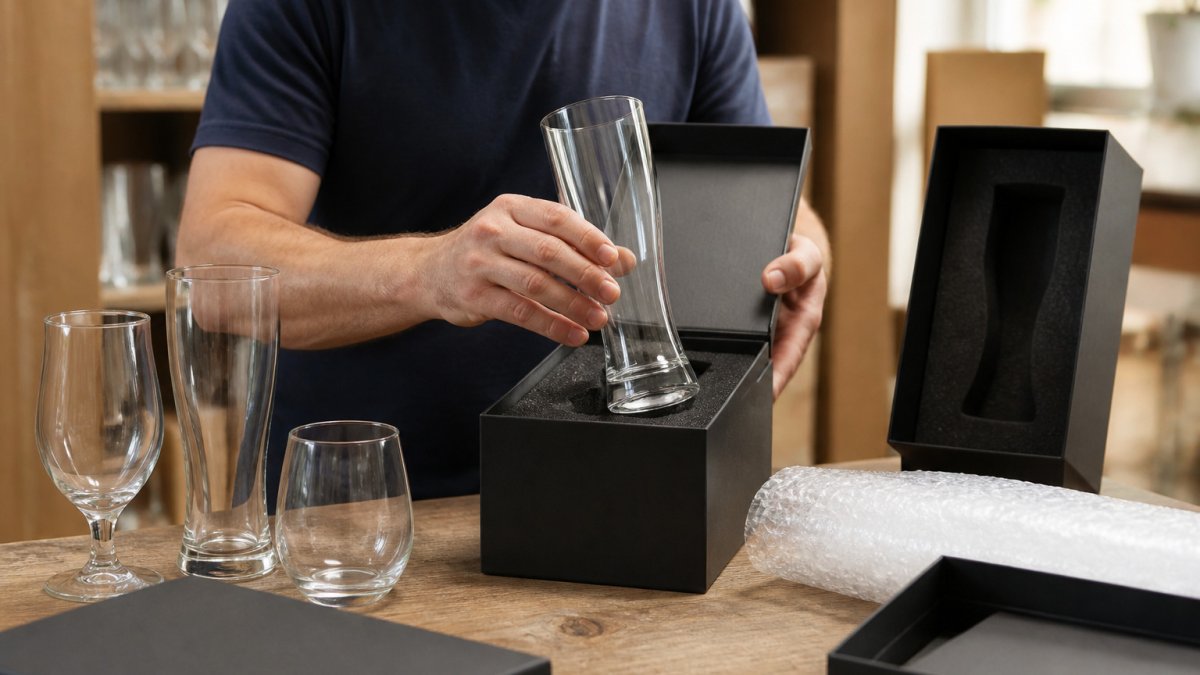
A physical sample is the best way to check a design. See how to check print durability on promotional glassware so you know what to test on the sample before approving the full run. Holding a real glass shows you how the decoration looks under bar lights and how it feels in the hand.
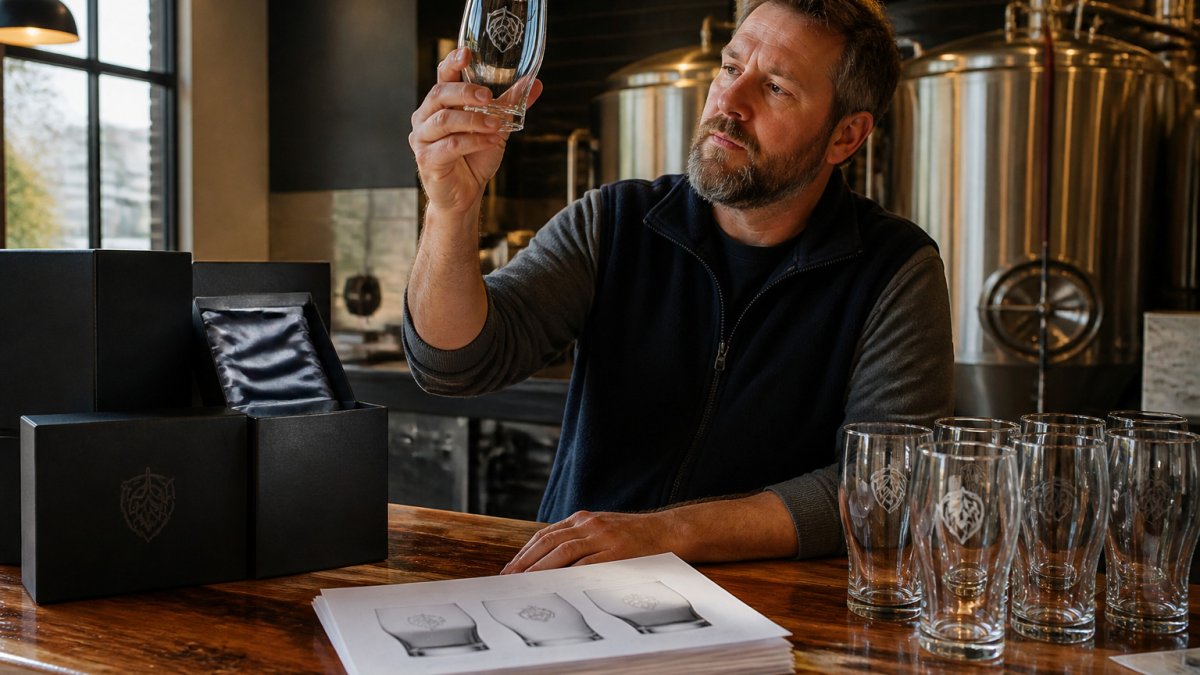
On the sample, look for:
- Edge sharpness and clarity of fine lines
- Legibility of any small text
- Colour and finish compared with your brand references
- Any marks, smudges or uneven areas
Ask whether the sample uses the same glass and decoration method as the full order. A sample on a different glass can mislead you.
Signing Off the Proof: Quantity, Lead Time and Commercial Terms
Design approval and commercial approval are two different sign-offs, and conflating them is how orders go wrong. A glass can be perfectly proofed and still arrive late, short, or in the wrong carton configuration because the commercial terms were agreed verbally.
Treat the final approval as a written order confirmation. The document should restate every variable that affects price, timing, and the finished product.
The written order confirmation checklist
Before you sign, confirm each of the following appears in the supplier's order confirmation, not just in an email thread:
- Glass style and capacity: the exact product code, the shape name, and the volume in millilitres. A "pint glass" is not a specification; a "570 ml nonic pint" is.
- Decoration method and placement: the method, the number of decoration positions per glass, and the placement dimensions agreed on the proof.
- Quantity: the ordered quantity, plus the supplier's over-run or under-run allowance. Glassware runs commonly carry a small percentage allowance either way; confirm the number and how it is invoiced.
- Minimum order quantity: the MOQ for the chosen glass and method, and whether the MOQ applies per design or per order.
- Setup and tooling charges: any charge for screens, masks, or setup, and whether it is charged once or per revision.
- Unit pricing basis: confirm what the unit price includes, decoration, packing, and carton configuration, and what is charged separately.
- Lead time: the production lead time in working days, the dispatch date, and the delivery date you actually need. State both, because they are rarely the same.
- Rush options: whether an expedited schedule is available and what it changes about the lead time.
- Freight and delivery: the delivery address, the delivery window, and who is responsible for unloading and checking in the cartons.
- Revision policy after approval: what happens if you need a change after sign-off, and at what point a new setup charge applies.
- Presentation packaging: whether gift boxing or branded packaging is included, and whether it is priced per unit or per order.
Booking the premium presentation option
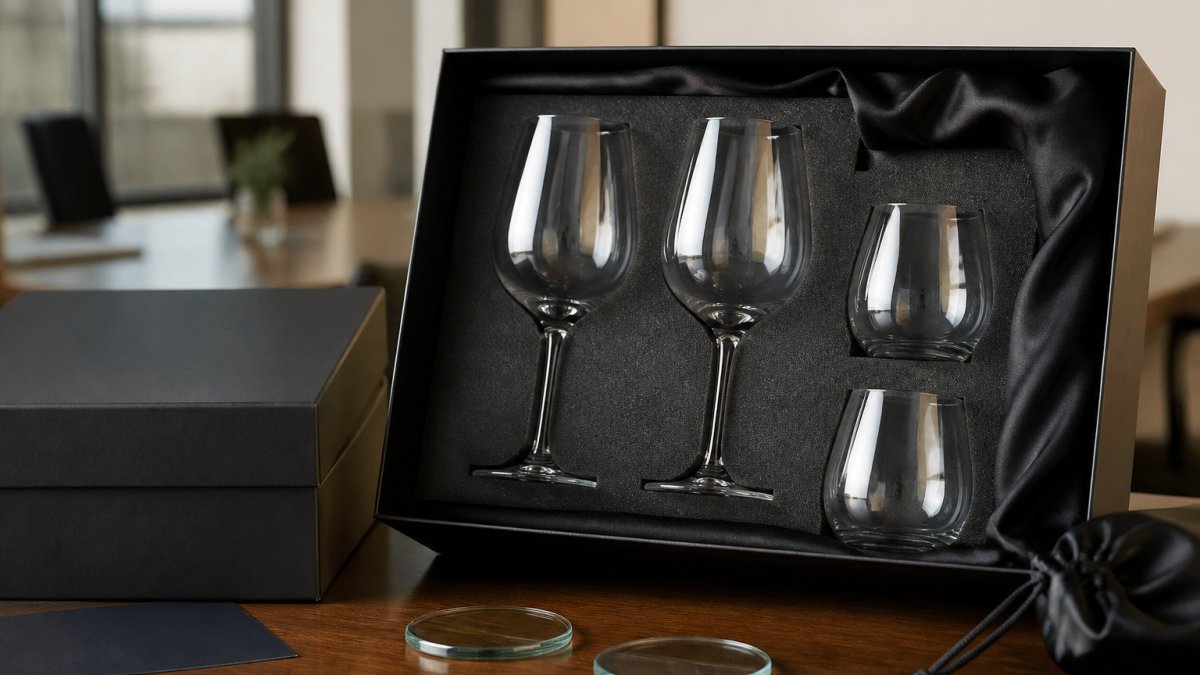
If the glasses are for gifting, awards, or a launch, the presentation matters as much as the glass. Our custom manufactured gift boxing service for etched and branded glassware is a premium presentation option with an approximately 28 working day turnaround. Explore custom gift boxing for etched glassware to plan the presentation alongside your order.
Inspecting the delivery against the approved order
Inspection is the last proof check, and it should be done against the written order confirmation and the approved proof, not against memory.
- Count and carton condition: check the carton count against the delivery docket before signing for the delivery, and note any damaged cartons on the docket.
- Glass integrity: inspect for chips, cracks, and seams. Breakages in transit are common enough that a small allowance is normal; confirm the supplier's policy for reporting them.
- Decoration alignment: compare a sample of glasses against the approved proof for placement, size, and registration. Check the first and last glass in a carton, because drift across a run shows up at the extremes.
- Colour and finish: compare against the approved physical sample where one was supplied, under the lighting the glasses will actually be used in.
- Food-contact and durability suitability: confirm the decoration sits clear of the rim, that the method is suitable for repeated beverage service, and whether the glasses are dishwasher-safe according to the supplier's care instructions.
- Report window: confirm in writing how long you have to report issues after delivery, and what evidence the supplier needs, photographs, carton numbers, and the approved proof reference.
The written order confirmation should restate each variable that affects price, timing and the finished product.
| Item | What to confirm | Why it matters |
|---|---|---|
| Glass style and capacity | Product code, shape name, volume in ml | A "pint glass" is not a specification |
| Quantity | Ordered quantity plus over-run or under-run allowance | Allowance affects invoice and delivery count |
| Minimum order quantity | MOQ per design or per order | Determines whether your order qualifies |
| Setup and tooling charges | Whether charged once or per revision | Revisions can add cost |
| Lead time | Working days, dispatch date, delivery date needed | These are rarely the same date |
| Revision policy | Point after which a new setup charge applies | Changes after sign-off can delay production |
| Presentation packaging | Whether gift boxing is included and how it is priced | Gift boxing carries an approx. 28 working day turnaround |
Inspecting Your Delivery and Booking Your Next Order
When you are ready to order again, you can request a quote from The Glassware Company. Keeping your glasses looking good is worth reading before your next delivery arrives.
Frequently Asked Questions
What should I check on a custom beer glass proof?
Check the spelling of all text. Sign off only when every point on your checklist is confirmed.
What is the difference between a digital proof and a physical sample?
A digital proof is a screen or PDF mock-up that shows where the artwork will sit on the glass. It is useful for checking layout, text and placement, but it cannot show how etching depth, frosting or print finish will look under real light. A physical sample is a finished piece decorated with your artwork, so you can judge the actual finish, colour and feel. For a custom beer glass order, request both where possible, and treat the sample as the reference for final acceptance.
How long does custom beer glass production take?
For current timing and pricing, contact The Glassware Company directly for a quote.