 how-to
How to Check Print Durability on Promotional Glassware
Table of Contents
- Why Print Durability Matters for Promotional Glassware
- How to Test Glass Printing Quality Before Ordering
- Custom Promotional Glassware Sample Inspection Checklist
- Testing Dishwasher-Safe Logo Printing on Glass
- Understanding Screen-Printed Glassware Care Instructions
- Comparing Print Methods and Durability Outcomes
- Questions to Ask Your Supplier About Print Durability
- Frequently Asked Questions
Last Updated: October 21, 2026
Why Print Durability Matters for Promotional Glassware
Custom promotional glassware makes a statement about your brand, a faded logo after a few dishwasher cycles sends the opposite message. That's why how to check print durability on promotional glassware before you order is essential.
Print quality isn't guaranteed across suppliers: some inks fade within months, and some primers don't bond properly to glass. The difference comes down to testing.
How to Test Glass Printing Quality Before Ordering
Testing glass printing quality starts with actual samples, you can't assess durability from photos or marketing claims alone.
Request a Physical Sample
Ask your supplier for a sample of the exact glass style, printing method, and design you're considering, not a generic one. A quality supplier will provide this without hesitation; pushback is a warning sign.
When the sample arrives, inspect it under good lighting and run your fingers across the printed area. The ink should feel smooth and integrated, part of the glass, not a coating that could peel.
Examine Surface Finish and Ink Adhesion
Hold the sample up to natural light and check for uneven coverage, thin spots, colour consistency, sharp edges, and any bubbles, cracks, or separation from the glass.
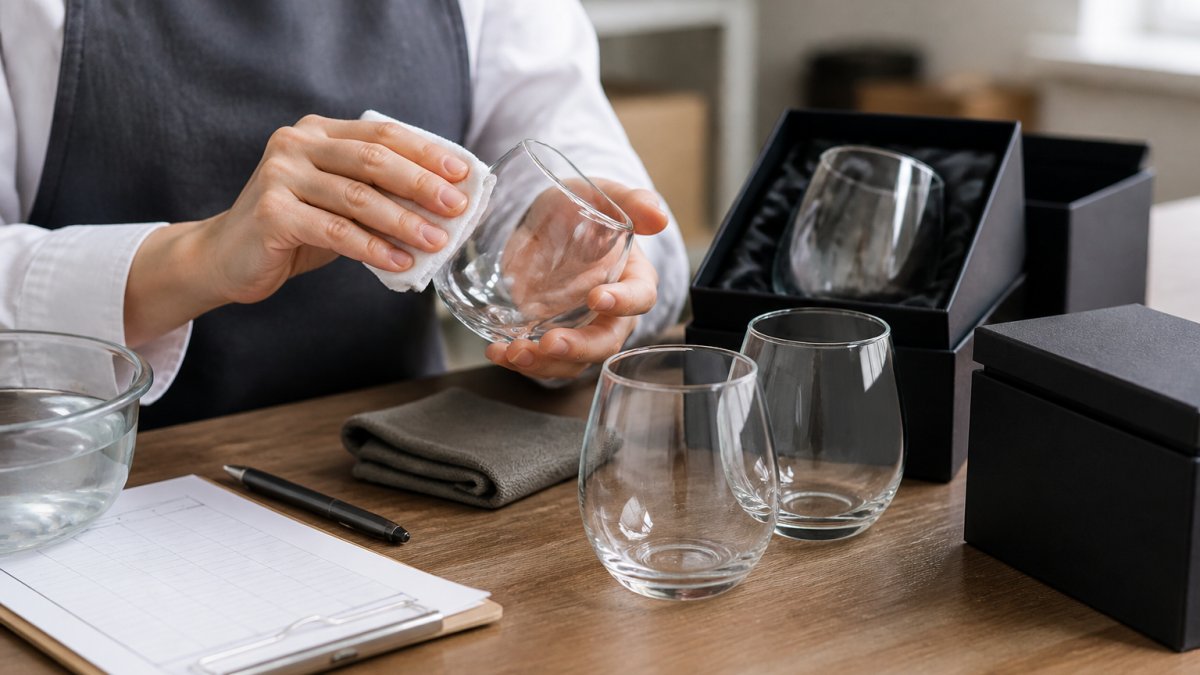
For adhesion testing, wet the sample and rub the printed area with a soft cloth under running water for 10-15 seconds, repeating 3-4 times. High-quality prints show no fading, peeling, or ink transfer.
Custom Promotional Glassware Sample Inspection Checklist
| Inspection Point | What to Check | Pass Criteria |
|---|---|---|
| Visual clarity | Sharpness of logo edges and colour definition | No blur, bleeding, or fading |
| Ink adhesion | Fingerprint and water resistance | No peeling, flaking, or transfer |
| Surface finish | Texture and integration with glass | Smooth, bonded, not raised |
| Colour accuracy | Match to approved artwork | Consistent across entire print |
| Coverage uniformity | Even ink distribution | No thin spots or gaps |
| Edge quality | Print boundaries | Clean lines, no rough edges |
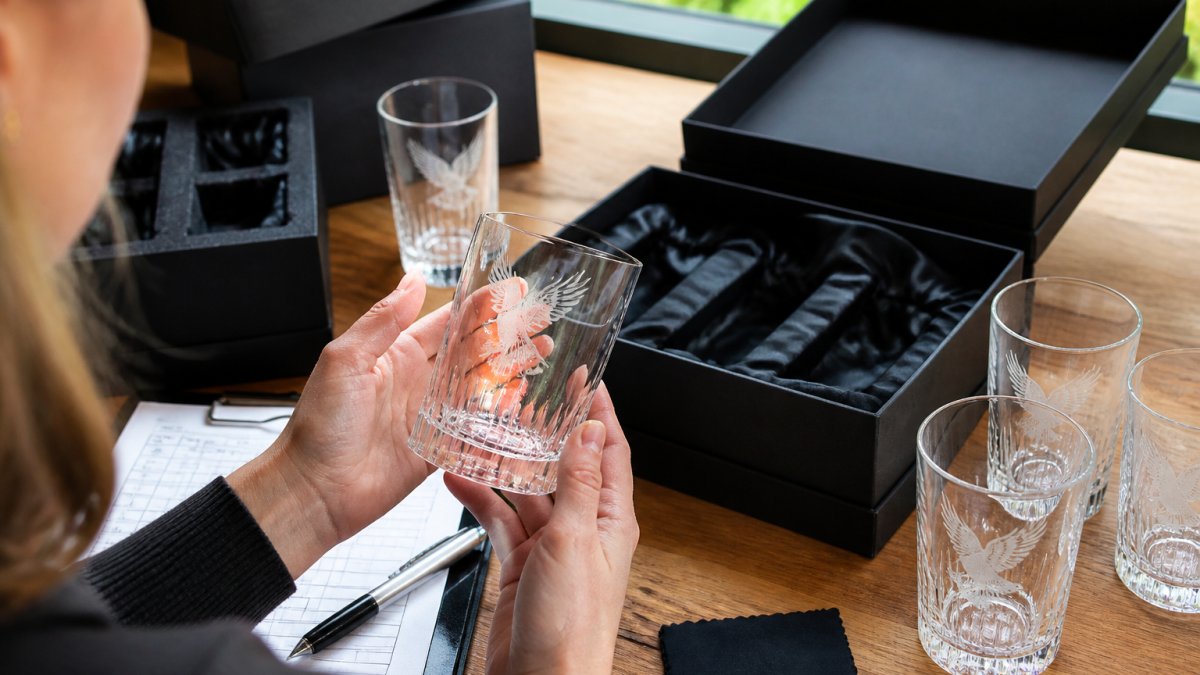
Match your testing intensity to the real-world environment: a busy bar or restaurant means constant washing and handling, while corporate gifts on office shelves have lower durability requirements.
Testing Dishwasher-Safe Logo Printing on Glass
"Dishwasher-safe" is a broad claim that doesn't tell you how many cycles the print will survive, how much fading is acceptable, or whether it copes with commercial washing. The only way to know is a repeatable protocol with clear pass/fail criteria.
Build a Simple Durability Test Protocol
A practical durability test needs only a sample, a dishwasher, a camera, and a scoring sheet. Run the same protocol on every supplier's sample to compare results.
What you need: two samples of the exact glass style, print method, and design; a home dishwasher or commercial unit; standard detergent (not a gentle or eco cycle); soft and microfibre cloths; a bright light; a camera; and a printed scorecard.
The protocol:
- Photograph both samples under the same lighting before testing. Include a close-up of the printed area and a full-glass shot.
- Record the baseline: colour intensity, edge sharpness, and any pre-existing flaws.
- Run one sample through 10 consecutive dishwasher cycles on the hottest standard programme, top rack, with normal detergent. Do not hand-wash between cycles.
- Run the second sample through 30 consecutive cycles under the same conditions.
- After every 5 cycles, remove the glass, let it cool, and inspect under bright light. Photograph the printed area.
- At the end of the protocol, compare the 10-cycle and 30-cycle samples against the baseline images.
If you can access a commercial dishwasher, run a third sample through 10 commercial cycles, hotter water, stronger detergents, and more aggressive cycles can produce markedly different results.
Pass/Fail Criteria You Can Apply
| Test | Pass | Borderline | Fail |
|---|---|---|---|
| Print loss after 10 home cycles | No visible loss | Slight edge wear, under 5% of print area | Any flaking, peeling, or loss over 5% |
| Print loss after 30 home cycles | Edge wear under 10% of print area | Edge wear 10-20% | Loss over 20% or any peeling |
| Colour fade after 30 cycles | Barely perceptible against baseline photo | Noticeable but brand still legible | Clearly faded or colour shift |
| Scratch resistance (fingernail, normal pressure) | No mark | Light surface mark that does not remove ink | Ink removed or lifted |
| Adhesion after wet rub (10-15 seconds, soft cloth) | No ink on cloth | Trace colour on cloth | Visible ink transfer |
| Commercial cycle result (10 cycles) | Comparable to 10 home cycles | Moderate edge wear | Significant loss or peeling |
Treat the borderline column as a warning. A sample that is borderline at 10 cycles is unlikely to survive a year of real use. A sample that passes at 30 cycles gives you reasonable confidence for hospitality or frequent-wash environments.
Simulating Commercial Washing Conditions
Commercial units run hotter, use stronger alkaline detergents, and complete cycles faster with more mechanical action, so a home-dishwasher result is only a proxy for bar, restaurant, brewery, or hotel use. Without a commercial machine, use the hottest programme, standard detergent, and 30 cycles rather than 10, and document the conditions.
Hand Washing and Abrasion Tests
Wine glasses, decorated tumblers, and premium gifts are often hand-washed, so test that use case separately: hand-wash one sample 30 times with warm water, standard dish soap, and a soft sponge, inspecting and photographing every 10 washes.
For abrasion resistance, rub the printed area with a damp microfibre cloth 100 times at moderate pressure, then repeat with soft cotton, recording any ink transfer or dulling. Avoid abrasive sponges, they aren't representative of normal handling.
Record and Interpret the Results
Keep a simple log per supplier: sample ID, print method, cycle count, checkpoint observations, and a final pass/borderline/fail rating, with consistently lit photographs as evidence. A sample that passes 30 home cycles and 10 commercial cycles with no wet-rub transfer is low-risk for frequent-wash use; one that's borderline at 10 cycles is high-risk regardless of marketing claims.
Understanding Screen-Printed Glassware Care Instructions
Screen printing is one of the most common methods for promotional glassware. Ink is applied through a mesh screen and sits on top of the glass, held by adhesion to a primer or coating applied beforehand, producing vibrant colours cost-effectively for larger orders.
Screen-printed glassware typically requires gentle care: hand-washing or top-rack dishwasher placement, no abrasive scrubbing, and no extreme temperature changes. These protect the print. When you receive screen-printed glassware, follow the care instructions provided to keep your artwork sharp for years.
Comparing Print Methods and Durability Outcomes
Different printing methods produce different durability profiles. Understanding these differences helps you choose the right method for your use case.
Screen Printing vs Direct-to-Glass Printing
Screen printing applies ink through a mesh screen onto the glass, relying on a primer for adhesion, vibrant and economical for large runs. Direct-to-glass printing (UV printing) applies ink without a separate primer and cures it with UV light, bonding at the molecular level for superior fade and wash resistance, though at higher per-unit cost and longer turnaround.
UV-Cured Ink and Colour Retention
UV-cured inks harden instantly under ultraviolet light, locking onto the glass for a bond that resists fading, scratching, and washing. They also resist sunlight, a major cause of fading, so they last longer on glassware displayed in bright light or used outdoors. The trade-off is cost and turnaround time, but for premium gifts or high-visibility applications the durability advantage is worth it.
Questions to Ask Your Supplier About Print Durability
Questions are only useful if you can compare answers. The scorecard below pairs each question with what a strong answer looks like, so you can rank suppliers on evidence rather than sales confidence.
The Supplier Durability Scorecard
Score each supplier from 0 to 2 on every line: 0 for no answer or a vague claim, 1 for a partial answer, 2 for a specific, documented answer. A total of 20 or more out of 24 indicates a supplier who takes durability seriously. Below 12 is a warning sign.
| Area | Question to ask | What a strong answer looks like | Score (0-2) |
|---|---|---|---|
| Print method | Which printing method will you use for my design, and why? | Names the method (for example screen printing or UV direct-to-glass) and explains suitability for the glass shape and design | |
| Surface preparation | What surface preparation or primer do you apply before printing? | Describes a specific preparation step and primer or adhesion promoter, not a generic "we clean the glass" | |
| Ink specification | What ink type do you use, and what durability data do you have for it? | Names the ink family and can supply technical data or test results | |
| Curing | How is the ink cured, and what quality checks confirm full cure? | Describes the curing method and a measurable check, such as adhesion or solvent-resistance testing | |
| In-house testing | Do you test print adhesion and wash resistance before shipping? | Describes a repeatable test and shows a sample report or log | |
| Wash-cycle data | How many dishwasher cycles can your print withstand, and under what conditions? | Gives a number and the test conditions (home or commercial, detergent type, temperature) | |
| Documentation | Can you provide durability test documentation for my specific design and glass? | Offers a report, certificate, or sample test record rather than a verbal assurance | |
| Remediation policy | What is your policy if prints fade or peel within a stated period? | States a clear replacement or credit policy with a defined timeframe | |
| Care instructions | What care instructions do you recommend for my glassware? | Provides written instructions specific to the print method and intended use | |
| Comparable experience | Have you supplied similar applications, and what was the outcome? | Gives a relevant example with details, not a generic client list | |
| Food-contact suitability | Is the decoration appropriate for the intended use, including food-contact boundaries? | Explains which areas are decorated and confirms suitability for the glassware's use | |
| Presentation options | What presentation options do you offer alongside the glassware? | Describes packaging or gift-boxing options that protect the print and present the product well |
How to Interpret the Answers
A strong supplier answers in specifics: named methods, measurable tests, documented results, and clear policies. A weak one relies on phrases like "our prints are guaranteed" or "industry standard", not evidence. Pay particular attention to the wash-cycle question: a strong answer gives a number and the conditions under which it was achieved. Ask for documentation in writing; if a supplier can't provide it for your design, ask what testing they'll do before the full run and whether you can approve a pre-production sample against the protocol above.
Red Flags to Watch For
- Refusal to provide a physical sample, or excessive sample fees that are not credited against the order
- Vague answers about primer, ink type, or curing
- No remediation policy, or a policy that excludes print durability
Using the Scorecard Alongside Your Own Testing
The scorecard and the physical test protocol work together: the scorecard tells you whether the supplier's process and documentation are credible, while your own testing tells you whether the finished product meets your acceptance criteria.
For clients seeking premium presentation alongside durability, custom manufactured gift boxing for etched and branded glassware is available with approximately 28 working days turnaround.
Frequently Asked Questions
How do you test whether a glass print will withstand washing?
The most practical approach is to run a sample through multiple dishwasher cycles using standard commercial settings, then inspect for fading, peeling, or ink loss. Hand wash the sample with warm soapy water and a soft cloth to check adhesion. Gently rub the printed area with a fingernail or soft brush to simulate wear. If the print remains vibrant and intact after 10-15 cycles, it demonstrates good durability for typical use. Ask your supplier whether they perform similar tests before delivery.
What causes printed designs on glassware to fade or peel?
Poor surface preparation, inadequate primer application, or incompatible ink are common culprits. If the glass surface isn't properly cleaned and pretreated, ink adhesion suffers. Low-quality inks or improper curing also fail under heat and moisture exposure. Screen-printed glassware may peel if the ink layer is too thin or the curing temperature was insufficient. Direct-to-glass printing with UV-cured ink typically offers better durability if applied correctly. Always verify that your supplier uses appropriate pretreatment and quality inks matched to your chosen printing method.
How should promotional glassware be washed to protect its print?
Hand washing with warm water and a soft cloth is gentler than dishwashers. Use mild soap and avoid abrasive sponges or harsh scrubbing on the printed area. If dishwasher-safe, place glasses in the upper rack away from heating elements and use a gentle cycle. Dry promptly with a soft cloth to prevent water spots. Avoid extreme temperature changes, which can stress the ink layer. Store in a cool, dry place away from direct sunlight to preserve colour vibrancy. Your supplier should provide specific care instructions based on the printing method used.
How can you tell if a logo is permanently printed on glass?
Permanent printing resists fading and adhesion loss under repeated washing and handling. Run a fingernail or soft brush gently over the printed area, the design should not flake, peel, or transfer. After multiple dishwasher cycles, the colours should remain vibrant and the print edges sharp. Temporary or low-quality prints will show visible wear, fading, or peeling within a few cycles. Request a durability guarantee from your supplier and ask what testing standards they follow to confirm permanent adhesion.